Meditation Teacher Training Online
Meditation teacher training online gives you a recognised teaching credential without leaving home. Arhanta's 50-hour course covers 18 techniques, script writing and live delivery skills, and you study entirely at your own pace.
€ 550
Key takeaways
- Arhanta's meditation teacher training online runs 50 hours, self-paced, with lifetime access and unlimited teacher support.
- You learn 18 meditation techniques, work through 16 guided meditations and download 24 supporting resources.
- The certificate is Yoga Alliance accredited and worth 50 CEU credits if you already hold an RYT registration.
- Most students finish in 2 to 4 weeks part-time. The fastest have completed it in eight days.
- Every enrolment carries a 30-day full refund guarantee, no questions asked.
A meditation teacher training online is a structured course that teaches you the theory, technique library and live delivery skills needed to guide other people in meditation, assessed and certified remotely rather than in a classroom.
On this page
- What is a meditation teacher training online?
- Why choose Arhanta for your meditation teacher training online
- The 50-hour course at a glance
- The theory syllabus
- The practical syllabus
- The 18 techniques and 16 guided meditations
- How to become a certified meditation teacher online
- How long a meditation teacher training online takes
- Is meditation teacher training online accredited?
- Meditation teacher training online vs in-person training
- How much meditation teacher training online costs
- Is this meditation teacher training online right for you?
- Meet your teacher, Dr. Ram Jain
- What happens after you enrol
- Support, community and lifetime access
- What graduates say
- Career paths after certification
- Meditation teacher training online for yoga teachers
- Mistakes new meditation teachers make
- What a meditation teacher training online cannot give you
- How to choose a meditation teacher training online
- Frequently asked questions
- Enrol today
What is a meditation teacher training online?
A meditation teacher training online teaches you to guide others, not just yourself. That distinction matters more than most people expect. You can sit for twenty years and still freeze the first time eight strangers close their eyes and wait for you to speak.
A meditation teacher training online closes that gap. You study where the practices came from, what they do to the body, how to build a session, and how to say the words out loud so people can follow you.
Arhanta's meditation teacher training online runs 50 hours. It is delivered entirely through the Arhanta Online Academy, and you set the pace.
What "certified meditation teacher" actually means
There is no government licence for meditation teaching anywhere in the world. No board can strike you off. What exists instead is a market of school-issued certificates, some of which are registered with independent bodies that audit the curriculum behind them.
So a certificate is really two things at once: proof you completed a defined syllabus, and a signal about the school that issued it. A studio manager, a corporate wellness buyer or an insurer will look at the second part as hard as the first.
That is why the issuing school's history matters. Arhanta has been running internationally accredited yoga certifications since 2009.
Who signs up for meditation teacher training online
The cohort is broader than you would guess. The same profiles keep appearing across the market: yoga teachers adding a second skill, therapists and counsellors, coaches, school staff, nurses, HR and wellbeing leads, and people with a solid personal practice who want to teach it properly.
A good number are not planning to teach at all when they enrol. They want the depth. Many of them end up teaching anyway.
Meditation is no longer niche. According to the National Center for Complementary and Integrative Health, the share of US adults who practise meditation more than doubled between 2002 and 2022, from 7.5 to 17.3 percent, making it the single most popular complementary health approach in the 2022 National Health Interview Survey. Somebody has to teach all those people.
What a meditation teacher training online is not
A meditation teacher training online is not a retreat. You will not be looked after for a week while somebody else cooks.
It is also not a personal development course with a certificate stapled on the end. Roughly half of Arhanta's 50 hours is spent on material that only matters when there is someone else in the room: session structure, voice, script writing, and how to answer the question you were hoping nobody would ask.
If you want the depth without the teaching skills, a shorter self-study course will serve you better and cost less.
Why choose Arhanta for your meditation teacher training online
Plenty of schools sell a meditation teacher training online. Fewer have taught this material in a room, in person, for two decades before putting it on video.
Five generations of teaching, two ashrams, one classroom
Arhanta runs two yoga ashrams, one in India and one in the Netherlands. The family behind the school has lived and taught yoga for five generations. The online academy, launched in 2017, is the same curriculum delivered to people who cannot fly to India or Drenthe.
That heritage shows up in small ways. The philosophy sections are not summarised from a book. They come from a teacher who began formal study at a Vedic school in India at the age of eight.
You can read more about Arhanta Yoga and both ashrams if you want the full history.
24,000+ certified teachers since 2009
Since 2009, the two ashrams and the online academy have certified more than 24,000 yoga teachers. When the Arhanta Online Academy opened in 2017, more than a thousand practitioners enrolled within the first six months.
Numbers like that are a track record, not a guarantee. But they mean the material has been stress-tested by thousands of students who asked awkward questions and got answers.
Our online graduates rate their courses 4.9 out of 5.
What our core values mean in practice
Arhanta publishes five core values: authenticity, excellence, integrity, high standards, and a teaching approach built around student independence. Values statements are cheap. Here is what these ones cost us.
Authenticity means we teach classical technique with its source named, rather than rebranding old practices under new names. High standards means quizzes you have to pass, not a certificate that arrives because you clicked through the videos. Integrity means the 30-day refund is unconditional, including for students who have already watched the whole course.
The 50-hour meditation teacher training online at a glance
Everything below is what you receive when you enrol in the meditation teacher training online. No hidden fees, and a 30-day guarantee on all of it.
What's included in your meditation teacher training online
| What you get | Detail |
|---|---|
| Training hours | 50 hours of study and practice time |
| Meditation techniques | 18 techniques you learn to practise and to teach |
| Meditation scripts | 18 scripts |
| Guided meditations | 16 guided meditations |
| Downloadable resources | 24 resources |
| Course access | Lifetime access to all videos and materials |
| Teacher support | Unlimited, for life |
| Community | Access to the student discussion group |
| Assessment | Quizzes with unlimited attempts |
| Certificate | Certificate of completion, Yoga Alliance accredited |
| Continuing education | 50 CEU credits for registered Yoga Alliance teachers |
| Guarantee | 30-day full refund, no questions asked |
Course language and manual translations
The course is taught in English. The manual is available in English, Dutch, Italian, French, Spanish and German, which matters if you plan to teach in your first language and want the terminology right from the start.
 Dutch
 Italian
 French
 Spanish
 German
How the meditation teacher training online platform works
Everything lives in one account: on-demand videos, class recordings, printable notes, practical assignments, quizzes and the discussion group. There is no drip-feed and nothing is locked behind a schedule.
You can watch the brainwave module at six in the morning and the voice module on a Sunday afternoon three weeks later. The platform tracks what you have finished so you never lose your place.

Yoga Alliance accredited certificate Lifetime access and unlimited teacher support 30-day full refund, no questions asked
Meditation teacher training online: the theory syllabus
Theory is the half of a meditation teacher training online that stops you from becoming a person who reads scripts aloud. You need to know why a practice works before you can adapt it for the student who cannot sit still.
Where meditation came from and how the traditions differ
You start with definitions and origins. What meditation is, where the practice appears in the classical Indian traditions, and how the major schools diverge in method and intention.
This section also covers the philosophy underneath the technique. Not as decoration. A student will eventually ask you what the practice is for, and "it reduces stress" is a thin answer from a certified teacher.
If you want a preview of how we handle classical material, our separate yoga philosophy course uses the same approach.
The three bodies and the five koshas
Classical yoga maps a human being in layers: the three bodies, and the five koshas or sheaths. You also study the five pranas, the currents that move energy through the system.
These models are the reason a teacher can tell the difference between a student who is physically restless and one who is mentally agitated. Same fidgeting, different cause, different instruction.
Related reading: the seven chakras and how they work.
What meditation does to your brainwaves and nervous system
The course covers the effect of meditation on brainwave states and on the nervous system. This is the material students ask about most, and the material teachers most often get wrong.
Get it right and you can explain, honestly, what a practice is likely to do. The NCCIH review of the evidence reports that mindfulness approaches worked as well as established treatments for anxiety and depression, improved sleep quality more than education-based treatments, and were more effective at reducing chronic pain than several other approaches.
Notice the shape of those claims. They are specific, sourced and bounded. That is the register you want when a student asks whether meditation will help their blood pressure.
Meditation vs hypnosis vs relaxation vs visualisation
Here is a section almost no other meditation teacher training online includes, and it is the one that saves you from the most embarrassing mistakes.
Meditation, hypnosis, relaxation and visualisation are four different things that share a soft voice and closed eyes.
Meditation trains attention. Hypnosis works with suggestibility. Relaxation targets the physical stress response, and visualisation builds a directed mental image.
Blur them and you produce a session that promises one outcome and delivers another. Worse, you can drift into suggestion work you are not trained or insured to do. The course teaches you where each boundary sits and how to stay on your side of it.
Meditation themes and how to build one
A theme is the thread that holds a session together, and it is what stops a sequence of techniques from feeling like a playlist on shuffle.
You learn to choose a theme, carry it through the opening, the practice and the close, and then vary it across a block of sessions so returning students get progression rather than repetition.
How to read and analyse a meditation script
You will pull scripts apart line by line. Which words carry the instruction, which words carry the pacing, where the silences belong, and what happens when a script switches tense or person halfway through.
Analysis comes before authorship. By the time you write your own scripts in the practical module, you will know what you are building.
Meditation teacher training online: the practical syllabus
Theory earns you credibility. The practical module is what makes you employable.
The essentials of running a meditation session
You cover session structure from the first word to the last: how to open, how to settle a group, how long to hold a silence, how to close so people come back into the room properly instead of stumbling out dazed.
Small things decide this. The instruction you give before you start determines half of what happens after.
Voice modulation: the skill most trainings skip
Read a dozen competing course pages and you will see "voice" listed once, as a bullet, with no further detail. It deserves a module.
Your voice is the entire delivery mechanism. Pace, pitch, volume, where you breathe, how long you leave a gap, whether you speak on the student's inhale or their exhale.
Speak too fast and nobody can follow. Drop to a whisper and half the room strains to hear and tenses their shoulders doing it.
The course trains this deliberately, with a daily guided meditation practice and teaching practice built into the schedule. You practise out loud, repeatedly, which is the only way this skill has ever been learned.
Our article on finding your teaching voice as an instructor covers the same ground for yoga classes.
Teaching groups vs teaching one person
A group session and a one-to-one session are different jobs. In a group you teach to the middle and give branching options. One-to-one, you can watch a single face and adjust in real time.
The training covers both, including how to handle a student who opens their eyes, cries, falls asleep or asks a question mid-session.
Choosing the right posture for the student in front of you
Posture selection gets its own treatment. Cross-legged on the floor is one option among many, and it is the wrong one for a large share of adults.
You learn to match the seat to the body: chairs, props, kneeling, lying down, and when a supported position beats a "proper" one. A student in pain is not meditating, they are enduring.
Working with imagery
Imagery is powerful and easy to misuse. A mountain image steadies most people. It also lands badly for someone who associates mountains with a bereavement, and you will not know that in advance.
You learn to build imagery that is open enough for a group to complete for themselves, to offer an exit when an image is not working, and to ask for feedback in a way that gets you an honest answer.
Writing your own meditation scripts
The final practical skill is authorship. You use imagery deliberately, build a theme, and write custom scripts for a specific student or group rather than recycling a generic recording.
This is what separates a certified teacher from someone playing an app out loud.
The 18 meditation techniques and 16 guided meditations
The course teaches 18 meditation techniques, each one you learn to practise yourself and then to teach. Alongside them sit 18 scripts and 16 guided meditations you can use directly with students or study as models.
Why 18 techniques instead of one method
Single-method schools produce teachers who can serve one kind of student. If your only tool is breath awareness, the student with panic around breath control has nowhere to go with you.
A broad technique library means you can switch approach when the first one fails. It also means your own practice keeps developing after the certificate arrives.
If you want to specialise further afterwards, Arhanta runs separate trainings such as the Yoga Nidra teacher training course, and our blog covers mantra meditation, Yoga Nidra as yogic sleep and what mindfulness means inside yoga.
How the 24 downloadable resources fit in
The 24 downloadable resources are the working files you keep after the videos stop being new: notes, reference sheets and the material you will print and take to a class.
Most graduates end up with a small folder of the ones they use every week. Build that folder while you study rather than hunting for the right sheet ten minutes before your first session.

Yoga Alliance accredited certificate Lifetime access and unlimited teacher support 30-day full refund, no questions asked
How to become a certified meditation teacher online
Seven steps from choosing a meditation teacher training online to holding the certificate.
-
Decide what you want to teach.
Secular mindfulness, classical yogic meditation and Buddhist insight practice lead to different courses. Arhanta teaches classical yogic meditation.
-
Check the school's registrations.
Look for the accrediting bodies by name and confirm the school appears on their register.
-
Enrol and get your login.
At Arhanta the login details usually arrive within five minutes of enrolment.
-
Work through the theory modules.
Origins, philosophy, the three bodies, the koshas, brainwave and nervous system effects, and the boundaries between meditation and adjacent practices.
-
Practise every day.
The course includes a daily guided meditation. Do it. Teaching is downstream of practice.
-
Complete the practical assignments.
Voice work, session structure, script analysis, then writing and delivering your own scripts.
-
Pass the quizzes and claim your certificate.
You can attempt each quiz as many times as you need.
How long does a meditation teacher training online take?
Most students finish Arhanta's 50-hour meditation teacher training online in two to four weeks studying part-time. The fastest have completed it in eight days. There is no deadline, because lifetime access means you could enrol today and start six months from now.
That flexibility is the main practical advantage of studying online. It is also the main risk, because a course with no end date is a course that is easy to abandon.
A four-week study plan for your meditation teacher training online
Here is a schedule that has worked for students holding down full-time work. Roughly 12 hours a week, four weeks, done.
- Week 1, theory foundations. Around 12 hours. Definitions, origins, traditions and philosophy. Start the daily guided meditation on day one and do not skip it.
- Week 2, the body and the brain. Around 12 hours. Three bodies, five koshas, five pranas, brainwave states, nervous system effects, and the meditation versus hypnosis versus relaxation versus visualisation module.
- Week 3, delivery mechanics. Around 13 hours. Session essentials, voice modulation, group and individual instruction, posture selection. Record yourself guiding a five-minute practice and listen back. It will be uncomfortable and it will make you better.
- Week 4, scripts and assessment. Around 13 hours. Script analysis, imagery, writing custom scripts, then the quizzes.
Block the hours in your calendar as appointments. Students who schedule the time finish. Students who plan to fit it in around life usually do not.
Is meditation teacher training online accredited?
Arhanta's meditation teacher training online carries a Yoga Alliance accredited certificate. The school is also recognised by the International Yoga Association and the International Yoga Federation, and is registered with the CRKBO in the Netherlands.
The meditation teacher training online accreditation reality check
Read this before you compare any two courses on the word "accredited".
No country licenses meditation teachers. There is no equivalent of a nursing board or a bar association. Every organisation you see named on a course page is a voluntary membership or registration body, and their standards differ enormously.
So the useful questions are narrow ones. Which body, exactly? Is the school listed on that body's public register right now?
Does the credential give you continuing education hours you can actually file? And does anyone who might hire you recognise the name?
A course that says "internationally accredited" and names nobody has told you nothing.
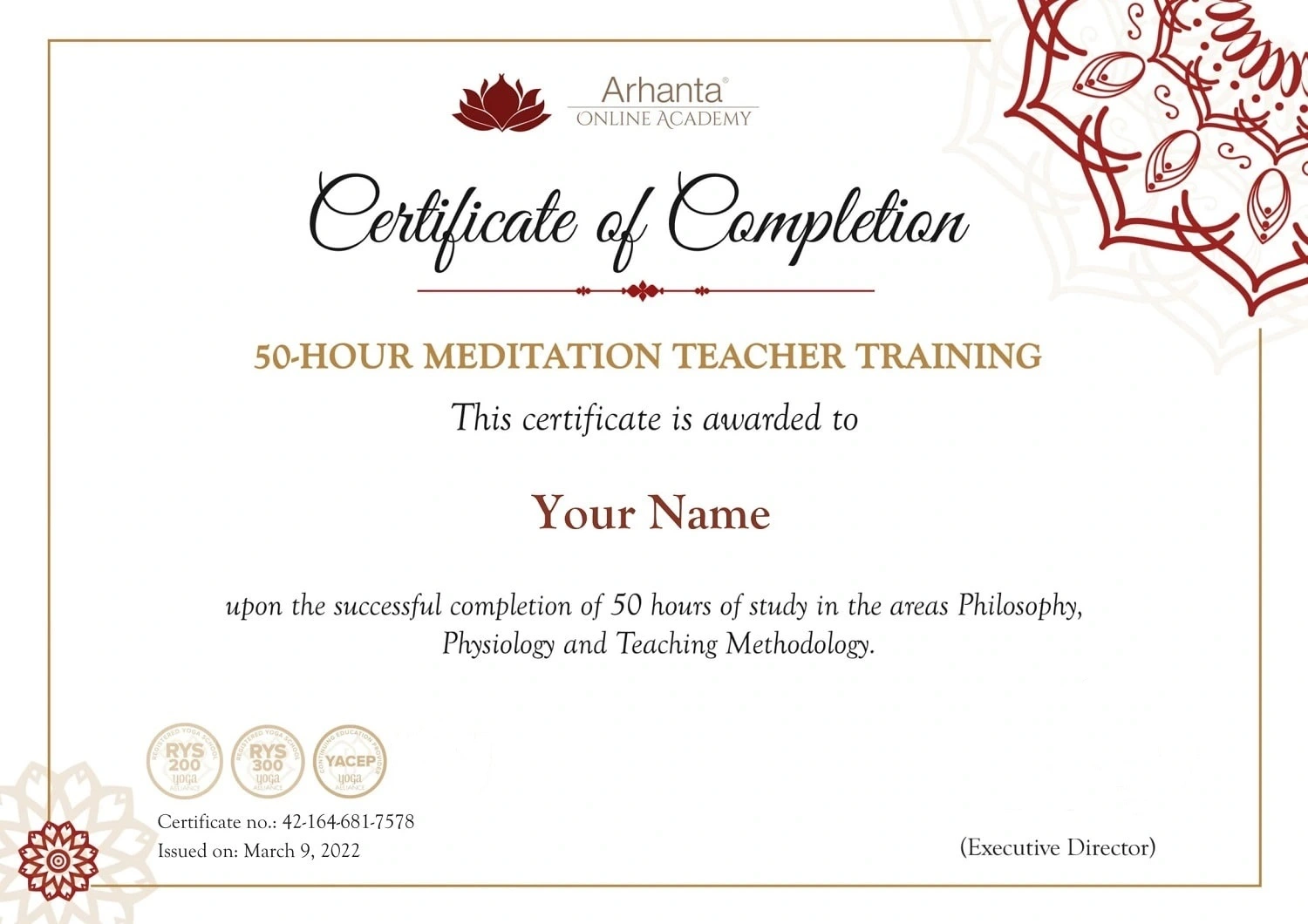
Arhanta's registrations and what each one covers
Four registrations, four different functions:
- Yoga Alliance. The most widely recognised registry in the yoga world, and the one that makes your certificate legible to studios and yoga employers.
- International Yoga Association. Independent recognition of the school and its curriculum.
- International Yoga Federation. A second independent recognition, useful in territories where Yoga Alliance is less established.
- CRKBO (the Netherlands). A Dutch register of accredited education providers, which sits under Dutch educational regulation rather than industry self-certification.
 Yoga Alliance
 International Yoga Association
 International Yoga Federation
 CRKBO (the Netherlands)
Claiming 50 CEU credits with Yoga Alliance
If you are already registered with Yoga Alliance, the 50-hour course is worth 50 CEU credits toward your continuing education requirement. That turns the training into two things at once: a new teaching skill, and the credits you needed to file anyway.
Dr. Ram Jain is registered as a YACEP, the Yoga Alliance designation for continuing education providers, which is what makes those credits claimable.


For the wider picture on credentials and cover, see our guide to the certifications and insurance you need to teach.
Yoga Alliance accredited certificate Lifetime access and unlimited teacher support 30-day full refund, no questions asked
Meditation teacher training online vs in-person training
Neither format is better in the abstract. A meditation teacher training online and a residential course fail and succeed at different things.
When meditation teacher training online wins
Self-paced study wins on four counts: cost, scheduling, repetition and retention of material. You can rewatch the brainwave module four times. In a weekend intensive you hear it once, at whatever hour it lands on the timetable.
Online also wins for anyone with a job, young children, a visa problem or a budget. The maths is simple when travel and accommodation are removed from the total.
And because access is for life, the course stays available when a real student presents a real problem two years later.
When a residential course is the better call
Live formats give you three things video cannot: a teacher watching your face while you guide, a room full of peers to practise on, and immersion that quiets the rest of your life for a week.
If those matter most to you, Arhanta runs an in-person meditation teacher training in Europe at the Netherlands ashram. Some students do the online course first and the residential second. That order works well.
The hybrid route most graduates end up taking
In practice the two formats are not a choice so much as a sequence. Study the theory online where repetition is free, then spend your live hours on the thing that genuinely needs a room.
Yoga teachers often stack differently again, pairing this course with the 200-hour online yoga teacher training so the meditation credential sits on top of a full teaching qualification.
How much does meditation teacher training online cost?
Meditation teacher training online prices run from under $200 to nearly $9,000, and the spread has almost nothing to do with quality. It tracks format: self-paced video at the bottom, live mentored cohorts at the top.
What the meditation teacher training online market charges in 2026
Every figure below was taken from the provider's own page in September 2026.
| Programme | Hours or duration | Tuition | Credential |
|---|---|---|---|
| Aura Wellness Center | 60 hours, self-paced | $197 (from $397) | 60 Yoga Alliance non-contact CEUs |
| AIHCP Meditation Instructor | 190 CE contact hours | $220 per four-year term | C-MI, AIHCP |
| School of Positive Transformation | 6 to 12 weeks, self-paced | $245 (from $490) | IMMA and CPD accredited |
| The Mindfulness Center (SOMA) | 160 hours, self-paced | $1,200 | Certificate of completion, IAYT credit |
| Mindfulness Exercises | Self-paced | $1,497 (from $2,497) | CPD and IMMA, 37.5 CE hours |
| Dharma Moon and Tibet House US | 100 hours, 5 live weekends | $1,995 early bird (from $2,744) | Dharma Moon and Tibet House US |
| The Path | 3 months, 12 live classes | $3,000 | The Path certification |
| MMTCP (Brach and Kornfield) | 18 months, live and online | $7,700 promotional (from $8,700) | Awareness Training Institute |
Two things stand out. Hours and price barely correlate, and the most expensive programmes are buying you mentorship rather than curriculum.
Your investment at Arhanta
Current pricing and payment options for the meditation teacher training online sit on the enrolment page, where they stay accurate. What does not change is the structure: no hidden fees, and a 30-day full refund guarantee with no questions asked. Payment can be made by debit card, iDeal, SEPA bank transfer or Sofort.
Work out the cost per usable skill rather than the headline number. Fifty hours, 18 techniques, 18 scripts, lifetime access and support that never expires is a different calculation from a weekend that ends when the weekend does.

Yoga Alliance accredited certificate Lifetime access and unlimited teacher support 30-day full refund, no questions asked
Is this meditation teacher training online right for you?
Straight answer on whether a meditation teacher training online suits you, in both directions.
Choose this meditation teacher training online if
- You want in-depth training rather than the fastest possible certificate.
- You want to deepen your own practice as much as your teaching.
- You value a peer community and want somewhere to ask questions.
- You want a clear, defined path to becoming a certified meditation teacher.
- You already teach yoga and want a second skill plus 50 CEU credits.
Look elsewhere if
- You need a certificate this weekend and do not care what is behind it.
- You only want basic personal knowledge, in which case a short course serves you better.
- You want live cohort teaching with fixed dates and a teacher watching you in real time.
Meet your teacher: Dr. Ram Jain
Dr. Ram Jain holds a PhD in Yoga and is registered as an E-RYT 500 and YACEP with Yoga Alliance. He has more than 22 years of teaching experience and over 50,000 hours of teaching behind him.

His training and lineage
He was born in India into a Jain family and began formal yoga study at the age of eight, at a Vedic school. He trained in yoga asana in the tradition of Swami Sivananda. He is the author of the Amazon bestseller Hatha Yoga for Teachers & Practitioners.
You can read his Dr. Ram Jain's full teaching background and credentials on his profile page.
Why lineage matters when you teach meditation
Meditation techniques carry context. A practice lifted out of its tradition and repackaged loses the instruction that made it safe, and the reasoning that made it effective.
When your teacher learned the material inside the tradition, you inherit that context instead of a summary of it. Your students then get an answer when they ask where a practice came from.
What happens after you enrol in the meditation teacher training online
Enrolment in the meditation teacher training online is immediate. Your login details for the Arhanta Online Academy usually arrive within five minutes, and you can start the same day.
From there the platform is yours for life. On-demand videos, class recordings, printable notes, practical assignments, quizzes and the discussion group all sit in one place, and you move through them in whatever order and at whatever speed suits you.
There are no cohort dates to wait for. If life gets busy, the course waits.
Support, community and lifetime access
A meditation teacher training online does not have to mean studying alone. Two things keep you connected.
Unlimited teacher support
You get unlimited teacher support, for life. Ask a question in month one or in year four and you get an answer either way.
This is the part students underuse. The teachers have taught this material to tens of thousands of people and have almost certainly met your problem before.
Send the awkward questions. How do I price a corporate session, what do I do when someone cries, is this script any good. Those are exactly the ones support exists for.
The student discussion group
The discussion group is where you find people at the same stage, plus graduates already teaching. It is the closest thing an online course has to the corridor conversation after class, and it is where most of the practical career questions get answered.
What graduates say
Arhanta's online graduates rate their courses 4.9 out of 5, with reviews posted publicly by students from Australia, the Netherlands, Belgium and beyond.
Rather than reprint testimonials here, read the graduate success stories in the students' own words. The reviews on the course page carry names, locations and dates.
Career paths after your meditation teacher certification
A meditation teacher training online opens more doors than a studio timetable.
What meditation teachers earn
The average annual pay for a meditation teacher in the United States is $53,476, or $25.71 an hour, according to ZipRecruiter data updated on 30 July 2026. The 25th percentile sits at $42,200 and the 75th at $60,200, with reported salaries running as high as $99,500.
Most teachers build that figure from several income streams rather than one job. For the mechanics of stacking them, see our yoga teacher salary guide and our guide to making a living as a yoga teacher.
Where the demand for meditation teachers is coming from
Meditation is now the most used complementary health approach among US adults, ahead of yoga at 15.8 percent, chiropractic care at 11.0 percent and massage therapy at 10.9 percent, on 2022 National Health Interview Survey data published by the NCCIH.
That demand shows up in corporate wellbeing programmes, schools, healthcare settings, retreats, yoga studios and private one-to-one work. Yoga teachers who add meditation typically monetise it fastest, because they already have students.
Settings where certified meditation teachers work
- Yoga studios, as a standalone class or the closing segment of an existing one.
- Corporate wellbeing programmes, usually 30-minute lunchtime sessions booked in blocks.
- Schools and universities, often around exam periods.
- Healthcare and allied health settings, alongside a clinician rather than instead of one.
- Retreats and workshops, where meditation is the reason people booked.
- Private one-to-one clients, the highest hourly rate and the slowest to build.
- Online classes and recorded programmes, which scale but need an audience first.
Your first 90 days as a new meditation teacher
The gap between certification and a paying student is where most new teachers stall. Close it deliberately.
-
Days 1 to 30: teach for free, on purpose.
Run four sessions for friends, colleagues or your existing yoga students. Ask each group one question afterwards: where did you lose me?
-
Days 31 to 60: pick one audience.
Stressed office workers, new parents, teenagers, people with sleep problems. One. Rewrite two of your scripts specifically for them.
-
Days 61 to 90: set a price and ask for it.
Offer a four-week block rather than single sessions. Blocks give students a reason to commit and give you predictable income.
Four sessions in three months sounds modest. It is also more live teaching than most graduates do in their first year, and it is the difference between a certificate and a practice.
Yoga Alliance accredited certificate Lifetime access and unlimited teacher support 30-day full refund, no questions asked
Meditation teacher training online for existing yoga teachers
If you already hold an RYT registration, this course does two jobs at once, and the second one is easy to underestimate.
The CEU arithmetic
Yoga Alliance requires registered teachers to log continuing education. A 50-hour meditation teacher training online with a YACEP-registered provider gives you 50 CEU credits for hours you were going to have to file anyway.
So the real comparison is not "course versus no course". It is "50 hours of credits plus a new teaching skill" against "50 hours of credits". Same obligation, different outcome.
Adding meditation to classes you already teach
The fastest way to start teaching meditation is to stop treating it as a separate class.
Extend savasana into a guided practice. Open with five minutes of breath awareness instead of announcements. Replace one week of a course block with a seated session.
Your existing students are already in the room and already trust you. That solves the hardest problem a newly certified meditation teacher has.
Building a second revenue line
Once the technique is working inside your classes, it becomes sellable on its own: a four-week evening block, a corporate lunchtime series, private one-to-ones for the students who keep asking after class.
Meditation also travels better than asana. It needs no floor space, no props and no changing room, which is why corporate buyers book it more readily than yoga.
Mistakes new meditation teachers make after certification
Every one of these is fixable, and each is easier to avoid during your meditation teacher training online than to unlearn afterwards.
Talking too much
The commonest fault by a distance. A new teacher fills every silence because silence feels like failure.
It is the opposite. The silence is where the meditation happens and your voice is the interruption. Time your gaps deliberately in practice until a 30-second pause stops feeling like an eternity.
Teaching your own practice instead of theirs
What works for you after ten years is rarely the right starting point for someone in week one. A long unguided sit is a wonderful personal practice and a terrible first class.
Match the technique to the student in front of you. That is why the course gives you 18 of them.
Overclaiming the benefits
Meditation has real, documented effects, and they are impressive enough without embellishment. Promising that a practice will cure a condition is both untrue and a liability.
Cite what the research actually says, name the source, and stay inside your scope. Refer on when someone needs clinical care.
Skipping the close
A rushed ending leaves people disoriented, and the last 60 seconds is what they remember. Bring students back deliberately: sound, breath, movement, eyes, and only then the room.
What a meditation teacher training online cannot give you
Honest limits, since every course page you read this week will skip them.
A video cannot watch you teach. You can record yourself and you should, but nobody is going to catch the habit you cannot hear in your own voice unless you ask them to. Use the discussion group and your practice students for that.
A certificate also does not produce clients. It qualifies you; the first 90 days plan above is what fills the room. Graduates who treat certification as the finish line usually stop teaching within a year.
And no course removes the need for your own practice. The teachers students come back to are the ones who still sit every day.
How to choose a meditation teacher training online
Every meditation teacher training online page is written to sell. Read them with a checklist instead of a mood.
Seven questions to ask before you pay for a meditation teacher training online
- Which named bodies accredit this school, and is it currently on their register?
- How many hours is the course, and how many of those are actual teaching instruction rather than personal practice?
- How many techniques will I be able to teach when I finish?
- Is there real assessment, or does the certificate arrive automatically?
- Do I get support after certification, and for how long?
- How long do I keep access to the materials?
- What is the refund policy, and does it apply after I have started?
Arhanta's answers, in order: Yoga Alliance, International Yoga Association, International Yoga Federation and CRKBO; 50 hours; 18 techniques; quizzes you must pass; unlimited support for life; lifetime access; 30 days, unconditional.
Ask any meditation teacher training online provider the same seven questions. The ones that answer plainly are the ones worth your money.
Yoga Alliance accredited certificate Lifetime access and unlimited teacher support 30-day full refund, no questions asked
Frequently asked questions about meditation teacher training online
Most students complete Arhanta's 50-hour meditation teacher training online in two to four weeks of part-time study. The quickest have finished in eight days. Because you get lifetime access there is no deadline at all, so you can also spread the 50 hours over several months without penalty.
No country legally requires a licence to teach meditation, so you can technically teach without one. In practice, studios, employers, insurers and corporate clients increasingly ask for a recognised credential before they will book you, and certification is what makes your training visible to people who cannot assess it themselves.
Meditation teacher training online ranges from around $197 to $8,700 depending on format. Self-paced video courses sit at the lower end, while live cohort programmes with mentorship and practicum sit at the top. Current pricing for the Arhanta 50-hour course is shown on its enrolment page, with a 30-day refund guarantee.
The average meditation teacher in the United States earns $53,476 a year, or $25.71 an hour, according to ZipRecruiter data updated on 30 July 2026. The 25th percentile is $42,200 and the 75th is $60,200, with some reported salaries reaching $99,500. Most teachers combine group classes, private clients and corporate work.
You do not need a formal qualification or years of practice to start the Arhanta course. The theory begins with definitions and origins, so a committed beginner can follow it. That said, a regular personal practice makes the practical modules far easier, because you are teaching from experience rather than from notes.
Yes. The 50-hour course carries a Yoga Alliance accredited certificate. Arhanta Yoga is also recognised by the International Yoga Association and the International Yoga Federation, and registered with the CRKBO in the Netherlands, which is the Dutch register for accredited education providers.
Yes. If you are already registered with Yoga Alliance, completing the 50-hour meditation teacher training online lets you claim 50 CEU credits toward your continuing education requirement. That means the course covers your filing obligation and gives you a new teaching skill in the same 50 hours.
You can start immediately. Login details for the Arhanta Online Academy usually arrive within five minutes of enrolment, and there are no cohort dates to wait for. Lifetime access also means you are free to enrol now and begin six months later if your schedule is full right now.
There is no sit-down exam. Assessment is by quizzes, which you need to pass in order to complete the course and receive your certificate. You can attempt each quiz as many times as you need, so the assessment tests whether you learned the material rather than how you performed on one day.
You need very little. A device to watch the videos, somewhere quiet to practise, and a comfortable seat. The course advises on recommended props, and part of the practical syllabus is specifically about choosing appropriate seated positions and supports for different bodies, including chairs and lying-down options.
The course includes 16 guided meditations, alongside 18 meditation scripts and 18 techniques you learn to practise and teach. There are also 24 downloadable resources. You can use the scripts directly with your own students or study them as models before writing your own.
Meditation is the broad category of attention-training practices. Mindfulness is one family within it, defined by non-judgemental awareness of present experience. Every mindfulness practice is meditation, but plenty of meditation is not mindfulness, including mantra repetition, visualisation and concentration practices on a single object.
No. Meditation teaching is a separate skill with its own credential, and many graduates come from counselling, coaching, education, healthcare and corporate roles. Existing yoga teachers do have an advantage, because they already have students and can add meditation to classes immediately while claiming 50 CEU credits.
Access is for life. The videos, class recordings, printable notes, scripts and downloadable resources stay available in your Arhanta Online Academy account with no expiry date, and so does teacher support. You can return to the brainwave module or a script three years after certifying, at no extra cost.
Arhanta offers a 30-day full refund guarantee with no questions asked. If the course is not what you expected within the first 30 days, you get your money back, including if you have already worked through the material. There are no hidden fees attached to enrolment.
You can pay by debit card, iDeal, SEPA bank transfer or Sofort. There are no hidden fees on top of the listed course price, and the 30-day full refund guarantee applies regardless of which payment method you use. Current pricing is displayed on the course enrolment page.
The meditation teacher training online is taught in English. The course manual is available in six languages: English, Dutch, Italian, French, Spanish and German, which helps if you intend to teach in a language other than English and want the terminology correct from the beginning.
For anyone who wants to teach, yes, provided the school is genuinely accredited and the course includes real delivery practice. Meditation is the most used complementary health approach among US adults, US meditation teachers average $53,476 a year, and a 50-hour credential is a small entry cost against that.
Start your meditation teacher training online today
Fifty hours, 18 techniques, 16 guided meditations and a Yoga Alliance accredited certificate you keep for life. That is what a meditation teacher training online with Arhanta gets you, taught by a teacher with a PhD in Yoga and more than 50,000 hours in front of students.
You can start today. Login details arrive in about five minutes, the pace is yours, and if it is not right for you within 30 days you get every cent back.
Enrol in the 50-hour course, or talk to us first on +31 618 504823 or at info@arhantayoga.org.
Yoga Alliance accredited, 50 CEU credits Login details in about five minutes 30-day full refund, no questions asked

