Online Yin Yoga Teacher Training
Online Yin Yoga Teacher Training gives you 75 accredited hours, 65 poses and four teaching modules you can study at your own pace, with lifetime access and lifetime teacher support from the Arhanta faculty.
€ 550
Key Takeaways
Arhanta's Online Yin Yoga Teacher Training runs 75 hours and covers 65 Yin poses with variations. The certificate is accredited by Yoga Alliance, the International Yoga Association, the International Yoga Federation and the CRKBO registered (Netherlands). Yoga Alliance requires RYTs to log 75 continuing education hours every three years, and only 30 of those must be training hours. Most students finish in 2 to 6 weeks part-time, and there are no start dates or deadlines. You get lifetime course access, lifetime teacher support and a full refund within 30 days if you have completed under 25%.
Yin Yoga is a slow, passive style of yoga in which floor poses are held for several minutes so the load reaches connective tissue and joints rather than muscle. Teaching it well takes a different skill set from teaching a flow class, and that gap is exactly what a dedicated Yin training closes.
Table of Contents
- What Is Yin Yoga Teacher Training?
- Why Choose an Online Yin Yoga Teacher Training?
- The 75-Hour Arhanta Course at a Glance
- What You Will Learn: The Full Curriculum
- The 65 Yin Yoga Poses You Will Master
- Yin Yoga Anatomy: Fascia, Tension and Compression
- Yin Yoga Philosophy: Meridians, Chakras and the Three Bodies
- How to Use Props in Yin Yoga
- How to Sequence and Teach a Yin Yoga Class
- Does This Training Count Toward Yoga Alliance Continuing Education?
- How Arhanta Compares With Other Online Yin Courses
- Who This Yin Yoga Course Is For
- Meet Your Teacher: Dr. Ram Jain
- What You Can Do After Certification
- Online, Residential or Hybrid: Choosing Your Format
- What Students Say About the Training
- What Happens After You Enroll
- Is This Course Right for You?
- Frequently Asked Questions
What Is Yin Yoga Teacher Training?
Yin Yoga teacher training is a specialist course that teaches you to practise and teach long-held, passive floor poses safely, using props, functional alignment and the anatomy of connective tissue. Arhanta's version runs 75 hours and covers 65 poses, philosophy, anatomy and four teaching modules.
Most 200-hour foundation courses give Yin a single afternoon. You come away able to name three poses and hold them. That's not enough to build a class around, and it's certainly not enough to keep a stiff 60-year-old and a hypermobile dancer safe in the same room.
A dedicated training fixes that. You learn why one student's forward fold stops at the hip and another's stops at the spine, and what to do about it.
How Yin Yoga Differs From Restorative and Hatha Yoga
Yin and Restorative look similar from the doorway. They aren't the same practice. Yin loads tissue deliberately to create adaptation; Restorative removes load so the nervous system can settle.
Arhanta's course states the distinction plainly: "Yin Yoga is a gentle, passive style of yoga, popularized by Paul Grilley. Principles of Yin Yoga are very different from the principles of Restorative Yoga."
Here's the practical version:
- Yin Yoga holds poses for 3 to 5 minutes with mild, tolerable stress on connective tissue.
- Restorative Yoga props the body so completely that no stretch sensation remains.
- Hatha and Vinyasa load muscle rhythmically and rarely hold a shape past a minute.
- Yin uses fewer props than Restorative, and uses them to allow the shape rather than to remove it.
- Yin targets joints, fascia and ligaments; Hatha targets muscle and cardiovascular capacity.
Teach a Restorative class thinking it's Yin and nobody adapts. Teach a Yin class thinking it's Restorative and someone gets hurt.
Where Yin Yoga Came From
Yin Yoga as it's taught today was developed by Paul Grilley, drawing on Taoist practice and Traditional Chinese Medicine. Arhanta teaches "the original Yin Yoga style as taught by its founder Paul Grilley."
Grilley's own teaching, and Bernie Clark's reference site YinYoga.com, remain the primary sources for the method.
That lineage matters when you're choosing a course, because Yin has been diluted fast. Plenty of short online courses teach a soft stretch class with candles and call it Yin. The Taoist framework, the meridian theory and the functional anatomy are what make it a distinct method rather than a mood.
Why Choose an Online Yin Yoga Teacher Training?
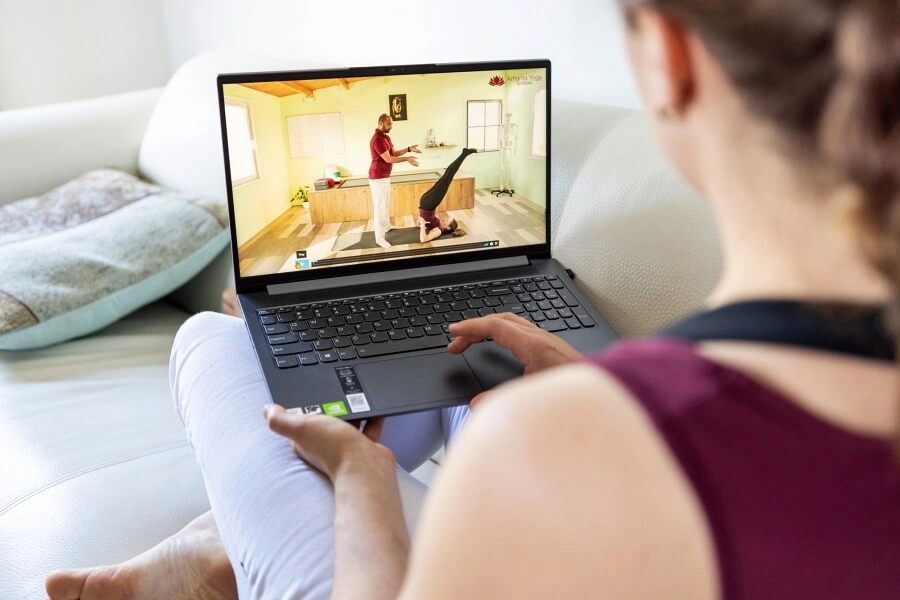
An Online Yin Yoga Teacher Training suits this style better than most. Yin is a floor practice with long holds and few transitions, so a camera captures almost everything a room would. What you lose is hands-on adjustment, and Yin uses far fewer adjustments than a Hatha class does.
Arhanta has run online trainings since 2017. According to the school, more than a thousand practitioners enrolled within the first six months.
Self-Paced Study Versus Fixed Timetables
There are no start dates on this course. Arhanta's own answer is blunt: "This course is self-paced, with no deadlines or fixed timings. You can start and complete it at your convenience."
Most students finish in 2 to 6 weeks studying part-time. Some take six months. Nobody gets pushed out of a cohort for falling behind, because there is no cohort.
That's a real advantage if you already teach. You can study the anatomy module on a Tuesday morning and film your practical assignment on a Sunday night.
Cost of Online Versus Residential Training
Online is the cheaper route by a wide margin. Arhanta's residential 75-hour Yin training at the Netherlands ashram is priced at €1,350 for a dormitory bed, €1,550 for a double shared room and €1,750 for a single room, including tuition, accommodation, three meals a day and course materials.
The online course removes the flights, the accommodation and the week off work. You also keep the material forever instead of leaving with a manual and a memory.
What Online Training Cannot Replace
Be honest with yourself about this. An ashram week gives you a daily schedule, silence, and eight other people struggling with the same pose at the same time. No login screen reproduces that.
What online gives you instead is repetition. You can rewatch the pelvic girdle lesson eleven times. In a room, you hear it once.
Self-paced, with no deadlines or fixed timings Full refund within 30 days under 25% completion
The 75-Hour Arhanta Online Yin Yoga Teacher Training at a Glance
The Online Yin Yoga Teacher Training is a 75-hour self-paced certification covering 65 Yin poses, delivered through 70+ video lessons and 22 downloadable resources, with 15 expert sequences, weekly live calls and lifetime access. The certificate carries four separate accreditations.
Course Format and Delivery
Everything sits in the Arhanta Online Academy portal. You log in with details emailed after registration and start immediately.
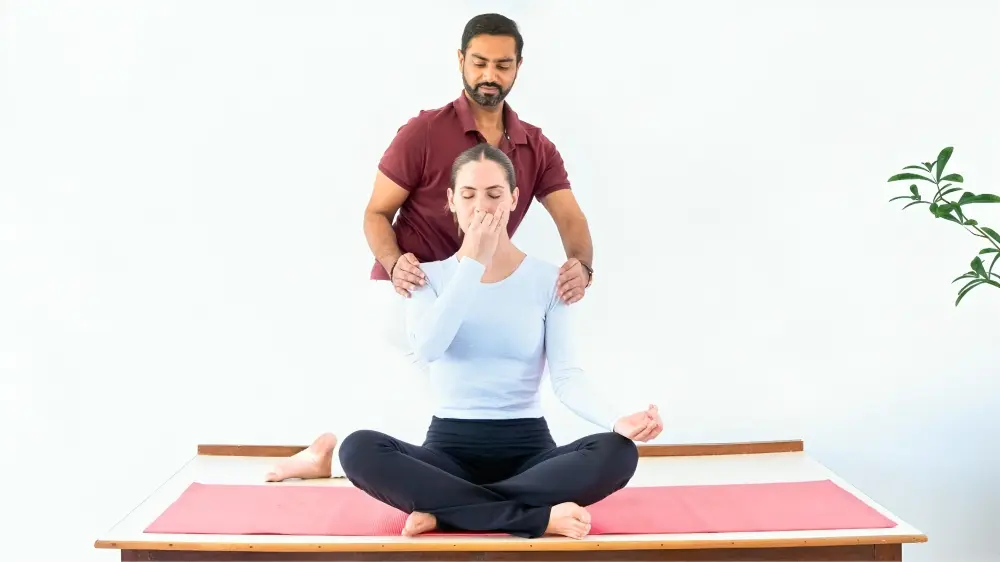
The teaching is video-led with printable notes underneath, and there are weekly video calls with the teachers where you can ask questions face to face. Assignments are assessed, and instructors give personalised feedback through video evaluations and live Q&A.
Live sessions are recorded, so a missed call is a catch-up rather than a loss.
What Is Included in the Course
The training is all-inclusive. There are no module unlocks, no separate manual fee and no exam charge.
- 75 hours of accredited Yin Yoga training
- 70+ video lessons covering theory, practice and teaching
- 22 downloadable resources including printable notes
- 15 expert sequences with full video walkthroughs
- Practical assignments and quizzes with instructor feedback
- Weekly live support calls with the teachers
- A private student discussion group
- Certificate of completion with worldwide accreditation
- Lifetime course access and access to all future updates
- Lifetime teacher support after graduation
Course Language and Access
The course is taught in English with English subtitles. Arhanta notes it is "taught in basic English to accommodate practitioners from all over the world," which matters if English is your second or third language.
Access is lifetime. That includes updates: when the school revises a module, you get the new version at no cost.
The 1:8 Teacher-Student Ratio
Arhanta runs a 1:8 teacher-student ratio across its trainings. On an online course that shows up in how fast assignment feedback comes back and how much room there is on a live call to ask something specific about your own hips.
What You Will Learn: The Full Curriculum
The syllabus splits into four modules: history and philosophy, anatomy and physiology, the poses themselves, and teaching technique. Each builds on the last, and the teaching module is the one that separates this from a practice course.
Module 1: History and Philosophy of Yin Yoga
This module covers the origin and development of Yin Yoga, its purpose, and the concepts of yin and yang including yin and yang organs. You study Taoist fundamentals, practising yin in daily life, and the intention of yin within asana.
It also introduces the energetic map you'll use for the rest of the course: 3 bodies, 5 pranas, 7 chakras and 12 meridians. If you want a primer before you start, Arhanta's guide to the 7 chakras and how these energy centres work covers the ground clearly.

Module 2: Anatomy and Physiology
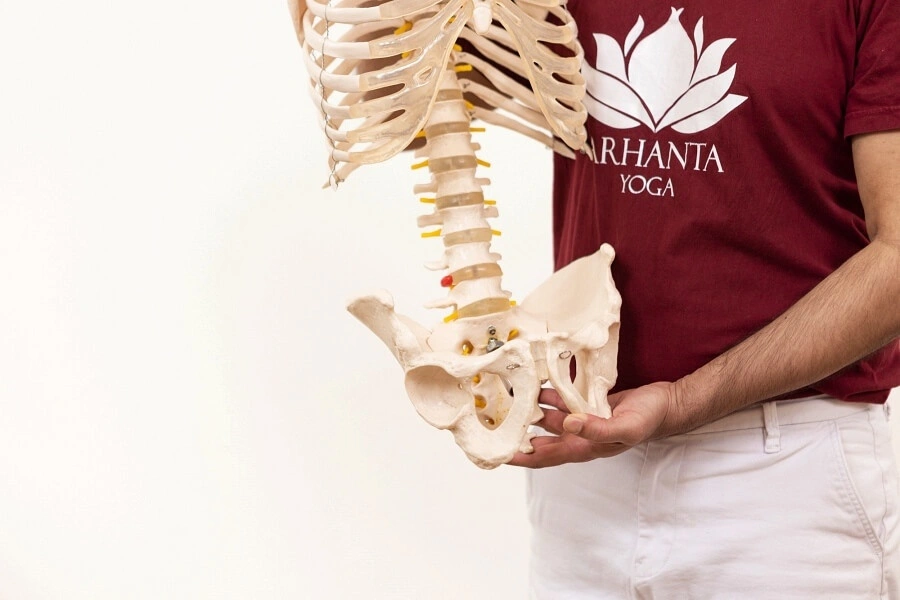
Here you work through the musculoskeletal system, the 14 skeletal segments and the 10 myofascial groups. You cover the effect of stretching on the body, the difference between tension and compression, connective tissue, bone differentiation, and the pelvic girdle.
Fascia gets proper treatment: what it is, why it matters, how Yin Yoga affects it, and the role of hyaluronic acid. This is the section most short courses skip.
Module 3: The 65 Yin Yoga Poses
You study and practise 60+ Yin poses and their variations, grouped by seven archetypes, plus transition poses. For each pose you learn functional alignment, the right breathing, the correct hold duration, physical and energetic benefits, contraindications and challenges.
The module also covers the 80% rule, the red, orange and green zone principle, and the right use and placement of props.


Module 4: Teaching Techniques
This is where you stop being a student. The module includes a live class series filmed with Ram Jain across six videos, and covers how to teach all 65 poses and their variations.
You learn how to give clear instructions, how to find the right voice in terms of tone and dynamics, when and how to give adjustments, how to spot when a student should skip a pose, how and when to modify, how to read a student's limitations, how to structure a class, how to build custom sequences, and how to use three levels of self-awareness during holds.
The 65 Yin Yoga Poses You Will Master
You'll learn 65 Yin poses for the upper and lower body, each with its alignments, instructions, physical and energetic benefits, contraindications and variations. That's more poses than most 50-hour courses cover, and every one comes with modifications.
The Seven Pose Archetypes
Yin poses reduce to seven archetypes. Learn the archetype and you can teach fifty variations of it without memorising fifty separate scripts.
This is the single most useful teaching shortcut in the syllabus. A student who can't do the classic shape can almost always do the archetype another way.
Upper Body Poses and Common Modifications
Shoulders, thoracic spine and neck get their own treatment, and they're the poses new Yin teachers get wrong most often. Loading a shoulder passively for four minutes is not the same as loading a hip.
If you want a taste of this before you enroll, try Arhanta's Yin Yoga poses for stiff and achy shoulders.
Lower Body Poses and the Pelvic Girdle
Hips, hamstrings, lower back and the pelvic girdle make up the bulk of a typical Yin class. The pelvic girdle gets its own anatomy lesson because hip socket orientation varies enormously between bodies, and that variation decides where a student's forward fold stops.
Arhanta's beginner Yin Yoga sequence for hips and legs shows the shapes in practice.
The 80% Rule and the Red, Orange and Green Zones
The 80% rule says you go to roughly 80% of your available range, never to your edge. The zone principle gives students language for sensation: green means safe to stay, orange means back off slightly, red means come out now.
Give students that vocabulary in week one and you'll spend far less time policing the room.
How Long to Hold a Yin Pose
Hold duration is one of the most searched Yin questions and one of the most badly answered. The course teaches the right duration per pose rather than one blanket number, because a neck pose and a hip pose don't earn the same time. Arhanta's article on how long to hold Yin poses explains the reasoning.
Yin Yoga Anatomy: Fascia, Tension and Compression
Yin Yoga anatomy is the study of how sustained, low-load stress affects connective tissue, joint capsules and fascia rather than muscle. The course covers tension versus compression, bone differentiation, the 10 myofascial groups, and how Yin practice changes hyaluronic acid in fascial layers.
Why Skeletal Variation Changes Everything
Two students in the same pose can look completely different and both be correct. One stops because muscle is at length, which is tension.
The other stops because bone has met bone. That's compression, and no amount of practice will change it.
Teach that distinction and you stop trying to fix bodies that aren't broken.
It's the reason Yin uses functional alignment rather than aesthetic alignment. The question is never "does this look like the picture." It's "is the load landing where I intend it to land."
How Yin Yoga Affects Connective Tissue
Muscle responds to rhythmic, short loads. Connective tissue responds to slow, sustained ones, which is why holds run minutes rather than breaths.
The syllabus covers what fascia is, why it matters, and what Yin practice does to it, including the hyaluronic acid mechanism. For the wider physiological picture, Arhanta's guide to yoga physiology is a good companion read.
Yin Yoga Philosophy: Meridians, Chakras and the Three Bodies
The philosophy module gives Yin its energetic framework: chakras as the body's energy points, the 12 meridians of Traditional Chinese Medicine, and the concept of three bodies. You also cover yin and yang organs and Taoist fundamentals.
The 12 Meridians and the Organ Pairs
Meridians are the channels Traditional Chinese Medicine maps across the body, paired to organ systems. Yin sequences are often built along a meridian line rather than a muscle group, which is why a "kidney and urinary bladder" class targets the inner legs and the back body.
You don't have to believe the metaphysics to use the map. It's a sequencing tool that produces coherent classes.
The Three Bodies and Five Pranas
Three bodies, five pranas and seven chakras form the layered model Yin philosophy works from. The five pranas describe directional energy: upward, downward, outward, inward and distributive.
Used well, this gives you class themes with actual structure behind them instead of a nice sentence at the start.
How to Use Props in Yin Yoga
Props in Yin exist to let you reach the target tissue, not to remove the stress. Arhanta's syllabus is specific: you learn "how to use props (like bolsters, cushions and straps) effectively, while not taking the effect away from the pose."
Follow this order when you set up any Yin pose:
-
Identify the target area before you touch a prop. Decide which tissue the pose is meant to load.
-
Put the student in the shape unpropped and watch where the body stops.
-
Decide whether the stop is tension or compression. Props help tension. They cannot help compression.
-
Add the minimum prop that lets the shape happen at roughly 80% of available range.
-
Check the sensation zone. Green means stay, orange means reduce, red means come out.
-
Re-check at 90 seconds. Tissue changes during a long hold, and a prop that was right at the start can become wrong.
-
Plan the exit. Long holds need slow, supported transitions out.
Arhanta's guide to using yoga props the right way covers the general principles across styles.
How to Sequence and Teach a Yin Yoga Class
Sequencing Yin is not sequencing flow with the speed turned down. You build around target areas and hold times, then decide where the counterposes and transitions go. The course covers class structure, custom sequencing, and the 15 expert sequences that come with full video.
Structuring a 75-Minute Yin Class
Fifteen poses is a crowded Yin class. Eight is usually plenty. Long holds eat the clock fast, and rushing a Yin class defeats the point of it.
Arhanta publishes a full 75-minute Yin Yoga sequence for hips and lower back if you want to see the shape of one before you teach your own.
Finding Your Teaching Voice
Yin exposes your voice more than any other style, because there's nothing else happening. You give an instruction, then you're quiet for four minutes.
The teaching module covers tone, dynamics and how to communicate simply. Arhanta's article on finding your teaching voice as a yoga instructor is worth reading alongside it. So is the school's list of 10 tips for teaching Yin Yoga.
When to Modify or Skip a Pose
Some students shouldn't be in some poses on some days. The module teaches you how to know when a student should skip a pose entirely, how and when to modify, and how to read the limitations in front of you rather than the ones in the manual.
That includes pregnancy. Arhanta's position is that you can do the training while pregnant if you don't push yourself too far, and the same judgment applies to what you ask of students.
15 expert sequences with full video walkthroughs Teaching module filmed with Dr. Ram Jain
Does This Online Yin Yoga Teacher Training Count Toward Yoga Alliance Continuing Education?
Yes. This 75-hour training is accredited by Yoga Alliance and Registered Yoga Teachers can apply it toward 75 hours of continuing education, subject to Yoga Alliance requirements. It also carries accreditation from the International Yoga Association, the International Yoga Federation and the CRKBO registered in the Netherlands.
-
 Yoga Alliance
-
 International Yoga Association
-
 International Yoga Federation
-
 CRKBO registered, Netherlands
The 75-Hour Rule Explained
Here's the part most course pages leave out. Yoga Alliance's continuing education requirements state that "RYTs and E-RYTs must complete 75 hours of CE within three years from the date of their initial registration," and of those 75 hours, 45 must be teaching hours and the remaining 30 must be yoga training in one of its educational categories.
So a 75-hour training doesn't just cover your 30 training hours. It covers them two and a half times over, with credit to spare.
Compare that with a 25-hour or 40-hour course and the arithmetic gets clearer:
| Course length | Covers the 30-hour CE training requirement? | Hours left over |
|---|---|---|
| 25 hours | No, 5 hours short | 0 |
| 40 hours | Yes | 10 |
| 50 hours | Yes | 20 |
| 75 hours (Arhanta) | Yes | 45 |
| 80 hours | Yes | 50 |
Source for the requirement: Yoga Alliance, Continuing Education Requirements, 2026.
What Registered Yoga Teachers Need to Log
Your 75 CE hours split into two buckets. Teaching hours are the 45 you spend actually leading classes. Training hours are the 30 you spend learning, and that's the bucket a course like this fills.
One 75-hour Yin training clears the training half of your three-year requirement with 45 hours banked. If you want the wider picture, Arhanta covers it in continuing education for yoga teachers.
How Arhanta Compares With Other Online Yin Yoga Courses
Course length varies more in Yin than in any other specialism, and Online Yin Yoga Teacher Training programmes are no exception. The online market runs from 25 hours to 80, and price doesn't track hours reliably.
Hours, Format and Accreditation Compared
Every figure below was taken from the provider's own live course page in September 2026.
| Provider | Hours | Listed price | Access | Accreditation stated |
|---|---|---|---|---|
| Arhanta Yoga (this course) | 75 | Not listed on page | Lifetime | Accredited by Yoga Alliance, IYA & IYF and registered with CRKBO |
| Akasha Yoga Academy | 80 | US$399 (from US$600) | Lifetime | Yoga Alliance, RYS-300, YACEP |
| Yoga Academy International | 60 | US$365 | Lifetime | Yoga Alliance registered school |
| Siddhi Yoga | 50 | US$297 (from US$497) | 6 months or lifetime tier | Yoga Alliance, 50 YACEP |
| School Yoga Institute | 50 | US$220 | Self-paced | Yoga Alliance YACEP |
| My Vinyasa Practice | 40 CEUs | US$179 (from US$358) | Self-paced | Yoga Alliance, 40 CEUs |
| Inspire Movement Coaching | 40 | US$149 | Self-paced | Yoga Alliance YACEP |
| Yoga with Kassandra | 30 | US$519 | Lifetime | Yoga Alliance, 20 non-contact CE |
| Online Yoga School | 25 | US$225 | Lifetime | Yoga Alliance YACEP |
| YogaRenew | Not stated | US$97 (from US$399) | Lifetime | Yoga Alliance accredited |
What the Hours Number Actually Tells You
Hours are a proxy for depth, and a rough one. What actually differs is pose count and teaching content.
Arhanta covers 65 poses. Online Yoga School's page lists 40+ poses across 5 practices and 5 lectures.
Inspire Movement lists 30+ pose demonstrations, and Yoga with Kassandra's programme runs roughly 30 hours.
Ask any course three questions before you pay: how many poses, how much of the syllabus is teaching methodology rather than practice, and does the price include the manual.
Who This Yin Yoga Course Is For
This Online Yin Yoga Teacher Training suits yoga teachers adding Yin to their timetable, dedicated practitioners going deeper, experienced teachers logging continuing education, and professionals in related fields bringing Yin into their work. Arhanta accepts students with no previous yoga education, and there are no age limits or health requirements.
Yoga Teachers Adding Yin to Their Schedule
If you already teach Hatha or Vinyasa, Yin is the easiest second style to add. It needs no new studio kit beyond bolsters, it fills evening and Sunday slots that flow classes struggle to fill, and it reaches students who won't come to a strong practice.
Dedicated Practitioners Without Teaching Plans
Plenty of students take this with no intention of teaching. Arhanta says so directly: many join "to deepen their personal practice, understand Yin Yoga in more depth, and learn how to use props, modifications, and sequencing safely."
The teaching module is still worth your time. Learning how a class is built changes how you practise in one.
Movement and Healthcare Professionals
Physiotherapists, personal trainers, massage therapists and mental health practitioners take Yin trainings for the connective tissue anatomy and the long-hold methodology. The fascia and pelvic girdle content is the part that usually transfers.
Complete Beginners With No Yoga Background
You can take this course without previous yoga education. Arhanta's requirement is "a genuine interest in yoga," nothing more.
Flexibility isn't a prerequisite either. The school's line on it is a good one: a flexible mind matters more than a flexible body, and the course shows you how to work through limitations with variations and modifications. If you're worried, Arhanta addresses flexibility requirements for yoga teacher training in more detail.
Meet Your Teacher: Dr. Ram Jain
Dr. Ram Jain, PhD (Yoga), holds E-RYT 500 and YACEP credentials and has 26 years of teaching experience with more than 50,000 hours of teaching behind him. He founded Arhanta Yoga and leads the teaching module of this course personally.
Ram Jain's Teaching Background
Ram Jain teaches the "how to teach" section on camera across six live class videos, which is unusual. On most online courses the founder appears in the welcome video and nowhere else.
You can read his full background on the Ram Jain profile page.



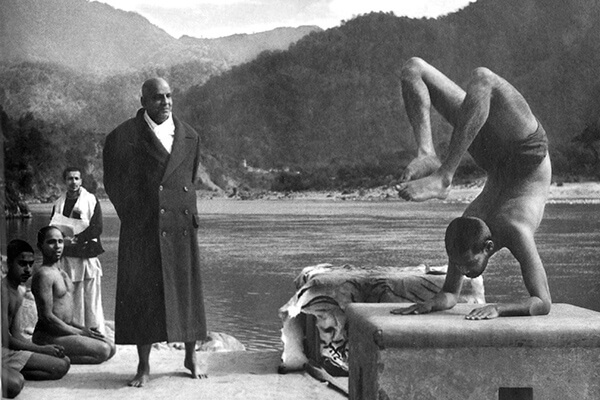
The Arhanta Lineage
Arhanta describes itself as living yoga across five generations and has provided professional yoga education since 2009. The school has certified over 24,000 yoga teachers from 94 countries. The school's full background is published on the Arhanta Yoga about page.
What You Can Do After Certification
After certification you can teach Yin Yoga classes full-time or part-time at professional studios, or run your own independent classes. Graduates are also eligible to buy yoga teacher insurance, because Arhanta is a Registered Yoga School with worldwide accreditations.
Teaching Yin in Studios and Independently
Studios are short of qualified Yin teachers more often than they're short of flow teachers. A specialist certificate plus 65 poses is a strong pitch for a Sunday evening slot.
Arhanta's guidance on becoming a freelance yoga teacher covers the business side.
Yoga Teacher Insurance and Credentials
Insurance providers want to see accredited training. Arhanta confirms that with its certificate, "you are eligible to buy yoga teacher insurance."
If you're still deciding what credentials you need overall, the school's article on required certifications and insurance for teaching yoga is the practical version.
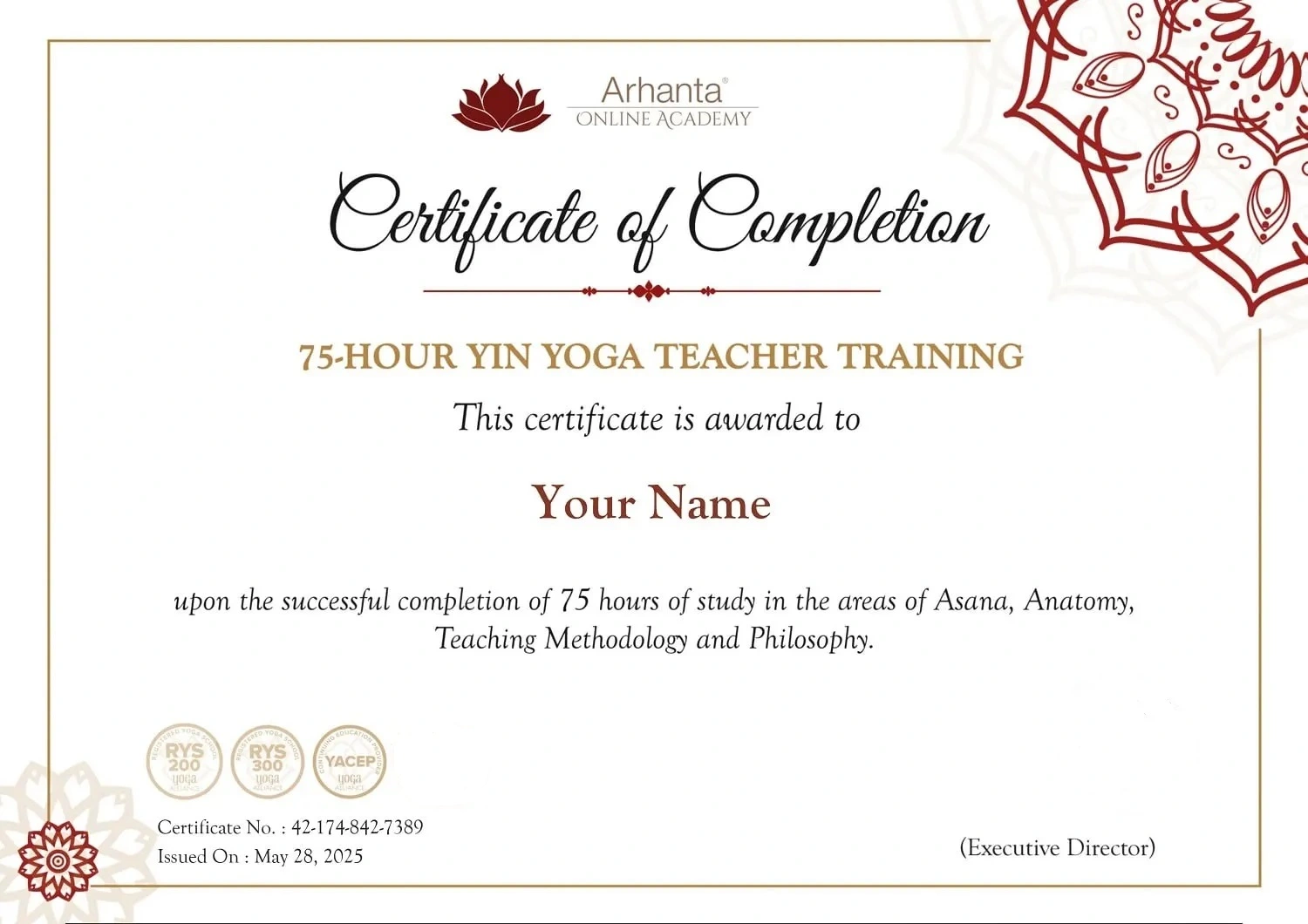
Do note: there's no legal requirement anywhere to be certified to teach Yin Yoga.
Certification through an accredited programme is strongly recommended so you can teach safely and meet professional standards, but the law isn't what makes it worth doing.
Online, Residential or Hybrid: Choosing Your Format
Online training gives you flexibility, lifetime access and self-paced study. A residential training in India or the Netherlands gives you immersion and daily ashram life. Neither is better in the abstract, and the right answer depends on what you can actually commit to.
Pick online if you're working, parenting, on a budget, or you want to revisit the material later. Pick residential if the value for you is in the environment rather than the syllabus.
Arhanta's comparison of online, residential and hybrid yoga teacher training sets the trade-offs out in full, and the school also runs a 75-hour residential Yin Yoga training in the Netherlands if you want the in-person route.
What Students Say About the Training
Arhanta's online graduates rate the school 4.9 out of 5. Three of the reviews published on the course page are below.
The 4.9 Rating and Where It Comes From
The 4.9 out of 5 figure is the rating Arhanta publishes for its online graduates on the course page itself. Review headlines shown there include "An Excellent Course", "This Course Was Well Build", "Highly Qualitative Information", "Clear Explanation" and "Awesome Course!".
- "An Excellent Course"
- "This Course Was Well Build"
- "Highly Qualitative Information"
- "Clear Explanation"
- "Awesome Course!"
Named Graduates Featured on the Course Page
Online graduate reviews on the page are attributed to Véronique Thomann, Regina Hunger and Edith Kurek. Course testimonials elsewhere on the page come from Canay, Monica and Florence.
Online graduate reviews
-
 Véronique Thomann
-
 Regina Hunger
-
 Edith Kurek
Course testimonials
-
 Canay
-
 Monica
-
 Florence
Named reviews are worth more than anonymous ones. You can look a person up.
How to Verify a Yoga School's Reviews Yourself
Don't take any school's word for its own rating, including this one. Check the school's Yoga Alliance directory listing, where reviews are tied to registered accounts and can't be edited by the school. Then search the school name plus the word "review" and read what's on third-party sites rather than what's on the sales page.
Two questions worth asking any graduate you find: did the teaching module actually teach you to sequence, and did support answer after you finished?
What Happens After You Enroll
You get instant access to the full training and can start immediately. Login details arrive by email once registration is complete, and access to the course and to teacher support is lifetime.
Instant Access and Login
There's no waiting list and no intake date. Register, check your inbox for your portal login, and open Module 1 the same evening if you want to.
All you need is a computer with Wi-Fi, a yoga mat, comfortable clothing and a quiet space. No special software.
The 30-Day Refund Policy
Arhanta's refund terms are stated on the course page: you can request a full refund within 30 days of purchase, as long as you haven't completed more than 25% of the course.
Invoices are available, so the training can go through a company's accounts as a cost.
Instant access, no waiting list and no intake date Lifetime course access and lifetime teacher support
Is This Online Yin Yoga Teacher Training Right for You?

Say yes if you want depth, a real teaching methodology and a certificate four bodies recognise. Say no if you want a fast certificate and a basic overview, because this course is neither.
Seventy-five hours, 65 poses, four modules, lifetime access and lifetime support from a school that has certified over 24,000 teachers since 2009. If that's the training you're after, the Online Yin Yoga Teacher Training is open now with no start date to wait for, and you're covered by the 30-day refund policy while you look around inside.
Ready to teach Yin properly? Enroll on the course and start Module 1 tonight.
Yoga Alliance, IYA & IYF Accredited | CRKBO Registered 24,000+ teachers certified since 2009 30-day refund under 25% completion
Frequently Asked Questions
The course and the curriculum
The Online Yin Yoga Teacher Training is 75 hours. Most students finish in about 2 to 6 weeks studying part-time, but there are no deadlines and you can move through the lessons at whatever pace suits your schedule. Some students take several months, and that's fine.
There's no start date and no end date. The course is fully self-paced with no deadlines or fixed timings, so you can enroll today and begin the same evening, then pause and resume whenever life gets in the way.
Yin Yoga is a gentle, passive style popularised by Paul Grilley, and its principles differ substantially from Restorative Yoga. Yin applies mild, sustained stress to connective tissue to create adaptation. Restorative removes stress entirely with props so the nervous system can rest.
The course covers 65 Yin Yoga poses for the upper and lower body. For each pose you learn the alignments, instructions, physical and energetic benefits, contraindications and variations, plus the seven archetypes that let you adapt any pose to any body.
Online training gives you flexibility, lifetime access and self-paced study. A residential yoga teacher training in India gives you full immersion and daily ashram life. Arhanta runs both, so the choice depends on whether you value the schedule or the environment more.
No. There's no mandatory reading list. Arhanta provides a suggested reading list after you complete the course instead, so you can go deeper on the areas that interested you most rather than preparing for material you haven't seen yet.
The qualification
Yes. The 75-hour training is accredited by Yoga Alliance, and Registered Yoga Teachers can apply it toward 75 hours of continuing education, subject to Yoga Alliance requirements. It also holds accreditation from the International Yoga Association, the International Yoga Federation and the CRKBO registered in the Netherlands.
Yes, you'll be certified to teach Yin Yoga. Many teachers also recommend completing a 200-hour yoga teacher training in another style such as Hatha Yoga for broader foundational knowledge, but the 75-hour Yin certificate stands on its own as a specialist qualification.
Yes to both. You receive a Yin Yoga teacher certification on completion, accredited by Yoga Alliance, the International Yoga Association, the International Yoga Federation and the CRKBO registered.
Because Arhanta is a Registered Yoga School with worldwide accreditations, graduates are eligible to buy yoga teacher insurance using that certificate.
Studying online
Yes. There are weekly video calls with the teachers where you can ask questions face to face. All live sessions are recorded, so if you miss one you can catch up at your own pace.
Instructors also give personalised feedback on your assignments through video evaluations.
Yes. Arhanta provides lifetime support to its students, so you can contact the teachers at any time, including years after you've completed the training. Course materials also stay available for life, so you can revisit any lesson whenever you need it.
You need a yoga mat, comfortable clothing and a quiet space to practise. No special software is required. As long as you have a computer with Wi-Fi you can take part in the training, including the weekly live video calls with teachers.
Yes. The training is taught in basic English specifically so practitioners from all over the world can follow it, and English subtitles are provided throughout. Printable notes accompany the video lessons, which helps if you prefer to read at your own speed.
You get course materials, a student discussion group, weekly live sessions, teacher guidance and personalised assignment feedback. Access to every lesson continues after completion for review, and teacher support is lifetime, so the help doesn't stop when the certificate arrives.
Who this course is for
No. The course is designed for both dedicated practitioners and qualified yoga teachers, and it requires no previous yoga education. Arhanta's only stated requirement is a genuine interest in yoga.
There are also no age limits and no health requirements to join this Online Yin Yoga Teacher Training.
No. A flexible mind matters more than a flexible body here, and the course teaches you how to work through different limitations using the right variations and modifications. Skeletal variation means bodies simply stop in different places, and the anatomy module explains exactly why.
Yes. Many students enroll to deepen their personal practice, understand Yin Yoga in more depth, and learn to use props, modifications and sequencing safely. The teaching module is still valuable, because understanding how a class is built changes how you practise in one.
Yes, provided you don't push yourself too far. Arhanta confirms the training can be taken during pregnancy. As with any practice during pregnancy, work within a comfortable range, use props generously, and check with your healthcare provider before you start.
Cost and enrollment
Arhanta doesn't publish the online course price on the training page, so check the enrollment page for the current figure. The training is all-inclusive: the price covers every resource needed to complete the certification, with no separate manual, exam or module fees.
You can request a full refund within 30 days of purchase, as long as you haven't completed more than 25% of the course. Arhanta also issues invoices, so a company can put the training through its accounts as a cost.


