Vinyasa Yoga Teacher Training: 50-Hour Online Certification Course
A vinyasa yoga teacher training teaches you to build and lead flowing, breath-linked classes, and this one does it in 50 self-paced online hours. Lifetime access, 50 CEU credits and a 30-day guarantee included.
€ 550
TL;DR: The essentials
- 50-hour online vinyasa yoga teacher training with 18 video lessons, 7 quizzes, a final exam and 22 downloadable resources.
- Covers sequencing strategies, Surya Namaskara variations, ujjayi breath, bandhas, and joint-by-joint anatomy with injury prevention.
- Accredited by Yoga Alliance, IYA and IYF; worth 50 CEU credits for registered teachers.
- Self-paced with lifetime access: finish in as little as 8 days; most students take 2 to 4 weeks.
- 30-day full refund guarantee, with up to 25% of the course available to explore before you decide.
Vinyasa yoga is the style that links breath to movement in continuous, intelligently sequenced flow, and a vinyasa yoga teacher training is the course that turns your love of that flow into the skill of teaching it. This page covers everything inside this 50-hour certification, and how to decide honestly between a focused course like this and a full 200-hour training, a decision most course pages won't help you make because they only sell one of the two.
Table of contents
- The course at a glance
- What is vinyasa yoga?
- What is a vinyasa yoga teacher training?
- 50-hour or 200-hour: which do you need?
- Who this course is for
- The complete curriculum, day by day
- Why sequencing is the heart of this course
- Anatomy that protects your students
- How the course works
- Your teacher: Kalyani Hauswirth-Jain
- The school behind the course
- Certification and 50 CEU credits
- How much does vinyasa yoga teacher training cost?
- How this course compares
- What you can do after the course
- How to enroll
- Frequently asked questions
The Vinyasa Yoga Teacher Training at a Glance
Every key fact, one table, so you can judge in half a minute whether this course matches what you're looking for:
| Detail | This course |
|---|---|
| Length | 50 hours of study and practice time |
| Format | 100% online, self-paced, start anytime |
| Lessons | 18 video lessons across 6 structured days, 7 quizzes, final exam |
| Resources | 22 downloadable resources, printable notes, class recordings |
| Completion | As little as 8 days; most students finish in 2 to 4 weeks part-time |
| Certificate | Auto-download after final chapter and exam, no extra cost |
| CE credits | 50 CEU for Yoga Alliance registered teachers |
| Access | Lifetime, including all future updates |
| Support | Unlimited teacher support via the student portal |
| Languages | English course; manual in English, Dutch, French, Italian, Spanish, German |
| Guarantee | 30-day full refund; explore up to 25% of the course first |
| Accreditation | Yoga Alliance, International Yoga Association, International Yoga Federation; CRKBO registered |
Yoga Alliance, IYA and IYF accredited; CRKBO registered 4.9 out of 5 student rating 30-day money-back guarantee
What Is Vinyasa Yoga?
Vinyasa yoga is a dynamic style in which postures link together in flowing sequences, synchronised with the breath. Where a classical hatha class holds poses as separate events, a vinyasa class moves: one breath, one movement, in an arc the teacher designs.
The word itself carries the method. Vinyasa is commonly rendered as "to place in a special way," and that's the teacher's entire job description: placing movement, breath and attention in an order that means something. Random flow isn't vinyasa; arranged flow is.
That design is the point, and the challenge. A vinyasa class is choreographed intelligence: it warms the body in the right order, builds toward a peak, and resolves safely. Done well, it feels effortless to the student precisely because the teacher did the structural thinking in advance.
That's also why vinyasa dominates modern studio timetables. It delivers movement, breath and meditation in one continuous experience, scales from gentle flow to athletic intensity, and keeps a class visually and physically engaged from first breath to savasana. Directory data reflects the demand: the largest training platform we reviewed lists nearly 2,500 vinyasa results, more than any comparable style filter.
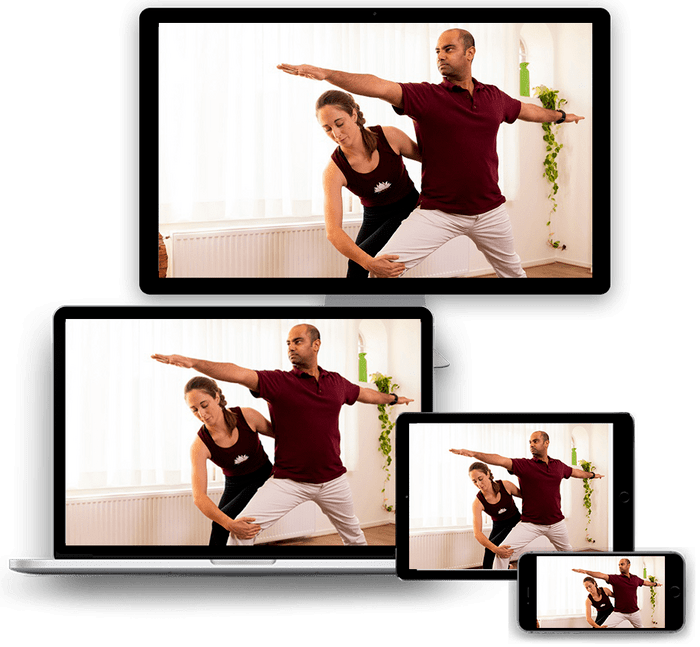
The style's engine is the breath. Ujjayi breathing paces the flow and anchors attention, turning movement into meditation, an idea explored beautifully in vinyasa's soul of mindful movement.
For students, that combination explains the style's pull: a vinyasa class occupies the body completely enough to quiet the mind, which is meditation arriving through the side door. For teachers, it defines the responsibility: you're not leading exercise with a soundtrack, you're building a moving meditation, and every design choice either serves that or breaks it.
And beneath the movement sits a classical principle: sthira sukham asanam, steadiness and ease together. Flow without that balance is just aerobics with Sanskrit names; this ancient idea of sthira sukham asanam is what separates vinyasa teaching from movement instruction.
What Makes Vinyasa Teaching Different From Practising It
Being good at vinyasa and being good at teaching vinyasa are different skills, and the gap between them is where most new flow teachers struggle.
As a practitioner, you follow the arc someone else built. Your attention is inward: your breath, your alignment, your edge. The class works on you.
As a teacher, you build the arc, and your attention inverts completely. You're watching twenty bodies while cueing the twenty-first movement, holding the sequence in your head while adapting it in real time for the wrists, knees and energy levels actually in the room.
That inversion is trainable, and it's what this course trains. Sequencing gives you the arc-building, and anatomy gives you the eyes for what bodies are doing. Teaching practice, three structured rounds of it, gives you the reps that make cueing while observing feel normal instead of overwhelming.
Practitioners often discover something unexpected in that process: teaching deepens their own practice. When you understand a flow well enough to guide someone else through it, your own body starts practising it differently. The course is built on that loop, with daily asana practice running alongside the teaching material.
It's also why "I'm not advanced enough to teach" usually aims at the wrong target. Teaching doesn't require the deepest backbend in the room; it requires understanding, observation and communication, none of which correlate with flexibility. A flexible mind is more important than a flexible body.
What Is a Vinyasa Yoga Teacher Training?
A structured course that teaches you to design and lead vinyasa classes: the sequencing logic, the breath work, the alignment and modifications, the anatomy that keeps flowing movement safe, and the teaching craft that holds a room.
Complete one at an accredited school and you can teach the style with a recognised certificate behind you.
The keyword in that definition is design. Vinyasa's defining feature, continuous sequenced movement, makes its teaching a design discipline in a way static styles aren't, and it's why generic teacher training leaves so many flow teachers under-prepared. The style demands its own education, which is the entire reason focused trainings exist.
Trainings come in two distinct shapes, and confusing them wastes money. Full 200-hour certifications teach you to be a yoga teacher, with vinyasa as the flavour. Focused trainings like this 50-hour course teach vinyasa itself, in depth, to people who already practise or teach.
This distinction is exactly where this course is honest in a way the market usually isn't. The page tells you plainly who it's for and who should build a foundation first, and this guide takes the same approach throughout.
The certification credentials, for the record
Accredited by Yoga Alliance, the International Yoga Association and the International Yoga Federation, registered with CRKBO in the Netherlands, and worth 50 CEU credits to Yoga Alliance registered teachers.
Specialisation, not entry credential
Shorter trainings like this one are often considered continuing education rather than entry credentials. That's why this course carries 50 CEU credits, and why a 200-hour foundation is recommended if your goal is general professional teaching.
50-Hour or 200-Hour: Which Do You Need?
Here's the decision in plain terms, straight from how the course itself explains it, because this is the question the entire market answers dishonestly by omission.
Schools selling 200-hour programs rarely mention that specialisations exist; schools selling short courses rarely admit when a foundation should come first. Both halves of the truth belong on one page.
Here's that page.
A 200-hour training provides a broad foundation in yoga teaching, philosophy, anatomy and methodology. It's the internationally recognised entry credential, the one studios ask for, and the right starting point if you're becoming a yoga teacher from scratch. That path runs through a course like the online 200-hour yoga teacher training.
This 50-hour course is more focused: it deepens vinyasa-specific teaching skills, sequencing, methodology and class design. That's why shorter trainings like this are often considered continuing education, and why this one carries 50 CEU credits.
The structural comparison, side by side:
| Factor | 200-hour training | This 50-hour course |
|---|---|---|
| Purpose | Foundation: become a yoga teacher | Specialisation: master vinyasa teaching |
| Scope | Broad: philosophy, anatomy, methodology, practice | Deep: sequencing, flow anatomy, vinyasa craft |
| Recognition | Entry credential studios ask for | Continuing education; 50 CEU credits |
| Best taken | First | After a 200h, or with a regular vinyasa practice |
| Typical market price (Jul 2026) | $397 online to $3,800 in-person | Lower bracket; shown at checkout |
So which is yours?
-
You're new to yoga teaching and want a career.
Take a 200-hour training first. For professional teaching, a 200-hour foundational training, in any style such as hatha, is strongly recommended before or alongside this course.
-
You're a 200-hour graduate.
This course is ideal for you: it adds the vinyasa depth most foundational trainings only sample, which is why the course names you as its ideal student.
-
You're a dedicated vinyasa practitioner who only wants to teach vinyasa.
The course is perfectly suitable for vinyasa practitioners with no previous formal education, provided you have a regular practice.
-
You're a working teacher needing CE hours.
Fifty CEUs in the style your students actually request is efficient professional maintenance.
A useful way to test yourself: look at the skills list rather than the label. If sequencing strategies, joint-by-joint anatomy, modification skills and structured teaching practice are things your current training already gave you deeply, you may not need this course. If any of those made you pause, that pause is the answer.
Timing-wise, there's no wrong moment within a teaching career. New graduates take it to convert foundation into specialty; five-year teachers take it to systematise what they've been improvising; returning teachers take it to rebuild confidence on current knowledge. Lifetime access means even "too early" self-corrects, since the material waits for the career to catch up.
Genuinely torn between 200 hours and 50?
Err toward the foundation. The 50-hour course will still be here, with lifetime access, when you're ready to specialise; the skills a 200-hour training builds are the ground everything else stands on.
For the fuller map of how course lengths relate, these guides lay it out: the difference between 50, 100 and 200-hour certifications and 200, 300 and 500-hour trainings explained.
The Breath: Ujjayi and the Art of Pacing
Strip vinyasa to its essence and one thing remains: breath leading movement. Every transition lands on an inhale or an exhale, which makes the teacher's relationship with breath the class's actual metronome.
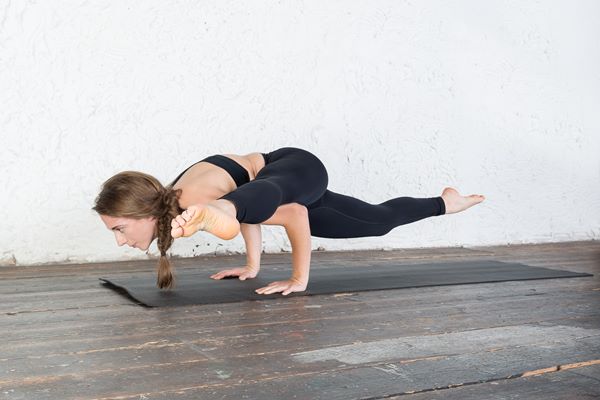
That's why ujjayi breathing sits in Day 1 of this curriculum, before warriors, before sequencing, before anatomy. The audible, oceanic ujjayi breath does three jobs at once: it paces the flow, it keeps attention anchored in the body, and it gives the teacher real-time feedback, because a room that's lost its breath is a room moving too fast.
Learning to teach breath is subtler than learning to teach shape. A pose can be demonstrated; breath has to be transmitted, through your own cueing rhythm, your voice's pace, and the way you build breath cues into every transition rather than bolting them on.
The course treats this as core curriculum rather than decoration, which reflects its lineage. In classical teaching, pranayama is a discipline in its own right, and a vinyasa teacher who understands breath as practice, not just as a counting device, teaches a fundamentally richer class.
Watch what happens in your own practice as you study this material. Flows tend to slow down and deepen within the first week of study, which is the material working exactly as intended.
One practical marker of a well-taught breath foundation: your future students will stop holding their breath in transitions, because your cueing won't let them. That single change transforms how a room feels, and it's built in the course's first hours.
Who This Vinyasa Yoga Teacher Training Is For
The course page draws its own honest lines, so let's keep them.
This course fits you if:
- You're looking for in-depth training in vinyasa specifically, not a general survey.
- You want to deepen your knowledge of sequencing, alignment and flow teaching.
- You value a dedicated peer community studying alongside you.
- You want a clear path to becoming a certified vinyasa teacher.
- You already have a regular vinyasa practice to build on.
And it's not for you if:
- You're looking for a quick certificate to collect: there's a final exam with a required passing grade.
- You want only basic-level knowledge that free videos already give you.
- You're a complete beginner: you'd be better served building a strong foundation through regular practice or a broader foundational training first, and that honesty comes straight from the course page.
Not sure vinyasa is even your style to teach?
This guide to picking the right yoga style for your training helps you choose before you commit to any course.
One more reassurance
Flexibility is not the entry ticket. Vinyasa can be for anyone with the proper use of props and support, and a flexible mind matters more than a flexible body.
The Complete Curriculum, Day by Day
The 50 hours are organised into six structured days, and the course publishes exactly what happens in each. Here's the full map with what each day builds.
- Surya Namaskara A & B
- ujjayi breathing
- sequencing strategies
- bandhas and fascia
- joint-by-joint anatomy
- 3 rounds of teaching practice
Day 1: The Foundation of Flow
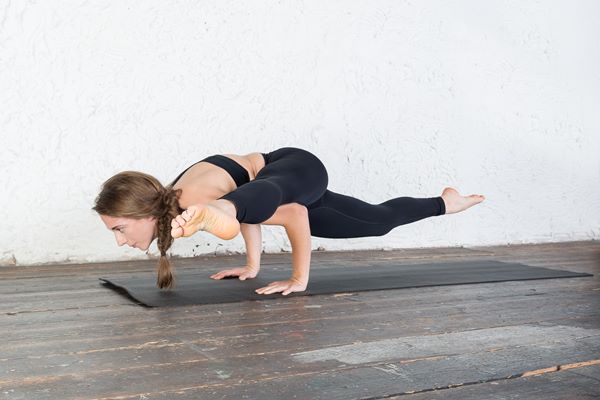
Vinyasa overview, Surya Namaskara A and B with easy variations, ujjayi breathing, and asana practice.
Everything in vinyasa grows from the sun salutation, so the course starts by taking it apart properly: the classical A and B forms plus accessible variations for real students. And because breath is the engine, ujjayi gets dedicated treatment from day one; this guide to ujjayi breath previews the territory.
Why so much time on something "everyone knows"? Because Surya Namaskara is where teaching habits form. Most flow classes open with it, most students learn their transitions inside it, and most repetitive-strain issues in vinyasa trace back to how it's done a thousand times over.
The easy variations matter as much as the classical forms. Real rooms contain real bodies: tight hamstrings, tender wrists, first-timers. A teacher who can offer a genuinely equivalent easier pathway keeps the whole room in the same flow, and that skill starts on this first day.
Day 1 also sets the course's tone: nothing assumed, everything explained. Even material you think you know arrives rebuilt from its foundations, which is exactly what you want before you start teaching it to others.
Day 2: The Standing Architecture
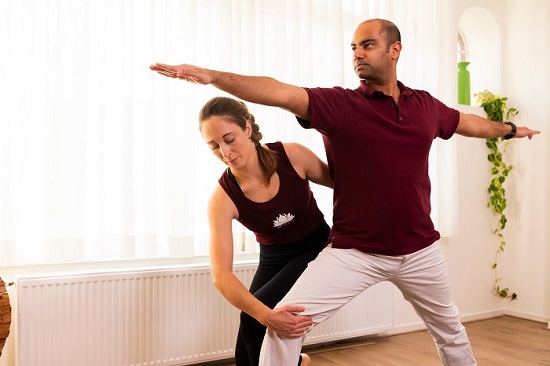
Warriors, lunges, triangles and standing forward bends, plus vinyasa history and ashtanga philosophy, with asana practice.
The standing poses are vinyasa's vocabulary, and teaching them well means knowing their alignments, transitions and modifications cold. The history and philosophy material grounds your teaching: vinyasa didn't appear from nowhere, and understanding its ashtanga roots gives your classes lineage rather than just choreography.
Look at what the pose list actually covers: warriors, lunges, triangles, standing forward bends. These four families carry most of any flow class, and each has its own alignment logic, its own common errors and its own transition risks at speed.
The ashtanga philosophy material earns its place too. Vinyasa's counted, breath-led structure descends directly from the ashtanga tradition, and teachers who know that history answer the "where does this come from?" question with substance. Lineage isn't nostalgia; it's the difference between teaching a system and improvising one.
Day 3: Sequencing, the Teacher's Real Craft
Standing balances, class structures and sequencing strategies, with asana practice.
This is the day many students enroll for. Sequencing strategies and class structures are the difference between stringing poses together and designing a class that works, and the course treats them as the learnable systems they are.
Standing balances open the day for a practical reason: they're where sequencing errors show up first. A room that wobbles through tree pose was warmed up wrong three poses earlier, and learning to read that chain backwards is sequencing education in miniature.
From there, the day builds your structural toolkit: how classes are shaped, how intensity arcs are built and resolved, and how the same principles generate endless different classes. This is the material you'll still be using in a decade, whatever styles you add later.
A note on why this sits at the course's centre rather than its end: sequencing knowledge changes how you absorb everything after it. Once you think structurally, the anatomy days read as design constraints and the teaching practice reads as structure delivered aloud. The order of this vinyasa yoga teacher training is itself a sequencing lesson.
Day 4: Inside the Body, Part One

Teaching practice one, bandhas, connective tissue, fascia, muscles and joints, with asana practice.
The anatomy block begins where flowing movement actually happens: in connective tissue, fascia and joints under dynamic load. The bandhas material connects the subtle practice to the physical one, and your first structured teaching practice starts turning knowledge into instruction.
Fascia deserves its billing here. Flow practice works the connective-tissue web as much as the muscles, and understanding how fascia responds to repeated dynamic movement explains things every vinyasa practitioner has felt but few can name.
The bandhas, the energetic locks, are equally practical in this style. They're what make jump-throughs light and transitions stable, and they're taught here as usable technique connected to the anatomy, not as mystical garnish. Then teaching practice one begins the course's most important habit: saying the knowledge out loud, as instruction, to real ears.
Day 5: The Lower Body Under Load

Teaching practice two, knee joint anatomy and injury prevention, hip joint anatomy, with asana practice.
Knees and hips take the most strain in fast-moving classes, and this day teaches you exactly how they work and how to protect them. Your teaching practice continues in parallel, because anatomy you can't cue is anatomy you don't really have.
Consider the knee through one flow class: lunges, warriors, revolved poses, hip openers, often at pace. Each asks the joint for something different, and small tracking errors repeated across hundreds of transitions become the injuries that end practices. This day teaches you to see those errors early and cue them away.
The hip material pairs naturally: hips that don't move send their workload to knees and lower backs that shouldn't take it. Understanding that chain is what lets a teacher fix the actual problem instead of the visible symptom.
Day 6: The Upper Body and the Spine
Teaching practice three, pelvis anatomy, spine anatomy, shoulder and wrist anatomy with injury prevention, and asana practice.
Wrists and shoulders carry vinyasa's signature transitions, and spines move through more positions in one flow class than most bodies manage in a day. The course closes its anatomy with these structures, and closes your preparation with a third round of teaching practice.
Wrist complaints are the most common physical objection to vinyasa, and shoulder overuse from repeated push-through transitions is its most common teacher hazard. This day gives you the anatomy of both, plus prevention strategies that keep students, and your own body, practising for decades rather than seasons.
The pelvis and spine material ties the whole skeleton together: how the pelvis positions the spine, how the spine sequences through flexion, extension and rotation across a flow, and what safe loading actually looks like in motion. By the third teaching practice, you're cueing all of it, which is the point.
Across the six days, you'll also learn adjusting and correcting during class, adapting and modifying postures, and modifications for injuries, the practical toolkit this guide to hands-on adjustments for yoga teachers introduces.
Yoga Alliance, IYA and IYF accredited; CRKBO registered 30-day money-back guarantee
The Vinyasa Teaching Toolkit You'll Graduate With
Here's the working vocabulary this vinyasa yoga teacher training installs, each piece taught properly inside the curriculum:
| Tool | What it gives your teaching |
|---|---|
| Surya Namaskara A & B + variations | The foundational flow every class builds from, adaptable to any room |
| Ujjayi breathing | The metronome that paces flow and anchors attention |
| Standing pose families | Warriors, lunges, triangles, forward bends: alignment, transitions, modifications |
| Standing balances | Focus poses and the sequencing that prepares them honestly |
| Class structures | Repeatable architectures for building complete classes |
| Sequencing strategies | The design systems that generate endless safe, intelligent flows |
| Bandhas | The energetic locks that stabilise transitions from the inside |
| Fascia & connective tissue knowledge | Why bodies respond to flow as they do, and how to load them well |
| Joint-by-joint anatomy | Knee, hip, pelvis, spine, shoulder, wrist, each with injury prevention |
| Adjusting & correcting | Real-time teaching interventions that help rather than harm |
| Modifications for injuries | Keeping every body in the flow safely |
| Vinyasa history & ashtanga philosophy | The lineage that gives your teaching roots |
Twelve tools, six days, one integrated system. That table is also a useful audit of any other vinyasa yoga teacher training you're comparing: count how many of these twelve their curriculum actually teaches, and how many appear only as bullet points without hours behind them.
Notice the balance across the twelve: four are about movement material, four about the body, and four about the craft of teaching itself. That three-way split is deliberate, and it's what "50 hours of study and practice time" buys that a weekend workshop structurally cannot.
Why Sequencing Is the Heart of This Course
Ask experienced students what separates a great vinyasa class from a forgettable one and they'll describe sequencing, even if they don't use the word. The class that built perfectly toward its peak pose. The flow where every transition made sense in the body.
Sequencing is design, and design can be taught. The course's third day is devoted to class structures and sequencing strategies: how to warm the body in the right order, build intensity intelligently, place the peak, and resolve toward stillness.
That structural knowledge compounds with everything else you learn. Alignment tells you how to teach a pose; sequencing tells you when and why. Anatomy tells you what the knee can do; sequencing keeps you from asking it to do the wrong thing while fatigued.
Teachers who can sequence don't run out of material, either. A finite pose vocabulary combined with sound sequencing strategy generates endless honest classes, which is why this skill, more than any single posture, is what makes a vinyasa teaching career sustainable.
Sequencing is also where burnout prevention hides, on both sides of the mat. Teachers who improvise every class from scratch exhaust their creativity within a year; teachers with structural systems compose quickly and spend their energy on teaching instead. Students, meanwhile, get classes their bodies can trust, which is what keeps them coming back.
And notice what good sequencing does for safety, quietly. Most flow injuries aren't caused by a single bad pose; they're caused by the right pose at the wrong moment, in a body prepared for something else. Structure is the anatomy lesson applied, which is why this course teaches them as one connected craft rather than separate subjects.
There's a creative payoff at the end of the discipline, too. Once the underlying strategies are second nature, your classes stop resembling anyone else's. The system doesn't constrain your voice as a teacher; it's what finally frees it.
Anatomy That Protects Your Students
Half the curriculum's second module lives in the body, and the emphasis is deliberate: three of the six days teach anatomy with injury prevention attached.
Vinyasa's speed is its risk. In a slow hatha class, a misaligned pose has time to be corrected; in flow, load arrives with momentum, repeatedly. Wrists bear weight through every transition, knees track through fast lunges, shoulders take the repeated push of the vinyasa sequence itself.
Multiply that by frequency and the stakes become clear. A dedicated student flows through hundreds of transitions per class, several classes a week, for years. At that volume, small technical faults stop being small, and the teacher's anatomical literacy becomes the single biggest safety factor in the room.
That's why this course teaches anatomy joint by joint: knee, hip, pelvis, spine, shoulder, wrist, each with its injury prevention. Plus the tissue-level understanding, fascia, connective tissue, muscles, that explains how bodies actually respond to repeated dynamic practice.
The payoff is a teacher students trust with their bodies. You'll know which modifications protect a cranky knee, why certain wrists need alternatives, and how to keep a mixed-level room moving safely at different speeds simultaneously.
That trust is commercial as well as ethical. Students with sensitive joints, and that's a growing share of every class as yoga's demographics widen, actively seek teachers who understand bodies.
Studios notice which teachers' students don't get hurt. Anatomy depth, invisible in a class description, becomes very visible in a teaching reputation.
The curriculum's tissue-level start matters for exactly this reason. Understanding fascia and connective tissue changes how you think about warm-ups, holds and repetition before you ever reach the joint-by-joint detail, so the specific knowledge lands on a general understanding rather than floating as trivia.
It protects your own practice too
Vinyasa teachers demonstrate for a living, and the same repetitive-load risks students face apply doubly to the person doing it across multiple classes a week. The injury-prevention material in this course is career insurance in the most literal sense.
Common Mistakes New Vinyasa Teachers Make
Watch enough new flow teachers and the same patterns repeat. This course is structured to prevent each one, so it's worth naming them:
-
Sequencing by playlist
Building the class around the music, or around poses that look good together, instead of around what bodies need in what order. The Day 3 sequencing strategies replace vibes with structure.
-
Cueing the pose, missing the transition
Injuries in vinyasa happen between poses more than in them, and new teachers cue destinations while ignoring the travel. The transition focus in Days 1 and 2 rewires this.
-
One speed for every body
A mixed room moving at one pace leaves half the students strained and half bored. Modification and variation training, woven through all six days, turns one sequence into a class everyone can actually take.
-
Anatomy by rumour
Repeating alignment cues you were once told, without knowing whether they're true for the body in front of you. Three days of joint-by-joint anatomy replace inherited cues with understanding.
-
Breath as an afterthought
Calling breaths without pacing them, until the room and the breathing diverge entirely. The ujjayi foundation from Day 1 keeps the metronome honest.
-
Teaching your own practice
Building classes around what you like doing, which works until a student unlike you walks in. Teaching practice under feedback, three rounds of it, builds the outward attention that fixes this permanently.
None of these mistakes mean a teacher lacks talent. They mean nobody structured the training. That's a solvable problem, and solving it is precisely what a vinyasa yoga teacher training is for.
There's a market observation hiding in this list, too. Because vinyasa is the style most often taught by imitation, the average quality bar is lower than the style's popularity deserves. Teachers who train the fundamentals properly stand out faster in flow than in any other format, simply because the contrast is visible from the first class.
How the Course Works
Enroll, receive your login within five minutes, and start. Here's the machinery:
Your First Week, Concretely
Enroll on a Sunday and here's a realistic opening week at the typical pace: Day 1's lessons across two evenings, with the Surya Namaskara material practised on your own mat each morning after. The first quiz confirms the foundation. Then Day 2's standing architecture over the next two sittings, again practised the same day.
By the weekend you're a third of the way through the curriculum, your daily practice has already changed shape, and you've likely posted your first question to the teacher. That's the rhythm the course is built for: study, embody, verify, repeat.
Week two typically carries you through sequencing and into the anatomy days, with teaching practice beginning to feel less like performing and more like explaining. Somewhere in week three or four, the final exam confirms what your practice already knows, and the certificate downloads. A month, honestly used, and you teach differently for the rest of your career.
If your month goes sideways instead, nothing is lost. The drip keeps releasing, your progress keeps standing, and the course meets you again wherever life pauses you. Self-paced with structure means the structure serves you, never the reverse, and that principle holds from your first login to your last revision years from now.
Self-Paced, With Structure
The 18 video lessons follow the six-day structure, with content released gradually to support better learning rather than dumped in one binge-able heap.
Your pace stays yours within that rhythm. Some students complete the course in as little as eight days; most finish part-time in about 2 to 4 weeks. There's no deadline, because access is lifetime.
The gradual release deserves a word of defence, since binge-friendly platforms have trained us to expect everything instantly. Teaching skill is motor learning as much as knowledge, and motor learning needs sleep and repetition between sessions. The drip isn't a restriction; it's the course protecting your retention from your own enthusiasm.
Assessment That Means Something
Seven quizzes checkpoint the modules, and a final exam with a required passing grade closes the course. Both can be attempted as many times as you need: the goal is verified understanding, not gatekeeping.
It's worth pausing on why the exam matters, because much of this market skips assessment entirely. A certificate without a test certifies that a video player ran to the end; a certificate behind a passing grade certifies that a person understood.
The unlimited-attempts policy keeps that rigorous without being punitive. Fail a quiz and you've located a gap while it's still free to fix; retake it after review and the gap closes. By the time you pass the final exam, the passing isn't luck, and everyone who sees the certificate can rely on that, including you.
Practice and Teaching Practice, Both
Every one of the six days includes asana practice, and days four through six add structured teaching practice. You learn the material in your body first, then learn to put it in other people's bodies safely.
The practical assignments extend that bridge, and the discussion group gives you fellow trainees to compare notes with. Printable notes and class recordings handle revision.
The peer layer earns more than a passing mention. Explaining a sequencing choice to a fellow trainee, or seeing how someone else modified a flow for their own body, teaches from an angle no video can. Cohorts of self-paced students still form real cohorts in the discussion group, and many keep exchanging class ideas long after certifying.
Support That Outlasts the Course
Unlimited teacher support comes included: for questions during or after your studies, you contact the teacher directly through the student portal.
After graduation, your access continues for life, including all future updates to the course. The course you buy keeps improving, and the teacher keeps answering.
A Realistic Study Plan
Fifty hours, honestly scheduled:
| Pace | Pattern | Time to certificate |
|---|---|---|
| Intensive | Several hours daily | As little as 8 days |
| Typical | Part-time, steady | About 2 to 4 weeks |
| Gentle | A few hours a week | 2 to 3 months |
| Interrupted | Life happens | No deadline; lifetime access |
Pair each lesson with your own mat time. A sequencing lesson followed by practising that structure the same evening cements twice as fast, and the course's built-in asana practice is designed for exactly that rhythm.
Unlimited teacher support, for life 30-day money-back guarantee
Does Online Vinyasa Training Actually Work?
A fair question for a physical, dynamic style. The honest answer: yes, with the right structure, and in some ways online suits vinyasa training unusually well.
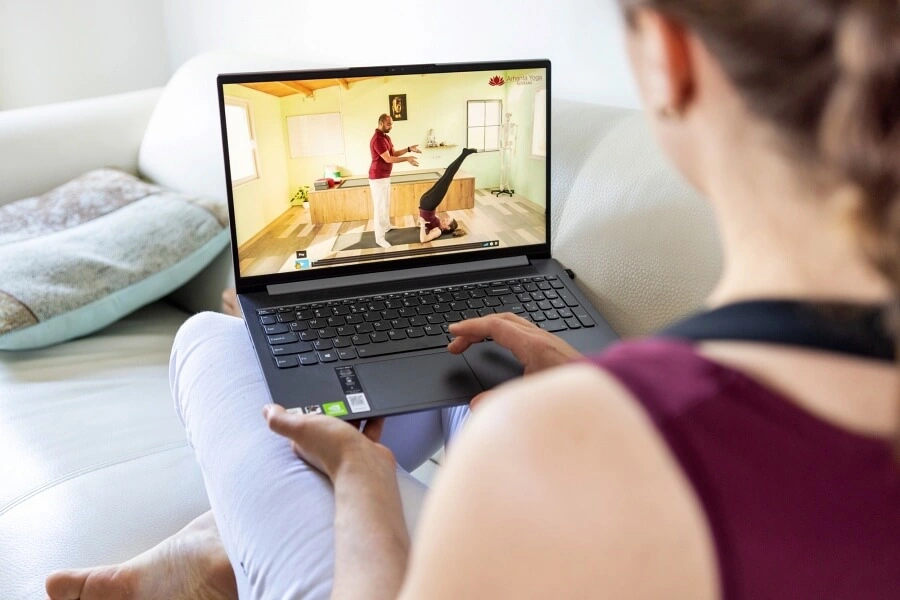
Sequencing, the course's heart, is design knowledge. It's learned from clear teaching, worked examples and your own practice, all of which video delivers excellently, with the advantage that you can rewatch a sequencing lesson the night before building your own class.
Anatomy gains even more from the format. Joint mechanics explained once in a live weekend evaporate; the same lesson on-demand gets rewatched exactly when you need it, for life.
The physical practice component runs through your own body on your own mat, with every day's asana practice built into the course. You're not learning vinyasa from scratch, remember: the course asks for a regular practice precisely so the online format has a foundation to build on.
What about feedback? That's what the practical assignments, teaching practice structure and unlimited teacher support through the student portal exist for. Ask, submit, refine: the loop works, as nine years of this school's online graduates demonstrate.
The result is a training you fit around your life without diluting the material, which for most working adults is the difference between certifying and postponing forever.
Compare the alternative honestly
The in-person 200-hour programs we reviewed run six weekends to ten months on fixed calendars in specific cities, at $2,650 to $3,800 before travel. Superb if your life allows it; irrelevant if it doesn't. Online specialisation exists precisely for the far larger group whose lives don't.
Your Teacher: Kalyani Hauswirth-Jain
Kalyani Hauswirth-Jain leads this course. She holds Yoga Alliance's ERYT 200 and YACEP designations, has been teaching yoga since 2007, training teachers since 2012, and carries 11,000 hours of teaching experience.
Those numbers deserve translation. Eleven thousand hours means thousands of real vinyasa classes taught and thousands of trainee teachers guided; fourteen years of teacher training means the explanations in these lessons have been refined against real students' confusion, year after year.
That refinement shows most in the hard parts. Anyone can present a sun salutation; explaining fascia so it changes how you cue, or sequencing so it becomes a system you can generate from, takes a teacher who has watched where students actually get stuck and rebuilt the explanation until they don't.
Her teaching-of-teachers experience since 2012 matters for one more reason: this is a course about becoming an instructor, and pedagogy is its own craft. You're not just learning vinyasa from her; you're watching, lesson by lesson, how skilled instruction is actually done, which is a second education running quietly inside the first.



Why the YACEP designation matters here specifically
It marks her as a Yoga Alliance Continuing Education Provider, approved to teach the already-certified. This course serves exactly that audience, and it's taught by someone credentialed for exactly that work.

The School's Founder Behind Her
Behind her stands the school's founder, Dr. Ram Jain, PhD (Yoga), and the combined teaching experience the two bring to the course spans decades. You're learning a modern style from teachers anchored in the classical tradition it grew from, which shows in how the course keeps breath, bandhas and philosophy attached to the flow.
That pairing, a specialist lead instructor inside a classical school, is the structure worth looking for anywhere you train. Specialists alone drift toward trend; institutions alone drift toward generic. Together they produce what this course demonstrates: current, style-specific teaching that still knows where it came from.
One more credential note for the comparison-minded: teacher-education experience is distinct from teaching experience, and since 2012 Kalyani's job has specifically been making teachers. When your goal is to become one, that's the experience that transfers.
Flow With Roots: The Classical Base Under This Course
Modern vinyasa has a quality problem its popularity hides: much of it floats free of the tradition that gives yoga its depth. Classes become workouts with a namaste at the end, and teachers trained inside that drift have nothing else to offer when students start asking for more.
This vinyasa yoga teacher training is built against that drift, visibly. The bandhas appear in the curriculum because flow without internal support is just momentum.
Ashtanga philosophy and vinyasa history appear because a style is more than its shapes. Ujjayi is taught as pranayama, a discipline, not as a sound effect.
That's the advantage of learning flow from a school whose foundation is classical teaching. The tradition doesn't slow the vinyasa down; it's what makes the vinyasa mean something, and students feel the difference even when they can't articulate it.
You'll feel it in the material too. Every modern technique in this course connects backward to a classical principle, which means what you learn coheres instead of accumulating. Teachers built that way don't chase trends, because they're standing on something older than trends.
The School Behind the Course
Arhanta Yoga has certified over 24,000 yoga teachers since 2009, through its ashrams and, since 2017, its online academy, which enrolled more than a thousand practitioners within its first six months. The student rating stands at 4.9.
For a specialisation course, that scale matters twice. It means the certificate you earn carries a recognised name, and it means the online delivery itself, the drip pacing, the quiz design, the support flow, has been refined across nine years and many thousands of online students.
The multi-language course manual, available in English, Dutch, French, Italian, Spanish and German, is a small detail that signals the same maturity. Schools serving a genuinely international student body build for it; the manual in your own language is what that looks like in practice.
It also anchors the lifetime-access promise. Course platforms with no institution behind them make the same promise cheaply; a 17-year-old school with physical ashrams and international accreditations is structured to keep it.
There's a curriculum benefit hiding in the school's classical roots, too. Arhanta's foundation is traditional hatha teaching, and vinyasa taught from that base keeps its connection to breath, bandhas and philosophy instead of drifting into pure fitness choreography. Modern style, classical spine: that's the combination this course delivers.
How This Course Fits a Teaching Career
Three realistic paths through this vinyasa yoga teacher training, matched to where you might be standing now.
The 200-Hour Graduate, One Year In
You certified, you're teaching a class or two, and you've discovered what every new teacher discovers: your foundational training sampled sequencing rather than teaching it. Your classes work, but building them takes hours and they lean on the same structures.
For you, this course is the second gear. The sequencing systems cut your planning time while raising class quality, the anatomy depth answers the student questions that used to worry you, and the 50 CEUs document it all for your Yoga Alliance registration.
It also fixes the specific loneliness of early teaching: having questions and nobody senior to ask. The teacher support line and the discussion group put experienced eyes back within reach, exactly when your first classes are generating your best questions.
The Dedicated Practitioner Testing the Water
You've practised vinyasa for years, people keep saying you should teach, and a 200-hour commitment still feels bigger than you're ready for. The course page is straight with you: with a regular practice, this training is perfectly suitable, and if you only want to teach vinyasa, it can stand alone.
Fifty hours later you'll know two things: the craft, and whether teaching is actually your path. Both answers are worth having before, not after, a 200-hour investment, and everything you learn here counts toward the bigger road if you take it.
The 30-day guarantee makes your case particularly low-stakes: a quarter of the course explorable, a full refund if teaching turns out not to call you after all, and lifetime access if it does. Few career questions can be tested this cheaply.
The Working Teacher Broadening the Timetable
You teach other styles, your studio wants flow classes covered, and your CE deadline is approaching anyway. This course solves all three with one enrollment: the style depth to say yes to those classes, the safety knowledge to teach them responsibly, and 50 CEUs banked.
The lifetime access matters most for you. Course material you can revisit the night before designing any new class is a working tool, not a completed course.
Certification and 50 CEU Credits
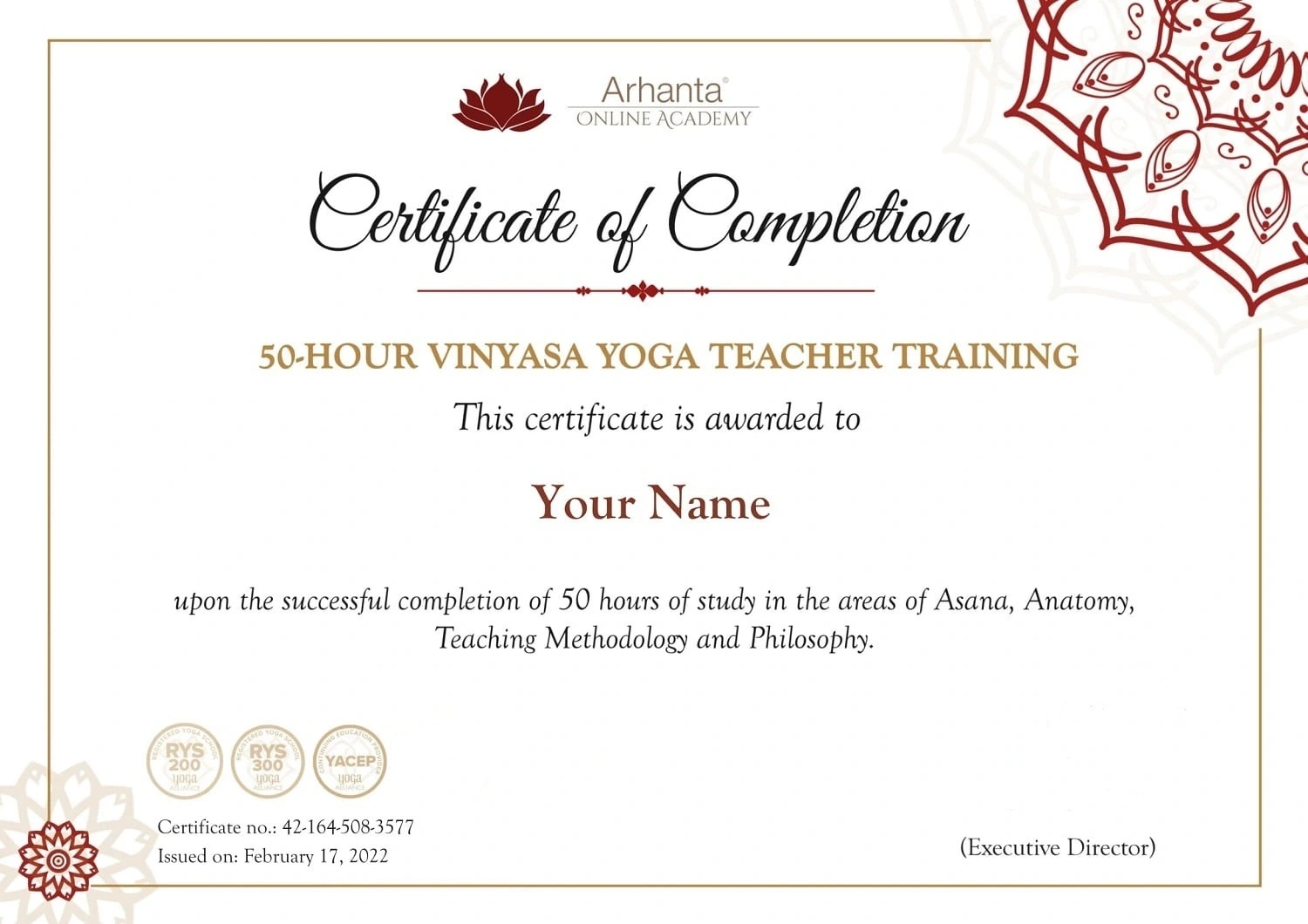
Pass the final exam and your certificate becomes available for download automatically, at no extra cost.
The training is accredited by Yoga Alliance, the International Yoga Association and the International Yoga Federation, and the school is registered with CRKBO, the Dutch Central Register for Short Vocational Education.
For registered teachers, the continuing-education value is the headline: 50 CEU credits with Yoga Alliance. According to Yoga Alliance, maintaining an RYT registration involves continuing education alongside a $65 annual membership (2026 figures), and a single course carrying 50 CEUs in a teachable, in-demand style handles that requirement with room to spare. Here's where it fits within continuing education for yoga teachers more broadly.
For everyone else, the certificate documents assessed vinyasa training from an internationally accredited school: quizzes plus a final exam with a required passing grade, not an attendance receipt.
-
 Yoga Alliance accredited
-
 International Yoga Association
-
 International Yoga Federation
-
 CRKBO registered, Netherlands
Why the CRKBO registration deserves its own sentence
Almost no yoga school carries it. It's the Dutch national register for short vocational education, whose institutions must meet a formal quality code. It's an educational-standards check from entirely outside the yoga industry, which is exactly what makes it valuable on a certificate.
Where does the credential show up in practice? On teaching profiles, where "50-hour assessed vinyasa specialisation" reads very differently from "loves flow"; in studio conversations, where documented CE signals a teacher who keeps developing; and in your own class design, every week, which is the place certificates matter most.
One honest boundary, consistent with the course's own guidance: a 50-hour certificate is a specialisation credential, not the 200-hour foundation studios usually require for general teaching roles. If that foundation is your goal, here's the direct answer on whether a 200-hour certification is enough, and how this course stacks on top of one.
How Much Does Vinyasa Yoga Teacher Training Cost?
Across the top-ranking options in July 2026, the spread is wide because the products differ fundamentally:
- Online 200-hour vinyasa certifications we compared advertised $397 to $547, with access windows from 6 months to lifetime depending on package.
- In-person 200-hour programs ran $2,650 to $2,950 in Chicago and $2,899 to $3,800 across nine New York programs, typically over 2 to 10 months of weekends.
- Worldwide, Yoga Alliance reports registered schools set tuition anywhere from $1,500 to over $5,000, and directory listings for vinyasa trainings span everything from under $200 to $3,000+.
Focused 50-hour specialisations like this one occupy a different bracket from all of those: less than a full certification, priced accordingly, with the current fee shown at checkout. Payment works by debit card, iDeal, Sepa bank transfer or Sofort, no credit card needed.
Why don't we print the number here? Because the page's price is set at checkout and this guide refuses to publish a figure that could drift out of date. What stays true regardless: no hidden fees beyond the shown price, everything listed in the inclusions table comes with it, and the guarantee below removes the risk the missing number might represent.
The guarantee changes the risk calculation more than the price does. You can explore up to 25% of the course within the first 30 days and still claim the full refund, no questions asked. A quarter of the actual course, not a trailer, before the decision becomes final.
Use that window like the diligence tool it is. A quarter of this course reaches well into the real material: foundation lessons, early sequencing content, your first quiz, the discussion group, a question to the teacher if you want one. Decide from inside the course, which is the only place course quality is actually visible.
When you compare, compare structures: hours, assessment, access duration, support and CE value. Price alone compares nothing.
Factor in the completion economics too. In-person weekend programs run months on a fixed calendar, and missing sessions means make-up fees at several schools we reviewed. A self-paced course completes on your schedule, with no travel, no lost weekends and no penalty when work interrupts. For employed adults, that difference is often worth more than the sticker gap.
A 30-Day Guarantee With a Quarter of the Course Inside It
Explore up to 25% of the course within your first 30 days. If it isn't right for you, the full refund applies, no questions asked. A refund window you can't study inside is decoration; this one is diligence made possible.
Login arrives within five minutes of payment No credit card required
How This Vinyasa Yoga Teacher Training Compares
The market snapshot from our July 2026 review:
| Attribute | Range observed across top courses | This course |
|---|---|---|
| Product type | Mostly full 200h certifications | 50h vinyasa specialisation + CE |
| Price | $397 to $3,800 (200h); brackets to $3,000+ | Shown at checkout |
| Access | 6 months to lifetime; 1-or-5-year windows | Lifetime, incl. updates |
| Assessment | Varies; often unstated | 7 quizzes + final exam, passing grade required |
| CE credits | Rarely stated for 200h products | 50 CEU (Yoga Alliance registered teachers) |
| Prerequisite honesty | Rarely addressed | Stated plainly: regular practice advised; 200h recommended for professional path |
| Guarantee | 14 to 30 days where offered | 30 days, with 25% of the course explorable |
The structural point is worth restating: most pages ranking for this search are selling complete 200-hour certifications. If that's what you need, take one. This course is the other product, the focused specialisation that either follows a 200-hour or serves committed vinyasa practitioners on its own terms, and it's one of very few in the ranking set built explicitly as continuing education.
Where This Course Deliberately Isn't Competing
Fairness cuts both ways, so here's what this vinyasa yoga teacher training doesn't try to be. It isn't a 200-hour entry credential, and it says so repeatedly rather than letting you discover it after payment.
It isn't a live cohort with fixed weekly classes; schools offering daily live sessions serve students who want scheduled accountability, at their own price and calendar.
And it isn't a destination experience. If three weeks in Rishikesh or a retreat-format training is part of what you're seeking, the in-person market exists for exactly that, and no online course honestly replaces it.
What it is: the deepest self-paced vinyasa specialisation this ranking set offers, from an accredited classical school, with lifetime access and 50 CEUs. Products win by being exactly what they are, and so do the students who choose them accurately.
Questions to Ask Before Buying Any Vinyasa Training
Whichever school you choose, run this checklist first:
- Is it a certification or a specialisation? Most pages ranking for this search sell full 200-hour programs; some sell focused specialisations like this one. Know which product you're buying and which you actually need.
- Who teaches it, with what vinyasa-specific depth? Hours, years and continuing-education credentials, not follower counts. Ask who reviews your teaching work.
- Is sequencing taught as a system? A vinyasa training without serious sequencing education is a posture catalogue. Ask to see the curriculum's structure, day by day.
- How much anatomy, and is injury prevention attached? Flow's speed makes this non-negotiable. Joint-by-joint coverage is the standard worth demanding.
- What's the assessment? Quizzes and a final exam with a passing grade mean the certificate certifies something. No assessment, no substance.
- How long is access, really? The market we reviewed ranges from 6-month windows and 1-or-5-year tiers to lifetime. For material you'll revisit before every new class you design, the difference compounds.
- What does the guarantee let you verify? A refund window you can't explore the course within is decoration. Being able to study up to a quarter of the course before deciding is diligence made possible.
This course answers all seven on this page, which is itself the eighth signal: schools confident in their answers publish them.
The reverse signal deserves equal weight
Pages we reviewed that omit pricing, hide curricula behind application forms, or leave assessment unmentioned aren't necessarily hiding bad answers, but you shouldn't have to enroll to find out. Your certificate will carry a school's name for your whole career; choose one that answers questions before taking money.
What You Can Do After the Course
Teach flow, with substance behind it:
- Lead vinyasa classes professionally. With a foundational training behind you, this course adds the style depth to teach flow classes confidently in studios and gyms.
- Upgrade the classes you already teach. Sequencing strategies, injury-aware anatomy and modification skills improve every dynamic class you lead, whatever the label.
- Serve the style students ask for most. Vinyasa dominates modern studio timetables, and the largest training directory we reviewed lists more vinyasa results than any comparable style filter. Deep competence in the most-requested style widens your employability immediately.
- Stack your specialisations. Graduates broaden into complementary quiet practices: yin yoga teacher training and yoga nidra teacher training pair naturally with dynamic teaching, giving you both halves of a complete timetable.
- Bank the CE hours. Fifty CEUs cover your Yoga Alliance continuing education generously while making you a better teacher, which is what CE was supposed to be for.
Think about positioning, too. "Vinyasa teacher" is the most crowded label in yoga; "vinyasa teacher with formal sequencing and injury-prevention training" is a much smaller club. In a market where most flow teachers learned sequencing by imitation, documented depth in exactly the skills studios worry about, safety and class quality, is a quiet but persistent advantage.
The stacking logic works forward as well as sideways. Sequencing systems transfer to every dynamic style you'll ever teach, anatomy transfers to everything with a body in it, and the teaching-practice habits transfer to workshops, retreats and online formats. Fifty hours here keeps paying in contexts far from this course.
And whatever direction you take it, the deeper outcome is the one this school builds every course around: knowing your subject well enough to teach it with authority. Here's the fuller picture of what makes a great yoga teacher, and why depth in your chosen style sits near the top.
One last practical note: momentum matters more than perfect timing. Teachers who certify and start teaching within weeks convert training into confidence; those who wait for readiness to arrive discover it's built, not found. The course's structure, short enough to finish, assessed enough to trust, is designed to hand you that momentum intact.
The Six Days as One System
Step back from the day-by-day detail and the curriculum's architecture becomes visible, because it mirrors how a vinyasa class itself is built.
Days 1 and 2 are the warm-up: foundations, vocabulary, breath. Day 3 is the peak of the design education, sequencing, where everything before it becomes usable. Days 4 through 6 are the integration: anatomy layered onto structure, teaching practice layered onto knowledge, until instruction becomes reflex.
Notice also what runs continuously. Asana practice appears every single day, because this school doesn't believe in teachers who study flow without living it.
Teaching practice appears three times, spaced, because spaced repetition is how cueing becomes automatic. The quizzes land at the joints of the structure, catching gaps while they're cheap.
That's not an accident of formatting; it's fourteen years of teacher-training experience shaped into a syllabus. Courses assembled from content look like lists. Courses designed by teachers look like this.
And it means the whole is genuinely more than the parts. A student who completes all six days hasn't collected twelve tools; they've built one integrated capability, which is why the final exam can fairly ask them to demonstrate it.
How to Enroll
The whole process takes a few minutes:
-
Press "Get Access" on the course page
You'll be redirected to the payment page, where you create an account with your email and name.
-
Pay your way
Debit card, iDeal, Sepa bank transfer or Sofort; no credit card required, which keeps enrollment open to students across Europe and beyond.
-
Check your inbox
Your login information arrives within five minutes of payment.
-
Start immediately, or later
Lifetime access means the course waits for you; begin today or when the timing suits you better.
-
Use the guarantee properly
Explore up to 25% of the course in your first 30 days. If it's not right for you, the full refund applies, no questions asked. Questions before you start? Call or WhatsApp + 31 618 504823, or email info@arhantayoga.org.
What you get, the moment you're in
- 18 on-demand video lessons and class recordings
- 22 downloadable resources and printable notes
- 7 quizzes, practical assignments and a final exam
- Access to the student discussion group
- Certificate of completion, auto-download, no extra cost
- Lifetime access and unlimited teacher support
No hidden fees. 30-day guarantee.
A suggestion for your first session
Start with Day 1's vinyasa overview, then practise the Surya Namaskara material the same day, while the cueing is fresh in your ears. The course's rhythm of study-then-embody establishes itself in that first afternoon, and everything after it compounds.
Frequently Asked Questions
The qualification
An online vinyasa yoga teacher training gives you the flexibility to study from anywhere and fit your training into your daily routine. Whether you learn at home or while travelling, you stay in control of your schedule without sacrificing depth or quality, and lifetime access means nothing is ever rushed.
Yes. This online vinyasa yoga teacher training is accredited by Yoga Alliance, along with the International Yoga Association and the International Yoga Federation. If you're already a registered yoga teacher, you may also count it toward continuing education requirements, at a value of 50 CEU credits.
Yes, ideally so. The course is designed for graduates of a 200-hour yoga teacher training who want to deepen their understanding of vinyasa sequencing, teaching methodology and class design, the areas foundational trainings sample but rarely have time to develop fully.
A 200-hour training provides a broad foundation in yoga teaching, philosophy, anatomy and methodology. This 50-hour course is more focused: it exists to deepen vinyasa-specific teaching skills, which is why shorter trainings like this are often considered continuing education rather than entry credentials.
Who it's for
The course is best suited to students who already have a regular vinyasa yoga practice. Complete beginners will get more from building a strong foundation first, through consistent practice or a broader foundational training, and the course page says so plainly rather than taking anyone's money regardless.
Vinyasa sequencing, teaching methodology, alignment, modifications, anatomy and injury prevention, and how to structure and lead flow classes with more confidence. The curriculum runs six structured days, from Surya Namaskara foundations and ujjayi breath through class structures to joint-by-joint anatomy.
If you already have a regular practice or a foundational teacher training, yes: this course deepens your teaching skills and moves you toward teaching vinyasa confidently, online or in person. If you're starting from zero with professional ambitions, begin with a 200-hour foundation.
No. Vinyasa yoga can be for anyone with the proper use of props and support, and difficulty somewhere is natural for every practitioner. As the course itself puts it, a flexible mind is more important than a flexible body, and teaching skill lives in the mind.
If you only want to teach vinyasa yoga, the course is perfectly suitable for vinyasa practitioners with no previous formal education, provided your practice is regular. For broader professional teaching, a 200-hour foundational training in any style, such as hatha, is strongly recommended first.
It's differently demanding: the teacher designs and paces continuous movement rather than guiding discrete holds, which asks more of sequencing skill and real-time observation. That's precisely why focused training matters. With the structures this course teaches, the difficulty becomes craft rather than stress.
Studying and assessment
You can start as soon as you enroll, or later, since lifetime access lets you return when the timing suits you. Content is released gradually to support better learning; some students complete the course in as little as eight days, and most finish part-time in about 2 to 4 weeks.
The course covers 50 hours of study and practice time, delivered through 18 video lessons across six structured days, seven quizzes, practical assignments, asana practice and three rounds of teaching practice, closing with a final exam.
Yes: simple quizzes throughout the course and a final exam that needs a passing grade to complete it. Both can be attempted as many times as you need. That's how the school ensures you have sufficient knowledge to teach vinyasa yoga before the certificate carries your name.
The course includes unlimited teacher support. If you have questions during or after your studies, you contact the teacher directly through the student portal, and the support doesn't expire when the course ends, because your access never does.
Very little for the study itself, and the course provides an advised props list when you enroll. For the asana practice component, expect the ordinary vinyasa practitioner's setup: a mat, space to flow, and the household props that make variations accessible. Nothing specialised is required to complete the training.
Certificate, access and payment
Your certificate becomes available for download automatically after you complete the final chapter and pass the exam, at no extra cost. No processing fees, no waiting: finishing the work is the only requirement between you and the credential.
For life. You have lifetime access to the course materials and all future updates, so the training you buy today keeps improving, and the lessons remain available whenever your teaching needs a refresher, years from now included.
You're redirected to the payment page, where you create an account with your email and name. After payment, your login information arrives by email within five minutes, and the course is immediately available to start.
Yes. You can pay with a debit card, iDeal, Sepa bank transfer or Sofort, which covers most European payment preferences comfortably. No credit card is required at any point in the enrollment process, and your login still arrives within five minutes of payment.
Among top-ranking options in July 2026, online 200-hour vinyasa certifications advertised $397 to $547, while in-person 200-hour programs ran roughly $2,650 to $3,800. Focused 50-hour courses like this one sit in a lower bracket, with the current fee shown at checkout and a 30-day guarantee attached.
Start Your Vinyasa Yoga Teacher Training Today
You've now seen the whole picture: what vinyasa asks of a teacher, what the six days teach, who leads them, what the certificate carries and how the market compares. If the sequencing day made you curious and the anatomy days made you nod, you already know your answer.
Flow is the style your future students already love; teaching it well is the skill most teachers never formally build. This vinyasa yoga teacher training gives you that skill in 50 assessed, self-paced hours: sequencing, breath, anatomy and teaching practice, certified with 50 CEUs and supported for life.
Enroll now and your login arrives within five minutes, with 25% of the course explorable inside the 30-day guarantee. Questions first? Email info@arhantayoga.org, and start when you're sure.
And if you're still deciding between this and a 200-hour foundation, take the decision seriously and take your time; the honest framework in this guide will still be accurate next month, and lifetime access means neither road closes. The next great flow class in your community is one trained teacher away, and it might as well be you.
Yoga Alliance, IYA and IYF accredited; CRKBO registered 4.9 out of 5 student rating 30-day full refund, with 25% of the course explorable


