If you aim to become a certified hatha yoga teacher, you must complete a 200-hour hatha yoga teacher training. This training builds your understanding of alignment, teaching method, anatomy, and philosophy, along with supervised practice to confidently guide real students.
What Does Hatha Yoga Teacher Training Certification Really Mean?
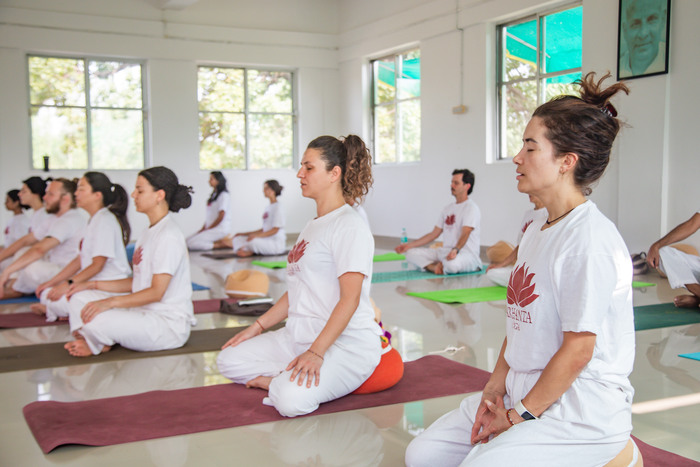
A Hatha yoga teacher training certification shows that you’ve been trained to teach with clarity, structure, and responsibility. It marks the shift from personal practice to guiding others safely and effectively.
At its core, a 200-hour training develops competence in these key areas:
- Asana & alignment: You learn how to break down postures, adjust for different bodies, and teach with precision
- Teaching methodology: You develop a clear understanding of structuring classes, giving clear verbal cues, and managing a group setting
- Anatomy & physiology: You build a clear understanding of how the body moves to prevent injury and support safe practice
- Yoga philosophy: You study traditional principles and learn how to apply them in teaching, not just theory
- Practicum (teaching practice): You get the opportunity to guide real students, receive feedback, and refine your approach where needed.
Organizations like Yoga Alliance and International Yoga Federation provide frameworks that standardize what a 200-hour training should include. Earning a Yoga Alliance-accredited hatha yoga certificate can offer more credibility, especially if you plan to teach internationally. But remember, this certification doesn’t mean you’ve mastered yoga. It means you’ve been trained to take responsibility for a class: to observe, adapt, and teach with awareness.
To go deeper into this, read our complete blog: What to Expect from a 200-Hour Yoga Teacher Training.
Step-by-Step Path to Becoming a Certified Hatha Yoga Teacher

Step 1: Build a Consistent Self-Practice
Although this is not mandatory, I always advise building a consistent personal yoga practice before stepping into a training. Try to spend at least 3–6 months building a steady practice. This creates familiarity and helps you adapt to the training environment faster.
Focus on:
Basic asanas: standing poses, forward bends, simple backbends
Breath awareness: noticing how breath supports or restricts movement
Discipline: showing up regularly, even on low-energy days
One thing you might realize during this phase: your body does not respond the same way every day. That observation later becomes crucial while teaching.
It’s also important to drop the idea that you need perfect flexibility to begin. In training, the focus doesn’t remain on flexibility. Here, the emphasis is on building knowledge step by step, which helps you lead the class confidently and refine your approach whenever needed.
If flexibility is still a question, read our complete blog: Do You Need to Be Flexible to Join a Yoga Teacher Training
Step 2: Choose a 200-Hour Hatha Yoga Teacher Training
Not all trainings are built the same way and offer the same benefits. Remember, the structure and depth of your course will directly affect how confidently you can teach later.
Pay attention to:
Approach: traditional (discipline, philosophy, method) vs modern (fitness-focused, fast-paced)
Curriculum depth: Find out more information about the curriculum. Does it explain why things are done in a certain way, or does it tell you what to do?
Teaching practice: Are you actually teaching during the course, or only observing?
Remember, you’ll also come across different formats, for example: Residential (ashram-style), structured training, Hybrid yoga teacher training, Fully online yoga teacher training.
If teaching is your primary goal, the presence of guided teaching practice is non-negotiable.
Need help in deciding the right format? Explore: Online, Residential, or Hybrid Yoga Teacher Training: Which One Is Right for You
Step 3: Understand the 200-Hour Curriculum
A good course gives you information step by step, so you can build your understanding without feeling overwhelmed.
It covers:
- Asana & Alignment
- Recognizing common mistakes and adjusting safely
- Anatomy & Physiology
- Basic understanding of joints, muscles, and movement patterns
- Knowing when a posture should be modified or avoided
- Yoga Philosophy
- Study of foundational texts like the Yoga Sutras
- Teaching Methodology
- Giving instructions that are clear and timed well
- Structuring a class so it progresses logically
- Observing students and making small but effective corrections
- Practicum (Teaching Practice)
- Guiding real or practice classes
- Receiving feedback and adjusting your approach
Always remember, there is a clear gap between knowing a pose and explaining it clearly. For example, while guiding a simple forward bend, you may see how easily instructions become confusing if they are not precise. This is where real learning happens. A well-structured Hatha yoga teacher training exposes you to real teaching situations where you learn to give precise instructions your students can follow easily.
Related: Should You Try a Short Course Before YTT
Step 4: Complete Assessments
You don’t get certified automatically. In Hatha yoga teacher training, you are assessed on how well you can use what you have learned.
This usually includes:
- Teaching assessments: guiding a class while being observed
- Written or practical exams: testing understanding of key concepts
- Participation: consistent involvement throughout the course
The teaching evaluation is usually the most eye-opening part. It shows if you can stay confident, give clear instructions, and answer your students’ questions as they come up.
Step 5: Receive Certification
After completing the training, you receive a 200-hour Hatha yoga teacher training certificate. Reputed yoga schools, including Arhanta Yoga, offer Yoga Alliance Accredited certification after you complete your 200-Hour Hatha Yoga Teacher Training. This Yoga Alliance-accredited certificate allows you to teach students globally.
Remember that Certification doesn’t mark the end of learning. It simply means you now have the foundation to teach with structure, awareness, and responsibility.
For more information, read our complete blog: A Simple Guide to Yoga Certification Titles & How to Earn Them.
How long does it take to get certified?
Intensive Residential Format (21 Days)
You can complete an intensive 200-hour Hatha yoga teacher training in a residential setting in 21 days. The schedule is structured, with full days dedicated to practice, study, and teaching.
This format creates a focused environment where you can learn continuously without distractions. Here, you absorb not just techniques but also rhythm, discipline, and teaching flow. It’s demanding, but many students find this immersion helpful in understanding concepts more clearly and quickly.
Part-Time Format (2–6 Months)
A part-time training usually takes 2 to 6 months, with classes held on weekends or certain weekdays.
This lets you continue training while working or managing daily responsibilities. The longer duration gives time to revisit material, practice independently, and build confidence gradually. However, consistency is your responsibility. You need to stay dedicated and show up even when you don’t feel like it.
Hybrid Yoga Teacher Training (Flexible Timeline)
Hybrid programs mix self-paced online learning with a shorter in-person session. The duration depends on how quickly you finish the online part. First, you study theory online. Then you join a 12-day in-person training to put what you learned into practice. This option suits those who like learning at their own pace before practicing teaching in person.
Remember, certification can be completed within weeks or months depending on the format. Teaching comfortably in a real class might take longer. The training gives you a solid foundation, but you develop real confidence with consistent practice and dedication.
Related: How to Become a Yoga Instructor: A Complete Career Guide
How to Choose the Right Hatha Yoga Teacher Training School

Not every Hatha yoga teacher training prepares you to teach with the same level of clarity. The difference usually comes down to how the course is structured and how seriously it treats teaching as a skill.
These are the key factors that shape your learning experience:
Teaching Practice Hours
This is where most of your real learning happens. A strong program doesn’t limit you to observation; it requires you to teach repeatedly during the course.
Look for:
- Guided teaching sessions from early in the training
- Opportunities to lead full or partial classes
- Specific, real-time feedback from experienced teachers after each attempt
In my 28 years of teaching, I have seen many students admit during their first teaching attempt that knowing a sequence is different from explaining it clearly. The more you practice in training, the more confident you feel as a teacher later.
Teacher Experience
Your teachers influence not just what you learn, but how you understand yoga as a discipline. So, before choosing a yoga teacher training school, always try to research who runs the school. Try to learn more about their teaching experience. Remember, experienced teachers don’t just demonstrate; they simplify complex ideas and correct you in a way that actually improves your teaching.
Class Size
Class size directly affects how much attention you receive during your training. While smaller groups allow for detailed corrections and personalized feedback, larger groups often limit your chances to ask questions, teach, and refine your techniques. If your goal is to teach, personalized guidance from experienced teachers is essential.
Depth of Philosophy
In a traditional Hatha yoga teacher training, philosophy is not treated as theory to memorize. It shapes how you approach practice and teaching. Make sure the yoga school you are choosing covers important subjects, including foundational texts like the Yoga Sutras. Also, the yoga teacher trainees need to understand the practical application of how these ideas influence discipline, awareness, and teaching decisions. When philosophy is taught properly, it changes how you guide a class, not just what you say about yoga.
Post-Training Support
What happens after certification tells a lot about the yoga school you are choosing.
Consider:
- Whether the school offers guidance once you start teaching
- Opportunities for continued learning or advanced training
- Access to mentors or teaching resources
The first few classes you teach on your own often raise new questions. Post-training support can help find the answers, letting you lead the classes with clarity and confidence.
If you want more guidance, read: How to Choose the Best Yoga Teacher Training for You.
What Happens After Certification?
Completing a 200-hour Hatha yoga teacher training gives you the foundation to begin, but your real journey starts once you step into your first class.
Start Teaching in Simple Settings
Most teachers begin with:
- Small groups (friends, community spaces)
- Online classes
- Beginner-level studio sessions
These settings give you space to experiment, adjust your pace, and understand how students respond to your cues. Early on, even basic instructions can feel different when you’re the one giving them. So, it’s best to begin with simple settings. I even advise my students to begin with their friends and family members. Start teaching them in a familiar environment so that you can cope with the nervousness and build confidence gradually.
Continue Your Own Practice
Your personal practice doesn’t stop after certification; it becomes more intentional.
You start to notice how subtle changes affect alignment. You refine your understanding of breath and movement. You test what you teach before offering it to others. Remember, teaching becomes easy when your own practice stays consistent.
Consider Advanced Training (300-Hour)
After gaining some teaching experience, many teachers choose to deepen their training through a 300-hour yoga teacher training program.
This training focuses on:
- More detailed alignment and adjustments
- Advanced teaching methodology
- Deeper study of philosophy and anatomy
Through this advanced training, you gain more clarity on teaching, refine your approach, and build detailed knowledge of alignment.
Build Confidence Through Repetition
A certificate can’t make you a confident teacher overnight. You build confidence by showing up consistently. Every class you lead helps you build confidence and clarity.
In your first few classes, you may forget cues, lose track of sequencing, and adjust your pace mid-class. This is part of the process. With each session, your instructions become clearer, your timing improves, and your ability to observe students sharpens. Over time, teaching shifts from something you prepare carefully to something you can continue with steadiness and awareness.
Related: Can You Teach Yoga Confidently with a 200-Hour Certification?
Is a 200-Hour Hatha Yoga Teacher Training Enough?
A 200-hour Hatha yoga teacher training is enough to prepare you to begin teaching, but not to complete your learning.
Enough to Start Teaching Safely
A well-structured course equips you with clear alignment principles and basic anatomy awareness. It gives you the ability to structure and guide a class. This is enough to teach beginners safely and responsibly. You learn how to give instructions, observe students, and make simple corrections without overcomplicating the practice.
Not Enough for Mastery
Mastery in yoga teaching isn’t achieved within a fixed number of hours.
It develops through teaching different types of students, handling real-time adjustments in class, and repeating and refining your instructions. Many teachers notice that their understanding deepens significantly only after teaching consistently for months.
Frequently Asked Questions
1. Is certification mandatory to teach Hatha yoga?
In some places, you can teach without certification. Still, most studios and students look for formal training. Being certified shows you know how to teach safely, not just practice by yourself.
2. What is the difference between Hatha yoga and other styles like Vinyasa?
Hatha yoga focuses on slower, more controlled practice with attention to alignment and breath. Vinyasa is more dynamic, linking movement with breath in a continuous flow. Hatha training often builds a stronger foundation for beginners.
3. How much can I earn after becoming a certified Hatha yoga teacher?
How much you earn depends on where you live, your experience, and whether you teach in studios, privately, or online. Most teachers begin part-time and earn more as they gain experience and attract more students.
4. Can I teach online after completing a 200-hour training?
Yes, you can. Many new teachers start with online classes. This helps you practice leading sessions, improve your communication, and connect with students outside your area.
5. What if I feel nervous about teaching even after earning certification?
Feeling nervous is normal. The first classes can feel uncertain, but you’ll gain confidence as you teach more often. Each class helps you get better at timing, clear instructions, and being present.
6. Do I need to register with Yoga Alliance after completing the course?
Registration is optional. It can add credibility, especially if you plan to teach internationally, but your actual teaching ability depends more on how well you apply what you’ve learned.
7. How do I know if a Hatha yoga teacher training is right for me?
Check the course structure: how much teaching practice you get, how clearly ideas are explained, who the trainers are, and if the style matches how you learn. A good program gets you ready to teach, not just finish the hours.
8. Can I specialize after completing my 200-hour certification?
Yes, you can. Once you have some teaching experience, you might want to try areas like therapeutic yoga, Yin, prenatal yoga, or advanced Hatha. Specializing makes more sense after you’ve taught for a while.
Final Thoughts
A 200-hour Hatha yoga teacher training helps you move from practicing on your own to teaching others. You’ll learn about alignment, class planning, and communication; skills you can use in real classes.
What matters next is how you use your training. Staying disciplined in your own practice, giving clear instructions, and watching and helping students are the skills that will shape you as a teacher.
Your certificate is just the start. How far you go depends on your consistency.
If you want to become a certified Hatha yoga teacher, you can begin by joining our 200-hour Yoga Teacher Training. It gives you the foundation and clear guidance you need to start teaching.