If you’ve ever been to a yoga class, you might have noticed people chanting “Om” at the start or end and wondered what it really means. Om chanting is more than just a yoga tradition. It comes from classical Indian texts and has its own philosophical meanings and practical methods.
What Does Om Chanting Mean?
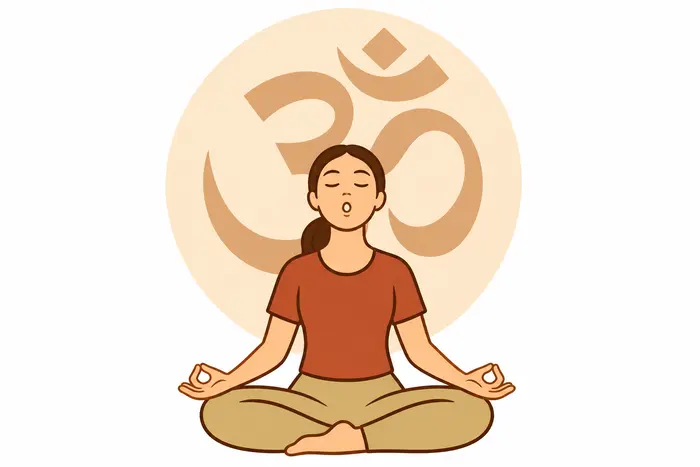
Om chanting refers to the vocal repetition of Om (ॐ), a sacred word with an important place in several Indian philosophical and yogic traditions. It is commonly pronounced as a sequence that moves from A to U and ends with M, followed by a period of silence.
Texts like the Mandukya Upanishad perceive Om as a deep symbol that shapes our consciousness and reality. On the other hand, In the Yoga Sutras of Patanjali, the word Om is associated with Ishvara and is something people are encouraged to chant often.
Understanding this difference is important. Om as a philosophical concept refers to what the syllable represents within a particular tradition, while Om as a practice involves actually vocalizing or mentally repeating it. A person may therefore chant Om without yet engaging with its deeper philosophical meaning.
So, chanting Om is more than just making a long “OM” sound to relax. It can include focusing on how you say it, your breath, the sound, the silence afterward, and what Om means. Different yoga traditions may focus on different parts of this practice.
The familiar A-U-M structure has a specific role in traditional interpretation. The Mandukya Upanishad connects the three sounds with three states of experience: waking, dreaming, and deep sleep, and discusses a fourth aspect associated with what lies beyond these three. This is one reason Om holds such a significant position in the text.
Is Om the Same as Aum?
Yes, Om and Aum usually mean the same sacred syllable, but people use the terms differently depending on the situation.
“Om” is the spelling you’ll see most often, while “Aum” shows the three sounds: A, U, and M. Talking about A-U-M is helpful when explaining the syllable’s traditional meanings.
It’s also important to remember that not every meaning of A-U-M applies to all Indian traditions. The meaning changes depending on the text, school of thought, or commentary.
Why Is Om Chanted in Yoga?
People chant Om in yoga because it has long been used for repetition, focus, and reflection. For example, Patanjali’s Yoga Sutras describes repeating the syllable associated with Ishvara and keeping its meaning in mind as a way to focus the mind.
In today’s yoga classes, people might chant Om at the start or end, during meditation, or on its own. The reason for chanting can differ: one teacher might focus on its traditional meaning, while another might use it to help everyone settle in before practice.
For beginners chanting Om, understanding this context is useful. You don’t need to master its philosophical meaning before practicing, but knowing that Om has a deeper textual and traditional context keeps the practice from being treated as merely a breathing or relaxation exercise.
Also See: Sanskrit Mantras to Uplift Your Practice & Life
Where the Concept Appears in the Classical Texts
Mandukya Upanishad
The Mandukya Upanishad places Om at the center of the discussion of consciousness, the Self, and the nature of reality. Its twelve passages examine the syllable alongside the nature of the Self and different states of consciousness. The text begins by presenting Om as surrounding all experience, including what has been, what is, and what will be.
The Upanishad then introduces a fourfold model of the Self:
- Waking: consciousness focused on the outside world.
- Dreaming: consciousness experienced within.
- Deep sleep: a state where usual desires and dreams are not present.
- The fourth: described as beyond the qualities that define the other three.
The first three are associated with the three elements of Om: A, U, and M. The fourth is associated with what is beyond these three sounds.
This fourth aspect is commonly called Turiya in later philosophical discussions. It is important not to describe Turiya simply as a state of deep relaxation or as another type of sleep. In the Mandukya, the fourth is described through terms such as non-dual, ungraspable, and beyond ordinary description.
Bhagavad Gita
The Bhagavad Gita also mentions Om, but its meaning there is different from the detailed explanation in the Mandukya Upanishad.
In Chapter 8, Krishna describes the practice of remembering the Supreme at the time of death and mentions Om as part of this practice. Here, Om is connected with focused remembrance and meditation.
The Gita also uses Om in other ways, such as when talking about sacred words and disciplined action. This shows that Om was not just for one meditation method. Its meaning reached into wider religious and reflective practices.
It is important to note that the Gita does not treat Om as a modern relaxation method. Instead, it appears in a larger philosophical context about Brahman, remembrance, meditation, and spiritual discipline.
Patanjali’s Yoga Sutras
Patanjali gives Om a particularly important place in the Yoga Sutras.
Sutra 1.27 identifies Om as the name or expression of Ishvara. Sutra 1.28 tells the practitioner to repeat Om and understand its meaning. Sutra 1.29 says this practice leads to greater inward focus and removes obstacles.
The sequence is significant:
Ishvara → Om → repetition → contemplation of meaning
So, in Patanjali’s presentation, simply producing the sound doesn’t define the entire practice. The sutra specifically connects repetition with understanding its meaning.
This also helps separate Patanjali’s actual teaching from interpretations added much later. The Yoga Sutras state that Om is associated with Ishvara and that it should be repeated with an understanding of its meaning.
Together, these texts show that Om chanting cannot be explained by just one definition. The Mandukya Upanishad uses Om to explore consciousness and the Self. The Bhagavad Gita includes it in practices of remembrance and spiritual discipline. On the other hand, Patanjali links repeating Om with Ishvara and meditation.
Related: The Bhagavad Gita’s Guide to Life: Key Yoga Philosophy Wisdom Explained
How Is Om Traditionally Interpreted?
Om as Pranava
In yogic and philosophical texts, Om is often called Pranava. In the Yoga Sutras, it is closely connected with Ishvara and the practice of repeating Om. The practice is not only about producing the sound; Patanjali also connects repetition with understanding its meaning and using it to focus the mind.
In Yoga Sutra 1.28, Patanjali tells practitioners to repeat Om while thinking about its meaning. This shows that traditional Om practice involves both repeating the syllable and reflecting on it at the same time.
Om as a Symbol of Totality and Ultimate Reality
The Upanishads often present Om as a symbol with a deeper philosophical meaning. For example, the Mandukya Upanishad starts by connecting Om to all of time and experience, then uses it to explore the nature of the Self.
This is why Om is sometimes described as a symbol of totality. However, that description needs context. It does not simply mean that the physical sound “contains” everything. Instead, the text uses Om to explore the nature of consciousness, the Self and reality.
What Does the Silence After Om Mean?
When Om is chanted, the audible sound eventually ends. Traditional interpretations, particularly those influenced by the Mandukya Upanishad, give significance to what lies beyond the three audible components.
The silence is not just the most relaxing part of the practice. In the Mandukya’s philosophy, it is linked to the fourth aspect, which cannot be explained by A, U, or M.
This is a philosophical idea, not a claim that silence itself always creates a certain state of mind. Someone chanting Om may find the silence calming or spacious, but that personal feeling is different from what the Upanishads teach.
Om as Symbol, not a Literal Explanation of Sound
You might hear people say, “Om is the vibration of the universe.” While this is an inspiring idea, it does not fully sum up the classical teachings described above.
Traditional texts see Om as a symbol, a sacred syllable, and something to think about, with meanings that change depending on the context. If we treat these meanings as a literal scientific explanation of a sound, it changes what the original teaching was about.
Knowing this difference helps when reading about the benefits of chanting Om. Traditional interpretations explain what Om means in a philosophy, while research studies look at what happens when people chant it. These are two different types of evidence and should not be treated as if they prove the same thing.
For someone practicing, this difference also makes the practice more meaningful. Om can be seen as a sound to chant, a syllable to repeat, and a symbol to think about. These are connected parts of the practice, but they are not the same thing.
Also See: Understanding Patanjali’s 5 States of Mind & How to Master the Meditative State
What It Looks Like in Modern Practice
In a modern yoga class, Om chanting may take place for only a few minutes, but how it is practiced can vary significantly. A teacher may invite students to chant Om before beginning asana practice, use it to close a class, or include it within meditation. Some practitioners may also maintain a separate chanting practice at home.
There isn’t one way to chant Om that all yoga schools follow. Some traditions care most about how Om sounds and is pronounced, while others focus on repeating it, paying attention, or thinking about its deeper meaning.
During yoga teacher training, we notice that beginners have different ideas about Om chanting. Some try to hold the sound for a long time, while others focus on matching how someone else says it. With some guidance, they learn that Om chanting isn’t about making it perfect. What matters most is breathing comfortably, staying focused, and knowing what the practice is about.
You may encounter Om chanting in several settings:
- At the beginning of a yoga class: A teacher may use it to mark the transition from everyday activity to practice.
- At the end of a class: The chant may provide a peaceful closing to the session.
- During meditation: Practitioners may repeat Om as an object for maintaining attention.
- As a personal practice: Someone may chant a few rounds independently while sitting quietly.
- In group chanting: Several people chant together, creating a shared rhythm and sustained sound.
- Alongside pranayama or meditation: Om may be part of a systematic pranayama practice rather than a separate technique.
The setting changes, but the basic practice remains simple: produce the syllable comfortably, listen to the sound, and maintain your attention rather than treating the chant as a performance.
How to Do Om Chanting
- Sit comfortably. Keep your spine upright without tensing your shoulders or face.
- Take a natural breath. No need to fill your lungs as much as possible.
- Begin with the “A” sound. Let the first part of the syllable start naturally.
- Move into “U.” Allow the sound to change smoothly rather than separating the two sounds abruptly.
- Finish with “M.” Close the lips gently and let the final sound continue comfortably.
- Notice the silence afterward. Wait for the next natural breath instead of immediately starting another repetition.
- Repeat Om a few times. For beginners, five repetitions are enough to get a feel for the practice without making it tiring.
If you’re new to Om chanting, focus on the sound, your breath, and the quiet moments between each chant instead of copying a recording or someone else’s voice. As you practice more, you can learn how different yoga traditions use Om and what it means to them.
Also Read: What Is Pratyahara? Meaning, Benefits, and 4 Types of Practice
Practical Exercises to Explore Om Chanting
Exercise 1: Explore A-U-M
Start by becoming familiar with the three parts of the syllable.
- Sit comfortably and take a natural breath.
- As you breathe out, make the A sound for a short moment.
- Let the sound flow naturally into U.
- End with M, gently closing your lips.
- Notice how the sound shifts as you move through each part.
- Repeat these 3 to 5 times, and don’t worry about making each one exactly the same.
Exercise 2: One Complete Om
- Once A-U-M feels familiar, practice the complete syllable as one continuous exhalation.
- Breathe in comfortably. As you breathe out, chant one full Om, letting your breath last as long as it feels natural. When you finish, return to normal breathing before starting again.
- Start with 3–5 repetitions. Over time, you can increase the number if the practice remains comfortable.
Exercise 3: Om and Silence
This exercise helps you focus on what happens right after the sound ends.
- Chant one Om, then sit quietly for a moment. Take your time before starting again. Notice when the sound ends, how your breath returns, and the short silence that follows.
- Then repeat.
The silence is not something you need to manufacture or extend. Notice it. This makes the exercise useful for observing how quickly the mind wants to move on to the next repetition.
Exercise 4: Mental Repetition
Sit quietly and repeat Om in your mind at a comfortable pace. Focus on the repetition itself, not on making the sound as loud as possible in your imagination.
Repeating Om in your mind is different from chanting it out loud, and the experience may not be the same. The goal is to get to know another traditional way to practice.
A Simple Practice for Beginners
If you’re just beginning, keep your practice as simple as you can.
Duration: 3–5 minutes
Repetitions: 5–10 Om chants
Setting: A quiet, comfortable place
Focus: Breath, sound, attention, and the silence after each chant
What Are the Benefits of Chanting Om? What Practitioners Report
People often search for the benefits of chanting Om, expecting a simple list of effects. Om chanting has a long place in yogic practice, and practitioners may describe experiences such as calmness, improved concentration, or greater awareness.
What Practitioners Commonly Report
Some people say they feel calmer after chanting Om a few times. Others notice they can focus better or pay more attention to their breath and the sound.
A person may also experience:
- a greater sense of mental settling
- easier concentration on a single object
- more awareness of the breath
- a stronger sense of being present during practice
- enjoyment or steadiness during group chanting
- greater sensitivity to the shift from sound into silence
These experiences are personal and can be very different from person to person. One person might find the sound comforting, while someone else might find group chanting distracting or new.
What Research Can and Cannot Tell Us
Research on Om chanting is still relatively small, but one study published in the International Journal of Yoga examined its immediate effect on heart rate variability (HRV). The researchers studied 36 participants, including 19 experienced yoga practitioners and 17 people without prior yoga experience. Participants performed five minutes of loud Om chanting, following a slow breathing pattern of approximately six breaths per minute.
After five minutes of chanting, the group with yoga experience showed a clear increase in high-frequency HRV, which is linked to relaxation in the body. The researchers saw this as a sign of more relaxation in that group. The group without yoga experience did not show a significant change.
So, what can we reasonably say about the benefits of Om chanting?
What research has investigated:
- changes in heart rate variability during or after chanting
- autonomic responses associated with relaxation
- the interaction between chanting and slow breathing
- physiological responses to vocalization and contemplative practices
What research has not established yet:
- that Om chanting cures or treats specific diseases
- that every practitioner will experience the same effect
- that Om itself, independent of breathing or other factors, accounts for every measured physiological change
- that all traditional descriptions of Om have been scientifically validated
Keep in mind that a study showing a short-term change in HRV does not prove that Om chanting is a medical treatment or that everyone will feel calmer after chanting. In the same way, a person’s experience can be important, even if it is not scientific proof.
Related: The Best Yoga Practices for Building Prana
Common Misunderstandings about OM chanting
Misunderstanding 1: “Om is just a relaxing sound”
Chanting Om can feel calming, but relaxation is just one aspect. Traditional texts give Om a much deeper meaning. The Mandukya Upanishad connects it to the Self and different states of consciousness, and Patanjali links repeating Om with Ishvara.
So, perceiving Om as just a sound used for relaxation misses why it became an important part of yogic practice in the first place.
Misunderstanding 2: “Everyone experiences the same benefits”
Everyone experiences Om chanting differently.
In yoga teacher training sessions, we have seen this clearly. Some students chant with confidence, while others hesitate because they feel uneasy hearing their own voice. Some settle into the practice easily, while others stay more aware of the group. The practice is the same, but each student’s experience is different.
Misunderstanding 3: “You have to chant Om very loudly”
You do not have to chant Om loudly to do it right. A louder sound does not make the practice deeper or more effective. When I teach beginners, I often see them trying to chant as loudly as possible. When I ask why, they usually say they heard that chanting loudly makes the practice work better.
I tell them right away that your voice should feel comfortable and your breath should not feel strained. There is no clear guideline about how loud the sound should be.
Misunderstanding 4: “The longer you chant, the better”
Chanting Om for a long time does not always make it better.
Sometimes beginners take a deep breath and try to hold the sound as long as possible. This can turn a simple practice into a breath control exercise. If your throat tightens or your breath feels uncomfortable, you may lose sight of the real purpose of the practice.
Just breathe in naturally and let your breath out without forcing it. That is enough.
Misunderstanding 5: “Om chanting is only a modern wellness practice”
You may now come across Om in meditation classes, wellness programs, and fitness-oriented yoga sessions, but the syllable has a much older place in Indian yoga traditions.
The Mandukya Upanishad, Bhagavad Gita, and Yoga Sutras all discuss Om in different contexts. Their explanations are philosophical and reflective, not simply instructions for relaxation.
A modern class may use Om in a simpler way, but that is different from saying that the practice itself began as a modern wellness technique.
Misunderstanding 6: “Om chanting has proven medical effects”
Research has examined Om chanting and related practices, including their effects on breathing and certain measures of autonomic activity. That does not mean that every claim made about Om has been scientifically proven.
For example, a study showing a change in heart rate variability does not automatically prove that Om chanting treats anxiety, cures disease, or has the same effect for everyone.
For yoga teachers, accuracy matters. Adding medical claims does not make the practice more valuable.
Read: Seeds Of Wisdom: 5 Fundamental Upanishads in Yoga Philosophy Explained
Why It Matters for Yoga Teachers
Teaching Om chanting requires more than knowing when to say “Om.” A yoga teacher should understand what the practice means in the tradition, how it is practiced, and, most importantly, what they can reasonably say about its effects.
In my classes, students often ask, “Why do we chant Om?” A meaningful answer takes more than saying it helps you relax.
Here, a teacher should:
- Know the context: Understand how Om is described in the relevant yoga texts.
- Teach with clarity: Explain whether the focus is on sound, breath, repetition, concentration, or meaning.
- Avoid exaggerated claims: Do not present Om as a cure or promise the same benefit to every student.
- Respect different perspectives: Students may have different cultural, religious, or personal relationships with Om.
- Allow choice: When appropriate, a student can listen or practice silently instead of being pressured to chant aloud.
- Teach without performance pressure: Pronunciation matters, but producing the loudest or longest Om is not the aim.
- Separate evidence: Keep traditional teachings, personal experiences, and scientific findings clearly distinguished.
Teaching Om Without Overstating Its Effects
A good teacher does not have to promise a specific result. Share where the practice comes from, teach it thoughtfully, and let students notice their own experiences. This approach keeps your teaching genuine and honours the tradition’s depth.
Frequently Asked Questions About Om Chanting
What is Om chanting?
Om chanting is the repetition of the sacred syllable Om (Aum). In yoga, it may support concentration, meditation, or reflection.
What are the benefits of chanting Om?
Some practitioners report feeling calmer, more focused, and more aware of their breathing. Research has also examined its effects on measures such as heart rate variability, but evidence remains very limited.
How do you do Om chanting?
Sit in a comfortable position and breathe as you normally do. As you breathe out, chant A-U-M. Let the sound fade on its own, notice the quiet afterward, and repeat this a few times without forcing it.
Is Om chanting suitable for beginners?
Yes. If you are new, start with just a few repetitions. Pay attention to the sound, your breath, and the quiet moments, instead of trying to make the chant long or loud.
How many times should I chant Om?
There is no set number that works for everyone. If you are just starting, try chanting Om 5 to 10 times and see what feels comfortable for you.
What is the difference between Om and Aum?
Om and Aum generally refer to the same sacred syllable. “Aum” highlights the three components: A, U, and M, while “Om” is the commonly used form.
Why is Om important in yoga?
Om appears in important texts such as the Mandukya Upanishad, Bhagavad Gita, and Yoga Sutras. Its meaning extends beyond its use as a relaxing sound in modern yoga classes.
What does A-U-M represent?
According to the Mandukya Upanishad, A, U, and M stand for waking, dreaming, and deep sleep. The text also talks about a fourth state called Turiya.
Should Om be chanted loudly or softly?
You do not need to chant Om loudly. Choose a volume that feels comfortable, so you can breathe easily and avoid straining your voice.
Can Om be repeated mentally?
Yes. In some traditions, people repeat Om silently in their minds. This is different from chanting out loud and is considered its own type of practice.
Final Thoughts
Om chanting can start as simply as making a sound, but it goes deeper. The sound leads to practice, practice builds attention, and attention can help you explore deeper ideas.
To really understand Om, you need more than just a list of possible benefits. Its meaning becomes clearer when you explore its origins, how it is practiced, and what you notice during the practice.
If you are interested in the philosophy behind practices like Om chanting, you can learn more about our Yoga Philosophy Course. In this course, you will learn about the ideas, texts, and principles that shape traditional yoga.




