Pancha Mahabhuta: The Five Elements in Yoga and Ayurveda

What if the five elements in Yoga were never meant to be understood as physical substances? Pancha Mahabhuta refers to five fundamental principles: Prithvi (earth), Apas (water), Agni (fire), Vayu (air), and Akasha (space), used in Indian philosophy and Ayurveda to understand the material world, the body, and sensory experience.
What Does Pancha Mahabhuta, the Five Elements, Mean?
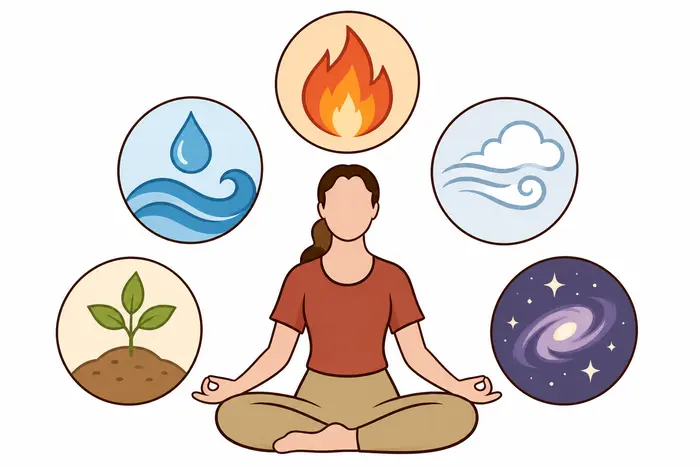
The Sanskrit term Pancha Mahabhuta can be described as the “five great elements.” Pancha means five, maha means great, and bhuta refers to an element or constituent of the material world. Together, the term refers to five fundamental principles in classical Yoga philosophy, Samkhya, and Ayurveda for understanding the material world and its qualities.
The five Mahabhutas are Prithvi (earth), Apas or Jala (water), Agni or Tejas (fire), Vayu (air), and Akasha (space). While these words are commonly described using familiar physical substances, their traditional meanings are broader than the common descriptions you often hear.
For example, Prithvi does not simply mean the soil beneath your feet, just as Agni does not refer only to a visible flame. Each Mahabhuta represents a set of qualities and principles. Earth is associated with solidity and stability, water with fluidity and cohesion, fire with heat and transformation, air with movement, and space with the capacity to accommodate or contain.
|
Mahabhuta
|
Element
|
Traditional Meaning
|
|---|---|---|
|
Prithvi
|
Earth
|
Solidity, form, stability, and resistance
|
|
Apas / Jala
|
Water
|
Fluidity, cohesion, and connection
|
|
Agni / Tejas
|
Fire
|
Heat, transformation, and conversion
|
|
Vayu
|
Air
|
Movement, activity, and mobility
|
|
Akasha
|
Space
|
Openness, extension, and the space that allows other phenomena to exist
|
This is why the Pancha Mahabhuta, or five elements, are different from the elements in modern science. Classical Indian traditions did not create a periodic table or say that our bodies are made of five actual substances called earth, water, fire, air, and space. Instead, the Mahabhutas are part of a traditional way to understand material life, our senses, and the qualities we see in ourselves and nature.
This framework also connects the five elements to our five senses. In traditional Indian philosophy, Akasha is linked to sound and hearing, Vayu to touch, Agni to form and sight, Apas to taste, and Prithvi to smell. These connections make more sense when you also look at the tanmatras, or subtle sensory principles, instead of seeing them as just simple physical matches.
It is also important to remember that Pancha Mahabhuta is not described in the same way across every Indian tradition. Yoga philosophy, Samkhya, and Ayurveda share certain concepts but use them within different systems of thought. Understanding those differences becomes especially important when you move from basic definitions to the classical sources behind the five-element framework.
Also See: Seeds Of Wisdom: 5 Fundamental Upanishads in Yoga Philosophy Explained
Where Does the Concept of Pancha Mahabhuta Appear in Classical Texts?
The five elements do not originate from a single text or belong exclusively to Yoga or Ayurveda. The idea develops across several parts of classical literature, with different traditions placing the Mahabhutas within different explanations of creation, perception, the body, and the material world.
One early and important discussion appears in the Taittiriya Upanishad. In its discussion of the origin of the material world, it presents a sequence beginning with Akasha (space), followed by Vayu (air), Agni (fire), Apas (water), and Prithvi (earth). The sequence then continues from earth to plants, food, and the human being.
This is important because the elements are not just a list of things in nature. They are part of a bigger explanation of how the world comes into being. The same Upanishad also uses groups of five to link the outside world with parts of individual life, showing an early effort to understand how the world and the person are connected.
Pancha Mahabhuta in Samkhya Philosophy
Samkhya philosophy gives a more systematic explanation of Pancha Mahabhuta. In this tradition, the Mahabhutas are part of a larger theory about how everything comes from Prakriti. The five elements are not the first things created; instead, they appear later, after the tanmatras, which are subtle sensory principles.
The five tanmatras are traditionally associated with sound (shabda), touch (sparsha), form (rupa), taste (rasa), and smell (gandha). The Mahabhutas emerge through the development and combination of these refined principles.
This adds another layer of meaning to the five elements. They relate not just to physical things, but also to how we sense the world. That is why tradition connects Akasha with sound, Vayu with touch, Agni with form, Apas with taste, and Prithvi with smell.
The Five Elements in Classical Ayurveda
Ayurveda uses the Pancha Mahabhuta framework differently, focusing on the makeup and function of living beings, food, and the material world. Classical Ayurvedic texts describe both living and non-living things in terms of the five Mahabhutas, making this framework practical in Ayurvedic theory.
In the Charaka Samhita, for example, the five Mahabhutas are identified as Akasha, Vayu, Agni, Jala, and Prithvi. Ayurvedic explanations also connect these elements with the qualities of substances and with processes such as digestion and metabolism.
This is also where the link to the doshas becomes important. Ayurveda explains Vata, Pitta, and Kapha as combinations of the Mahabhutas. Still, it is important to remember that Yoga philosophy and Ayurveda are not teaching the same system for the same reasons. They use some of the same ideas, but their goals and frameworks are different.
Why the Context Matters
The history of Pancha Mahabhuta shows that it is misleading to call it just “the ancient Indian belief that everything is made of five elements.” This kind of statement leaves out the deeper philosophical context in which the elements were used.
In the Taittiriya Upanishad, the elements are part of a story about how the world appears and how individuals relate to it. In Samkhya, they fit into a detailed theory about creation that includes Prakriti and the tanmatras. In Ayurveda, they help explain the qualities and makeup of substances and the body.
Knowing these differences helps you get a clearer start when studying the Pancha Mahabhutas today. Instead of seeing Earth, Water, Fire, Air, and Space as just five physical substances, we can view them as parts of several connected traditional systems that explain the material world, our senses, and the human body.
Related: Ayurveda 101: Understanding and Identifying the 3 Doshas
How Are the Pancha Mahabhutas Traditionally Interpreted?
The Pancha Mahabhutas are more than just five physical substances. In Yoga philosophy and Ayurveda, they describe the basic qualities of the material world and the body. Each element stands for a different principle, and together they help explain how matter and our senses are organized.
Prithvi — Earth
Prithvi stands for solidity, stability, structure, and density. It is linked to what gives things their form and keeps them steady. In Ayurveda, these qualities describe the body’s solid, supportive parts and other materials.
Apas / Jala — Water
Apas, or Jala, represents fluidity, cohesion, moisture, and flow. It describes the qualities that allow things to remain connected and move in a fluid state. Its meaning extends beyond physical water to the broader principle of cohesion.
Agni / Tejas — Fire
Agni, or Tejas, stands for heat and change. In Ayurveda, this idea is especially important for digestion and other changes in the body. It means the ability to turn one thing into another, not just a physical flame.
Vayu — Air
Vayu represents movement, mobility, and activity. Its significance lies more in the principle of movement. Ayurveda applies this idea to various processes involving motion and direction within the body.
Akasha — Space
Akasha stands for space, openness, and the ability to make room for other things. It is not just empty space, but a wider idea of possibility and room for things to exist and interact.
The Five Mahabhutas, Senses, and Tanmatras
|
Mahabhuta
|
Sense
|
Tanmatra
|
|---|---|---|
|
Akasha
|
Hearing
|
Sound (Shabda)
|
|
Vayu
|
Touch
|
Touch (Sparsha)
|
|
Agni / Tejas
|
Sight
|
Form (Rupa)
|
|
Apas / Jala
|
Taste
|
Taste (Rasa)
|
|
Prithvi
|
Smell
|
Odor (Gandha)
|
These ideas come from traditional philosophy and should not be taken as explanations of how our senses work in modern science.
Pancha Mahabhuta in Yoga and Ayurveda: What Is the Difference?
Yoga philosophy and Ayurveda both use the Pancha Mahabhuta framework, but they apply it to different areas of study. Yoga uses the elements within a broader philosophical inquiry into nature, manifestation, and experience. Ayurveda applies them more directly to the body, substances, health, and the doshas.
Pancha Mahabhuta in Yoga Philosophy
In Samkhya and Yoga philosophy, the five Mahabhutas are part of the material world and come from Prakriti as things take shape. They help explain how the physical world develops and how it connects to our senses.
The elements are also linked to the tanmatras, which are the subtle qualities we sense. Because of this, the Mahabhutas help explain how we experience the world through hearing, touch, sight, taste, and smell.
For someone practicing yoga, the five elements are part of a bigger question: How does our awareness experience the world through our body and senses? So, the Mahabhutas are a key part of Yoga’s philosophy, not just a way to pick yoga poses.
Pancha Mahabhuta in Ayurveda
Ayurveda uses the same five elements within a practical framework for understanding the body, food, substances, and their qualities. The Mahabhutas help explain why different substances possess different characteristics and form part of Ayurveda’s traditional understanding of physiological processes.
The elements also come together to form the three doshas:
|
Dosha
|
Primary Mahabhutas
|
|---|---|
|
Vata
|
Air + Space
|
|
Pitta
|
Fire + Water
|
|
Kapha
|
Water + Earth
|
Curious about your dosha? Try the ‘What Is My Dosha?’ Quiz to find out.
What Does Pancha Mahabhuta Look Like in Modern Yoga Practice?
Today, many yoga teachers use the Pancha Mahabhuta as a theme for poses, breathing exercises, meditation, mudras, and sensory practices.
Exploring the Five Elements Through Practice
- Prithvi (Earth): Practicing Tadasana or Warrior poses helps you focus on stability, grounding, and support.
- Apas/Jala (Water): Moving gently and slowly between poses helps you experience fluidity and connection.
- Agni/Tejas (Fire): Practice Surya Namaskar. It brings warmth, energy, and transformation.
- Vayu (Air): Focusing on your breath or gentle breath-led movement helps you notice movement and mobility.
- Akasha (Space): Seated meditation and listening practices direct your attention to space, openness, and awareness.
These are ways of exploring the qualities associated with the Mahabhutas, not universal instructions from classical Yoga texts.
Practical Exercises to Explore the Five Elements
Honestly, there is no single classical practice that you can call “Pancha Mahabhuta practice.” Instead, the five elements can serve as a framework for observing qualities such as stability, fluidity, transformation, movement, and space. These simple exercises offer one way to explore those qualities through practice.
Earth — Explore Stability
Stand in Tadasana (Mountain Pose) with both feet on the floor. Lengthen your spine without becoming stiff. Stay for 5–10 breaths and notice the support of the ground under your feet.
Water — Explore Fluidity
Practice 5–8 rounds of Cat-Cow, moving slowly with your breath. Keep your movements smooth and continuous, letting your spine and joints move comfortably.
Fire — Explore Transformation
Practice 3–5 rounds of Surya Namaskar at a steady pace. Notice how warmth and activity build, then stand quietly for a few breaths before you continue.
Air — Explore Movement
Sit comfortably and watch your natural breath for 2–3 minutes. Notice how your abdomen, chest, and ribs move with each breath. Do not force or lengthen your breath. If you are experienced, you can use a gentle pranayama technique you already know.
Space — Explore Awareness
Sit quietly for 3–5 minutes. Notice sounds, bodily sensations, and the space around you without focusing on any one thing. Let your awareness stay open.
These exercises do not balance the five elements in a medical way. They give you a practical way to explore the qualities linked to the Mahabhutas through posture, movement, breath, sensation, and awareness. Beginners should stay within their comfort level and learn advanced pranayama from a qualified yoga teacher.
Pancha Mahabhuta Five Elements Benefits: What Can You Actually Expect?
Increased Sensory and Body Awareness
The five Mahabhutas give practitioners specific qualities to observe. Earth can draw attention to stability and pressure, water to fluid movement, fire to warmth and change, air to movement through the breath, and space to openness and sensory experience.
This approach can bring more awareness to your everyday yoga practice, making your practice more effective. Instead of moving through an asana mechanically, you begin to notice how each movement feels, where tension appears, how the breath changes, and how the senses respond.
Improved Concentration
Focusing on one element during practice gives your mind something clear to pay attention to. For example, you might notice the steadiness of Tadasana when working with Prithvi, or pay close attention to your breath when exploring Vayu.
Keep in mind that the real benefit comes from steady observation. This approach gives your concentration a clear focus, instead of simply trying to empty your mind.
Deeper Engagement with Yoga Philosophy
Pancha Mahabhuta gives practitioners a way to understand the philosophical ideas that shape a particular yoga practice. When you see terms like Akasha, Vayu, or Agni in classical texts, knowing their traditional meaning helps you understand them more deeply, rather than just seeing them as class themes.
This can be particularly useful for Yoga teacher training students and teachers who want to understand the philosophical background behind each traditional practice.
Helps You Observe Your Movement and Breath Properly
This approach encourages you to look beyond whether a posture is technically correct. You can also observe qualities such as steadiness, fluidity, effort, lightness, movement, and spaciousness.
For example, if you focus on Vayu, you might notice the movement of your breath more closely. If you work with Prithvi, you may pay more attention to grounding and stability. These connections offer a traditional way to observe your practice.
Greater Understanding of Ayurveda
Learning about the Mahabhutas also helps you understand Ayurvedic ideas that use the five elements. Ayurveda uses these elements to describe substances, qualities, the body, and the doshas.
For example, Vata is linked to Air and Space, Pitta to Fire and Water, and Kapha to Water and Earth. Knowing this can help you understand Ayurvedic theory better. Still, this information is not a replacement for a personal Ayurvedic assessment or a modern medical diagnosis.
Also See: Ayurveda for Sleep: Daily Habits to Support Deeper Rest
How to Do Pancha Mahabhuta Five Elements Practices
If you are searching for how to do Pancha Mahabhuta (the five elements), you must understand one thing first: Pancha Mahabhuta is a philosophical framework, not a standardized exercise or sequence. Different teachers may use the five elements differently during the yoga practice.
For a simple introduction, you can explore each element through a specific quality and practice, such as:
1. Earth (3 Minutes)
Stand in Tadasana, or Mountain Pose, while keeping your feet firmly grounded. Keep your spine straight and notice how your feet connect with the floor. Focus on feeling steady and supported.
2. Water (3 Minutes)
Move slowly through Cat-Cow or another gentle, flowing sequence. Match your movements with your natural breath and keep everything smooth. Pay attention to how fluid your movements feel, not how far you stretch.
3. Fire (3–5 Minutes)
Practice mindful Sun Salutations at a steady pace. Notice the warmth, effort, and changes in your breathing as the practice goes on. Keep the intensity appropriate for your level.
4. Air (3 Minutes)
Sit comfortably and watch your natural breath. Notice how your belly, chest, and ribs move, but don’t try to change your breathing.
5. Space (5 Minutes)
Sit quietly and let your attention take in sounds, body sensations, and the space around you. You don’t need to focus on just one thing; notice whatever comes and goes.
Also See: The Ayurvedic Detox Guide: 6 Safe Practices to Cleanse Body & Mind
Common Misunderstandings About Pancha Mahabhuta
1. The Five Elements Are the Same as Scientific Elements
No. Pancha Mahabhuta does not mean chemical elements like oxygen, carbon, or iron. The five Mahabhutas are basic principles or qualities in traditional Indian philosophy. They describe the material world differently and are not the same as what you find in modern chemistry or physics.
2. Pancha Mahabhuta Belongs Only to Ayurveda
No. While Ayurveda often uses the five-element framework, the idea extends beyond Ayurveda. Samkhya and Yoga philosophy also talk about the Mahabhutas when explaining how the material world forms and how we experience it through our senses.
3. Everyone Has One Dominant Element
Not in the way that modern ideas about ‘element types’ suggest. The five Mahabhutas offer a broad framework, not a system where each person is just an Earth, Water, Fire, Air, or Space type. The idea of having one main element is a later or popular interpretation, not the original meaning of Pancha Mahabhuta.
4. Each Element Has One Specific Yoga Pose
There is no classical rule that links one yoga pose to each Mahabhuta. Modern teachers might connect Tadasana with Earth or Sun Salutations with Fire to highlight certain qualities. This kind of sequencing can be helpful, but it’s a modern teaching method, not a traditional yoga sequence.
5. You Can Diagnose Yourself Through the Five Elements
The five elements are not meant for self-diagnosis. Looking at lists of Earth, Water, or Fire symptoms won’t tell you your physical or mental health status.
6. Element Balancing Has Established Medical Effects
Traditional Ayurveda makes therapeutic claims using concepts such as the Mahabhutas, but these claims should not be treated as established medical evidence. For example, describing Agni in terms of digestion within Ayurveda does not prove that an Agni-themed yoga practice can treat digestive disorders.
7. Akasha Means “Outer Space”
Akasha means more than just outer space. In traditional philosophy, it refers to space or the idea of making room for other things to exist. Calling it only ‘outer space’ can miss its deeper meaning.
Why Pancha Mahabhuta Matters for Yoga Teachers
A proper understanding of Pancha Mahabhuta helps teachers:
- Teach Yoga philosophy accurately rather than reducing it to simplified modern interpretations.
- Understand the background of traditional practices and the concepts associated with them.
- Differentiate Yoga philosophy from Ayurveda, which uses the five elements within its own medical and theoretical system.
- Explain Sanskrit terms responsibly, especially when their meaning cannot be captured by a single English word.
- Separate traditional claims from scientific evidence when discussing practices and their effects.
- Create meditative practices thoughtfully without presenting modern adaptations as fixed classical prescriptions.
A strong yoga teacher does not need to force the five elements into every class. Understanding the framework matters more than turning it into a formula.
Frequently Asked Questions About Pancha Mahabhuta
What are the five elements of Pancha Mahabhuta?
The five elements are Prithvi (Earth), Apas (Water), Agni (Fire), Vayu (Air), and Akasha (Space).
What does Pancha Mahabhuta mean in Yoga?
In Yoga the Pancha Mahabhuta refer to the five great elements. This system forms part of the traditional explanation of the material world and of sensory experience.
What are the Panchamahabhutas in Ayurveda?
The Panchamahabhutas are Earth, Water, Fire, Air, and Space. Ayurveda uses them to understand substances, the body, and the three doshas.
What are the benefits of the five elements?
The benefits of the Pancha Mahabhuta (five elements) are mainly meditative and educational. The framework can develop awareness, concentration, and understanding of traditional Yoga and Ayurveda.
How do you practice Pancha Mahabhuta?
You can practice Pancha Mahabhuta by exploring each element through movement, breathing, and meditation. There is no need to follow a single set sequence.
Can beginners practice Pancha Mahabhuta?
Yes, beginners can practice Pancha Mahabhuta. Simple standing, flowing, breathing, and meditation exercises are enough, so you do not need advanced yoga experience.
What is the relationship between Pancha Mahabhuta and the doshas?
The doshas combine the five elements in different ways: Vata is Air and Space, Pitta stands for Fire and Water, and Kapha is Water and Earth.
Is Pancha Mahabhuta scientifically proven?
Science does not recognize Pancha Mahabhuta as a model for matter or the body. It is part of traditional philosophy and Ayurveda.
What is Akasha in the five elements?
Akasha means space or the idea of accommodation in traditional philosophy. It is more than just outer space and is linked to sound and hearing.
Final Thoughts
You get to understand Pancha Mahabhuta more clearly when you look beyond the five names and study how the concept functions within Yoga philosophy and Ayurveda. It also reminds you to differentiate traditional teachings from modern interpretations and scientific claims.
If you want to study Yoga philosophy in detail, consider enrolling in our Yoga Philosophy Course, which explores the philosophical concepts, texts, and principles that shape the traditional understanding

Discover your Ayurvedic constitution (dosha-dominance) with our free self-assessment
Fill out our specially curated assessment to discover your dosha balance



