Anulom Vilom is usually one of the first pranayama techniques students learn in Yoga Teacher Training. The technique is simple, but teaching it well requires clear instructions. Without them, students might strain their breath, lift their shoulders, or lose their rhythm. Here are 10 cues to help teachers guide each step with confidence.
What Is Anulom Vilom Pranayama?
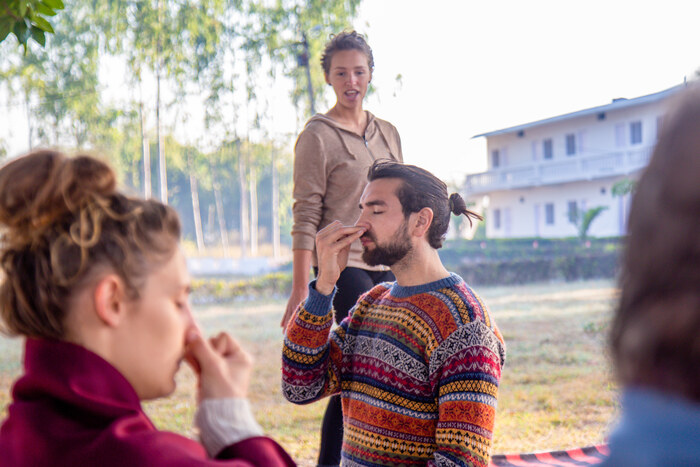
Anulom Vilom is a traditional breathing practice where you alternate the flow of breath between the left and right nostrils in a steady, controlled manner. It is often introduced early in yoga because of its simple methods; however, its effect depends entirely on how you practice it.
At its core, this practice helps settle the breath and create a more balanced internal rhythm. When guided correctly, it can support a calmer and more focused state of mind. Research suggests that Anulom Vilom Pranayama can instantly calm your nervous system and reduce stress levels.
Basic steps:
- Sit in a comfortable, upright position with the spine relaxed but stable
- Use the right hand to gently close the right nostril and inhale through the left
- Close the left nostril and exhale through the right
- Inhale through the right, then switch and exhale through the left
- Continue this alternating pattern in a slow, even rhythm
This is the basic structure I teach to most beginner students. There are more advanced variations of Anulom Vilom that include specific mudra, ratios and breath retention, but those require proper guidance and should not be introduced too early. We generally introduce such advanced versions in our pranayama courses or yoga teacher trainings.
For most practitioners, keeping the breath simple, steady, and relaxed is far more important than introducing them to advanced breathing techniques.
Read more: What Is Nadi Shodhana Pranayama? Meaning, Benefits & Steps
Why Cueing Matters More Than Technique in Pranayama
In pranayama, what you say directly shapes how your students experience the pranayama. If your instructions are easy, clear, and effective, your students will derive the maximum benefit from the practice. On the other hand, if your instructions are vague, unspecified, or don’t address safety and posture, it might confuse your students. They may not understand the practice beyond the posture.
Students Follow Your Words, Not Your Understanding
You may understand the technique clearly, but your students do not practice what you understand; they understand your words. They follow your instructions. And if those instructions are unclear, the breath quickly becomes strained, they start getting exhausted during practice, and it might eventually lose its efficiency.
When Cueing Is Unclear, the Breath Becomes Forced
I often see this in class. The moment guidance becomes vague or inconsistent; students start trying to “do it right.” The breath becomes heavier, the shoulders begin to lift, and the rhythm breaks. This is not the students’ fault. Neither did it happen because the technique is difficult, but because the instruction did not guide them properly.
Clear Cues Create Ease, Not Confusion
Remember, the quality of the pranayama practice largely depends on the cue. A well-placed instruction allows the breath to settle naturally. There is less effort, more continuity, and a clear sense of ease in the practice.
When your cues are precise:
- Students find a steady rhythm without overthinking
- The breath becomes quieter and more even
- Awareness stays with the flow instead of the effort
- Attention shifts inward and peace feels consistent.
Better Teaching doesn’t mean More Instruction, But Better Instructions
Good cueing does not mean saying more or saying everything at once. It means saying only what is necessary, at the right moment.
Over time, I have found that refining how you guide the breath is more valuable than adding new techniques or advancing the sequence. When your instructions become simple and consistent, even a basic practice begins to feel deeper and more effective.
Also See: Yoga Cues: Teacher Dos & Don’ts for a Safe & Functional Class
10 Cues That Will Transform How You Teach Anulom Vilom
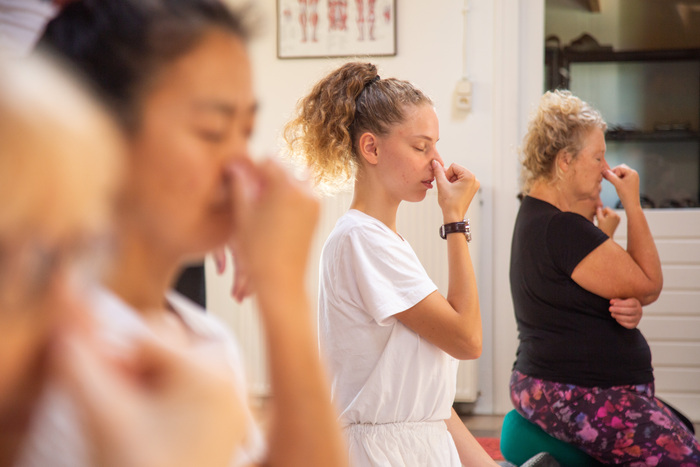
In my experience, the difference between a mechanical practice and a meaningful one often comes down to Anulom Vilom cues. The words you use may seem simple, but they directly influence how the student feels during the practice.
The cues I am sharing below are not about adding more information. They are about removing confusion so the breath can settle into a steady, natural rhythm.
1. Let the Body Settle Before You “Sit Straight”
One of the most common mistakes in Anulom Vilom I notice is that students try too hard to sit correctly. The moment they hear “sit straight,” their body automatically become stiff. The chest lifts unnaturally, the shoulders tighten, and the face starts to lose its natural softness. Before the breathing even begins, there is already an unnecessary effort in the system.
Instead of asking them to sit straight, I guide them to sit comfortably first. Once they feel settled and relaxed. I ask them to gently lengthen the spine without losing that ease. The posture should feel comfortable, not forced.
This small shift changes everything, making it one of the most important Anulom Vilom cues. You can easily understand the difference. When the body is not holding unnecessary tension, the breath does not have to push through resistance. It becomes smoother, quieter, and more consistent from the very beginning.
2. Soften the Face Before You Guide the Breath
Another pattern I often see is that students begin to control their breath so aggressively while their faces are still holding tension. The jaw is slightly tight, the lips are pressed together, and there is subtle effort around the eyes. Even if it is not obvious, this tension disrupts the natural flow of breathing and makes the practice a little more demanding than it should be.
Before I guide the technique or give breathing instructions, I bring their attention to the face. I ask them to relax their jaw, soften the area around the eyes, and let the tongue rest naturally. Only once this softness is present, I move to the breath.
This may seem like a small detail, but it has a direct effect. When the face relaxes, the nervous system settles. The breath becomes less controlled and more natural. Instead of trying to manage the inhale and exhale, the student begins to follow the breath with ease.
3. Apply Light, Controlled Pressure on the Nostrils
A common mistake I notice in my pranayama class is that students often press too firmly when closing the nostrils. There is a tendency to “seal” the nostril with force. Let me tell you honestly, this is unnecessary and often creates tension in the fingers, the wrist, and even the face. Over time, this affects the flow of your breath.
In Anulom Vilom, I always guide my students to use just enough pressure to close the nostril without collapsing it. The touch should be light and controlled, not forceful. The hands must remain relaxed, and the movement precise.
When the pressure is gentle, the breath can move freely without interruption. It also helps maintain the practice’s sensitivity. Instead of controlling the breath through effort, the student begins to practice it with awareness.
4. Do Not Deepen the Breath, Refine Its Flow
Many students assume that a “better” breath always means a deeper breath. So, they often begin to pull the inhale in, stretching it beyond what feels natural, and then push the exhale out with effort. This creates strain, and the rhythm becomes broken.
Instead of asking them to breathe deeply, I instruct them to keep the breath smooth and continuous. I remind them that the inhale and exhale should feel relaxing, without any sudden effort or dragging.
When the focus shifts from depth to smoothness, the breath settles into its own natural rhythm. There is no forcing, no interruption. Over time, the breath may deepen naturally, but this time it does so without tension.
5. Give More Attention to the Exhale Than the Inhale
A lot of times, students focus almost entirely on the inhale. They try to draw the breath in more fully, more deeply, as if that is where the real practice happens. In doing so, the exhale becomes passive or rushed, and the overall rhythm loses its natural balance.
In my class, I advise my students to shift their attention to the exhale. Not by forcing it, but by allowing it to be complete naturally, and unhurried. The inhale can remain natural, but the exhale is where I demand more awareness.
This immediately improves the quality of the practice. When the exhale is steady and relaxed, the body begins to let go of unnecessary effort. The breath becomes more grounded, and the next inhale happens more naturally, without being pulled.
6. Let the Shoulders Stay Quiet Throughout the Practice
A subtle but very common mistake in Anulom Vilom is the involvement of the shoulders in breathing. As soon as students begin to focus on the breath, the shoulders start lifting slightly with each inhale and dropping with the exhale. This may seem harmless, but it creates unnecessary tension and interrupts the natural flow of the practice.
I bring their awareness to this early in the practice. I ask them to keep their shoulders completely rested, allowing them to remain still and relaxed while the breath moves independently.
When the shoulders stop participating, the breath shifts deeper into a more natural pattern. There is less visible effort, less shoulder strain. Gradually, the movement becomes internal rather than external. This not only helps students experience the benefits of Anulom Vilom but also helps them to stay more relaxed and focused throughout the practice.
7. Allow a Natural Pause, Without Holding the Breath
I have seen that many students don’t like to pause during pranayama practices. Instead of taking a natural pause, they tend to hold their breath with effort. They often think holding their breath makes the practice more effective. Gradually, their throat tightens, the chest becomes rigid, and what should be a moment of relaxation slowly turns into strain.
When I introduce a pause, I make it clear that it should not feel like holding. I ask them to allow a brief, effortless gap at the end of the inhale or exhale, but only if it happens comfortably. There should be no tightening, no control, and no attempt to extend it.
When the pause is natural, it brings a sense of quietness to the practice. The breath does not feel interrupted. Instead, there is a subtle stillness between movements, which helps the mind settle without creating tension in the body.
8. Avoid Making Any Sound While Breathing
I often notice students start making a slight sound as they breathe, especially when they try to control the inhale or extend the exhale. It may feel like they are doing it more correctly, but it usually means extra effort to make the practice more accurate. Here, the question is whether producing a sound increases the accuracy of the practice? Well, no. It’s a common mistake in Anulom Vilom that makes the practice more intense than it should be.
One of the most useful Anulom Vilom cues is to let the breath move without any sound. There is no need to pull the air in or push it out. If the breath is gently guided, it will remain quiet on its own, making the practice more relaxing.
9. Focus on the Flow, Not the Count
A common mistake in Anulom Vilom is starting to measure the breath too early. Students begin tracking how many rounds they inhale and exhale, rather than staying with the actual experience of breathing. The moment this happens; the breath often becomes mechanical. Then they try to fit it into a structure rather than allowing it to move naturally.
I always advise my students to stay with the flow of the breath instead. The inhale and exhale should follow each other in a steady rhythm, without being forced into a fixed pattern.
When the attention remains on the flow, the breath naturally becomes more continuous and relaxed. Structured ratios can be introduced later, but at first, we should prioritize the natural flow of breathing.
10. If the Breath Feels Strained, Ease Back
This is something I repeatedly remind students of. The moment the breath feels heavy, uneven, or difficult to maintain, there is something wrong with the practice. In most cases, the students usually try to push through it. They assume that effort will improve the practice, but in pranayama, it has the opposite effect.
In my pranayama class, I ask my students to reduce their effort immediately if they feel the breathing is exhausting them rather than relaxing. Remember, the breath should feel manageable at all times. There is no benefit in extending it beyond what the body can comfortably sustain.
When the student learns to recognize this early and adjust, the practice becomes more stable and effective. The breath remains steady, and there is no buildup of tension. Over time, this awareness helps them develop control without forcing progress.
Read: A Teacher’s Guide to Better Alignment in 7 Common Asanas
Common Mistakes Teachers Make While Guiding Anulom Vilom
Giving Too Many Instructions at Once
Even when the technique is simple, it can become highly complicated through over-instruction. When students are asked to focus on posture, hand position, breath control, and timing all at once, they lose clarity, and it creates more confusion. This mistake often happens in the early stages of teaching, when new yoga teachers feel pressured to make their classes perfect.
Forcing the Breath to Become Deeper
Another common mistake teachers make when guiding students through the Anulom Vilom pranayama steps is encouraging students to breathe more deeply than they are ready for. This often leads to effort instead of ease. The breath becomes forced, making them exhausted faster. This often disrupts the natural rhythm of breath. In pranayama, depth cannot be forced; it develops over time.
Introducing Structure Too Early
I also see teachers introduce ratios or patterns before students even develop a clear understanding of the practice. This makes the practice mechanical. Instead of building awareness, the student starts trying to match a structure, often losing connection with the breath itself.
Not Observing the Student Closely Enough
Good guidance is not only about what you say, but also about what you notice and how well you observe them during practice. Subtle signs like shoulder movement, facial tension, or irregular rhythm are easy to miss. Without observation, it becomes difficult to adjust your instruction meaningfully.
Try: Bhramari Pranayama: A Beginner’s Guide to Bumblebee Breathing
Final Thoughts
In pranayama, progress does not come from learning more techniques. It comes from refining how you guide what is already simple.
Anulom Vilom is not a complicated practice. But the way it is taught can either make it feel effortless or unnecessarily difficult. When your Anulom Vilom cues are clear and measured, students do not have to struggle to follow the breath. They settle into it.
If you want to learn how to guide pranayama with clarity and structure, working within a systematic training approach can make a significant difference. Programs like a focused 50-hour online pranayama course can help you understand not just the techniques, but how to teach them effectively.
If you want to make this a part of your daily routine, watch this video and practice pranayama step by step.




