Yoni Mudra is a traditional yogic practice designed to turn your attention inward by reducing sensory distraction and supporting concentration. This practice also helps you build steady concentration and prepare your mind for meditation. In the classical yoga tradition, it is associated with pratyahara (withdrawal of the senses) and cultivating inner awareness.
What is Yoni Mudra and what is it used for?
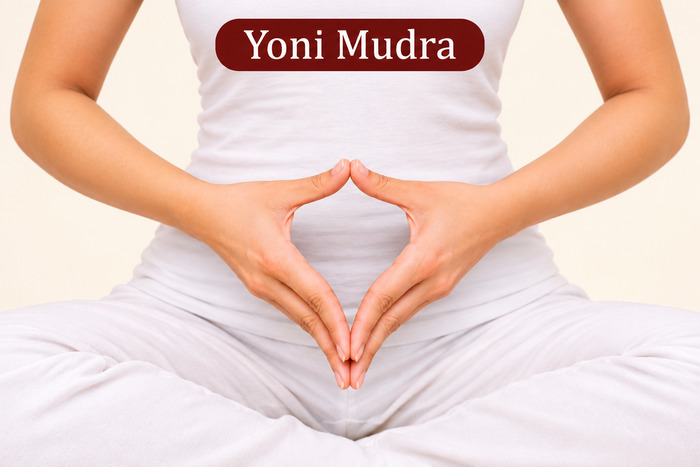
As mentioned earlier, Yoni Mudra is a traditional yoga practice that helps you move your focus from outside distractions to your inner self. The Sanskrit word yoni indicates source, origin, or womb. In yoga, the purpose of Yoni Mudra is to bring your attention back to its source.
This practice is usually associated with a yogic concept known as pratyahara: the withdrawal of the senses. When practiced properly, Yoni Mudra also helps you develop the stability required for meditation.
When people hear the term Yoni Mudra, they often think of the hand gesture. This is what most modern yoga schools often describe as Yoni Mudra. But remember, you cannot understand the purpose of Yoni Mudra simply from looking at the name. In reality, Yoni Mudra can actually refer to different techniques in various yoga traditions. The methods described in classical Hatha Yoga texts can differ significantly from the hand gesture usually taught as Yoni Mudra in modern yoga classes.
What Does “Mudra” Mean in Yoga?
In Hatha Yoga, mudras are a set of yogic practices used to support the regulation of prana, concentration, and meditation. While many modern yoga classes use the word Mudra to describe hand gestures, traditional mudras can also include movements of the body, breath, eyes, or muscles.
Traditional Hatha Yoga also states that a mudra is not merely a hand position or symbolic gesture; it is a series of yogic techniques that impacts our breath, concentration, prana, and meditation. In some cases, the hands are used; in others, the eyes, body position, breath, muscular engagement, or a combination of these are employed.
That is why referring to each mudra as a “hand gesture” might be misleading, since the technique, instructions, and purpose differ from one mudra and tradition to another.
Why We Practice Yoni Mudra
Yoni Mudra is primarily associated with inward attention, sensory withdrawal, concentration, and meditation. Although people often focus on its physical aspects, its true purpose is to change where and how the mind directs attention.
Traditional yoga texts described Yoni Mudra practices within their own framework of prana, senses, concentration, and inner awareness. Remember, one must not automatically translate these frameworks into modern medical claims like balancing hormones, improving fertility, or treating reproductive conditions. We often read articles online claiming Yoni mudra helps with complicated reproductive issues. But you shouldn’t believe these claims without knowing the real purpose of Yoni Mudra.
Is Every Yoni Mudra the Same?
No. If you are searching for how to do Yoni Mudra, you must understand that not every Yoni Mudra is the same.
- Classical Yoni Mudra: A technique described in traditional Hatha Yoga literature, with instructions and purposes that belong to a specific yogic system.
- The commonly taught hand gesture: A symmetrical hand position in which you arrange your fingers to create a shape associated with the yoni. This is widely taught in contemporary yoga and modern meditation settings.
- Other modern variations: Some yoga teachers and schools use the name for modified practices or techniques that combine a hand position with meditation, breath awareness, or other elements.
Related: Complete Guide to Mudras: Benefits and Use in Yoga, Meditation & Chakra Balancing
The Classical Source and Purpose of Yoni Mudra
Yoni Mudra becomes much easier to understand when you study the classical texts that describe it. The Gheranda Samhita gives Yoni Mudra a special place within its system of Hatha Yoga, while the Hatha Yoga Pradipika uses the term “Yoni Mudra” in a different context.
Yoni Mudra in the Gheranda Samhita
The Gheranda Samhita is known as one of the major classical texts of Hatha Yoga. It presents what it calls Ghaṭastha Yoga as a seven-limbed system, taught through a dialogue between the sage Gheranda and his student Chanda Kapali. Its seven stages are Shatkarma, Asana, Mudra, Pratyahara, Pranayama, Dhyana, and Samadhi.
Mudra is the third stage in this system, coming after purification practices and asana. The text lists 25 mudras, such as Yoni Mudra and Shakti Chalana. In this approach, mudra is seen as a key part of yoga, not just a set of hand gestures.
The description of Yoni Mudra in the third chapter is particularly important. In the chapter, the practitioner is advised to sit in Padmasana, and it describes breath control, muscular contraction, and work involving the prana and apana. It then states that you shouldn’t practice Yoni Mudra without Shakti Chalana and instructs all practitioners to practice Shakti Chalana first, then Yoni Mudra.
This detail changes how we understand the classical practice. The Yoni Mudra described in the Gheranda Samhita is not just the hand position seen in many modern yoga classes. Instead, it is part of a more challenging practice that includes posture, breath holding, muscle contractions, and the traditional Hatha Yoga ideas of prana, apana, and Kundalini.
Later, the same text mentions Yoni Mudra again when talking about Pratyahara, which means withdrawing the senses. It lists Yoni Mudra as one of five types of pratyahara, along with Shambhavi and other practices.
Yoni Mudra in the Hatha Yoga Pradipika
The Hatha Yoga Pradipika, written by Swami Swatmarama, is a classic Hatha Yoga manual. Its third chapter focuses on mudras and lists ten practices, such as Maha Mudra, Maha Bandha, Khechari, Uddiyana Bandha, Mula Bandha, Jalandhara Bandha, Viparita Karani, Vajroli, and Shakti Chalana.
However, Yoni Mudra does not appear as one of these ten mudras as a standalone practice. The term yoni-mudra does occur in verse 3.43, where the text describes it in connection with retaining bindu. A traditional commentary identifies this Yoni Mudra with a contraction associated with Vajroli Mudra.
This is important information for anyone researching how to do Yoni Mudra. It would be inaccurate to take instructions for the modern hand gesture commonly called Yoni Mudra and claim that they come straight from the Hatha Yoga Pradipika. The classical terminology and the techniques described under that terminology are more specific.
What the Classical Texts Actually Tell Us about Yoni Mudra
Taken together, these texts give us enough reason why Yoni Mudra cannot be described through a single definition. The Gheranda Samhita describes Yoni Mudra as a demanding practice connected with Shakti Chalana and later places Yoni Mudra among its forms of pratyahara. The Hatha Yoga Pradipika, meanwhile, uses yoni-mudra in a different technical context rather than presenting the familiar modern hand gesture as one of its ten principal mudras.
This also explains why online instructions for Yoni Mudra for beginners can vary so widely. Remember, a simple hand gesture used during meditation belongs to a very different instructional context from what classical texts tell us about Yoni Mudra.
The classical texts also make claims about siddhis, disease, aging, and even death. These statements are part of the traditional Hatha Yoga system. They should not be taken as proof that Yoni Mudra can cure illness, stop aging, prevent death, or have specific medical effects. These historical claims show what the texts meant the practices to achieve, but they are not modern scientific findings.
So, if you are curious to learn Yoni Mudra, follow this straightforward rule: before learning Yoni Mudra, identify which version you are learning and which tradition or source it comes from. The name may be the same, but the technique, purpose, and level of practice can be very different.
Also See: Best Yoga for Balance of the Body, Mind & Soul
How to Practice Yoni Mudra Correctly
First, Identify Which Yoni Mudra You Are Learning
If you are learning Yoni Mudra from a teacher, book, or online source, check which technique it describes. Different traditions may use the same name for different practices.
For beginners, it is better to learn one method clearly rather than combining instructions from different traditions.
How to Do Yoni Mudra Step by Step
1. Choose a comfortable seated position
- Sit in Sukhasana or another comfortable meditative posture.
- You may also sit on a chair if sitting on the floor feels uncomfortable.
- Keep the spine naturally upright without stiffening your back.
- Relax your shoulders and allow your hands to rest on your thighs before forming the mudra.
2. Form the hand position
- Bring both hands together in front of the lower abdomen.
- Turn your palms towards each other.
- Interlace the middle, ring, and little fingers of both hands.
- Extend both your index fingers and bring their fingertips together.
- Bring the tips of both thumbs together.
- Keep your fingers connected but avoid pressing them tightly.
- Keep the wrists and hands relaxed.
3. Keep the breath natural
- Breathe slowly and comfortably through the nose if possible.
- Do not deliberately hold the breath while learning the basic hand gesture.
- Avoid adding kumbhaka (breath retention) unless you have been properly instructed by a qualified yoga teacher.
- Let the breath remain steady.
4. Bring your attention inward
- Close your eyes if this feels comfortable.
- Rest the mudra in your lap or hold it gently in front of the lower abdomen.
- Notice your natural breathing and the position of your hands.
- When thoughts, sounds, or other distractions arise, gently return your attention to the breath or your chosen point of focus.
- Do not try to create a particular sensation or imagine your hands physically moving energy through the body.
5. Hold the position without strain
- Keep your jaw, face, shoulders, and hands relaxed.
- Do not force the fingers into a particular shape.
- Stop or adjust the position if you experience any discomfort in your fingers, wrists, or shoulders.
- Beginners should prioritize a comfortable, steady position rather than holding the mudra for a long time.
6. Release gradually
- Gently separate the fingers when you finish.
- Place your hands back on your thighs.
- Take a few normal breaths before opening your eyes.
- Spend a moment noticing your state of mind before moving on to another activity or practice.
Yoni Mudra for Beginners
If you are new to Yoni Mudra, start with the hand position and become comfortable with the practice before adding anything more advanced.
- Begin with a short, comfortable practice period.
- Learn it from a qualified yoga teacher if you are unsure about the hand position or method.
- Do not add breath retention, bandhas, forceful breathing, or other advanced techniques simply because they appear in descriptions of classical Yoni Mudra.
- Keep the practice relaxed and free from pain or excessive muscular effort.
- Focus on becoming familiar with the position and maintaining steady attention.
- If you want to learn the classical Yoni Mudra, seek guidance from a qualified yoga teacher who understands the relevant Hatha Yoga tradition. The Gheranda Samhita presents its Yoni Mudra in connection with Shakti Chalana, making it substantially different from the simple hand gesture commonly taught today.
Related: What Are the Bandhas? A Guide to Yoga’s 4 Energy Locks
Reported Benefits of Yoni Mudra and What to Expect
The benefits of Yoni Mudra are often described very differently depending on whether the source is a classical yoga text or a modern yoga guide. Classical Hatha Yoga texts discuss its benefits in terms of prana, sensory withdrawal, concentration, and other traditional concepts. Modern sources sometimes extend these claims to stress, hormones, reproductive health, or specific medical conditions, but evidence specifically studying Yoni Mudra itself remains limited.
For that reason, it is useful to separate what the tradition says about Yoni Mudra from what a practitioner may reasonably expect during a contemporary practice.
What Yoni Mudra Is Traditionally Used For
The Gheranda Samhita places Yoni Mudra within its system of mudras and describes it alongside practices involving breath retention, prana, apana, and Shakti Chalana. It also includes Yoni Mudra among practices associated with pratyahara, the withdrawal of the senses.
Within this traditional framework, the benefits are:
- Reducing the pull of sensory activity and directing attention away from external stimuli.
- Developing concentration, particularly when the practice is used alongside meditation.
- Working with prana, according to the traditional Hatha Yoga understanding of the vital force.
- Preparing the practitioner for deeper meditative practices, depending on the method and lineage.
Note: These are benefits listed in traditional frameworks; they are not clinical outcomes. The classical texts use their own understanding of the body, breath, senses, and subtle energy, so you should not use the facts they state to make modern physiological claims without evidence.
What You May Notice During Practice
If you practice the simple hand form of Yoni Mudra described earlier, the experience is likely to be much more ordinary than some online videos suggest.
You may notice:
- Your attention becoming more focused on the breath.
- Fewer interruptions from external sensory activity when you practice with the eyes closed.
- Greater awareness of your hands and posture.
- A quieter or more settled mental state after sitting for several minutes.
- Increased awareness of thoughts as they arise and pass.
None of these responses is guaranteed. Some days the practice may feel quiet and steady; on other days, your mind may remain busy. A lack of unusual sensations does not mean that you are practicing it incorrectly.
What the Research Actually Tells Us
There is an important evidence gap here. Research specifically investigating Yoni Mudra as an isolated practice is still very limited. Some modern sources suggest that Yoni Mudra, when practiced correctly, may support relaxation and stress management. Still, you cannot automatically treat evidence for these facts as evidence for Yoni Mudra itself.
You must understand this difference when evaluating claims about yoni mudra benefits. A study on meditation, breathing exercises, or another mudra does not establish that Yoni Mudra produces the same benefits.
What Yoni Mudra Should Not Be Promoted As
You may come across claims that Yoni Mudra:
- balances hormones
- improves fertility
- regulates menstruation
- treats PCOS
- cures reproductive disorders
- prevents disease
- reverses ageing
- activates specific organs or glands
These claims should not be presented as established yoni mudra benefits without direct, high-quality evidence. The classical texts themselves make powerful claims about the effects of Hatha Yoga practices, but those statements belong to their traditional framework rather than modern clinical research.
For a modern practitioner, Yoni Mudra can be used as a traditional yogic practice to cultivate inward attention and concentration, but research has not adequately established its specific medical effects.
Also See: 7 Chakra Yoga: Classical Poses for Holistic Health & Harmony
Common Mistakes When Practicing Yoni Mudra
1. Mixing different versions of Yoni Mudra
One source may teach a simple hand gesture called Yoni Mudra during meditation, while a classical text may describe Yoni Mudra alongside breath retention, muscular contractions, and Shakti Chalana. Taking the hand position from one method and the breathing instructions from another can create a practice that neither tradition actually teaches.
2. Copying an advanced practice without understanding it
Classical texts do not necessarily present every technique as an entry-level practice. If a description includes breath retention, bandhas, strong muscular contractions, or other advanced elements, do not assume that you should reproduce every step simply because you found it in a book. Copying advanced practices without understanding their actual purpose can cause more harm than benefits.
3. Forcing the fingers into position
The fingers should form the mudra without pain or excessive pressure. Trying to make the shape look exact by forcing the thumbs, fingers, or wrists can create unnecessary strain. If your joints feel uncomfortable, loosen the position or stop immediately.
4. Holding the breath unnecessarily
Breath retention is part of some traditional Hatha Yoga practices, but beginners don’t need to add it to the simple hand gesture. If you are practicing the basic form, allow the breath to remain natural unless a qualified teacher has given you any specific instructions.
5. Creating tension while trying to “do it correctly”
Keep your jaw, shoulders, and arms relaxed. Do not press your fingers together too hard or make your body stiff to hold the mudra correctly.
6. Looking for an immediate energy shift
You may notice warmth, tingling, pressure, relaxation, or nothing unusual at all. None of these experiences proves that the mudra is producing a particular energetic effect. Avoid changing your technique simply because you do not feel something dramatic.
7. Taking symbolic language literally
Classical Hatha Yoga texts use concepts such as prana, apana, nadis, and Kundalini to explain yogic processes. These belong to the traditional framework of yoga. They should not automatically be interpreted as descriptions of physical anatomy or presented as established physiological mechanisms.
8. Assuming that a seated practice cannot cause problems
Sitting quietly does not make every version of Yoni Mudra risk-free. Advanced forms may involve breath retention, muscular engagement, or pressure within the body. Your level of experience and the specific technique matter more than the fact that you perform the practice while seated. So do not underestimate the posture just because you are sitting.
9. Increasing the practice too quickly
Holding a mudra for longer does not necessarily make the practice more effective. Begin with a duration that you can maintain comfortably and increase it gradually if the practice remains stable and relaxed. Also, in this beginning phase, it’s best to practice under a qualified teacher.
When to Stop the Practice
Stop Yoni Mudra and return to normal breathing if you experience:
- Pain in the fingers, wrists, shoulders, back, or elsewhere
- Dizziness or light-headedness
- Breathlessness or difficulty breathing
- Numbness or persistent tingling
- Unusual pressure or significant discomfort
- Anxiety or distress that increases rather than settles during the practice
Do not try to push through these symptoms to complete a predetermined practice time.
When to Seek Guidance
If you have a medical condition that could be affected by breath retention, pressure, prolonged sitting, or muscular contractions, speak with an appropriate healthcare professional before attempting an advanced version of the practice.
And if you want to learn the classical form rather than the simple hand gesture, try to learn from a qualified teacher familiar with the relevant Hatha Yoga tradition. Advanced practices are better learned through direct instruction than copied from a short online video.
Who Should Avoid Yoni Mudra?
The simple seated hand gesture is usually easier than classical versions involving breath retention, muscular contractions, or internal pressure. Precautions therefore depend on the form you are practicing.
- Stop if you experience pain, dizziness, breathlessness, numbness, or significant discomfort.
- Do not force breath retention. If it makes you uncomfortable, return to normal breathing.
- If a healthcare professional has advised you to avoid certain breathing exercises or physical strain, you should avoid practicing Yoni Mudra
- During pregnancy, avoid advanced variations involving breath retention, strong abdominal or pelvic engagement, or internal pressure unless guided by a qualified teacher and, where appropriate, a healthcare professional.
- If you have a medical concern, do not use Yoni Mudra as a treatment. Seek appropriate medical advice first.
For beginners, the safest approach is to practice the simple hand gesture comfortably and learn advanced forms under qualified supervision.
Where It Fits in a Wider Practice
Yoni Mudra primarily supports inward attention and concentration, so it fits best with practices that prepare the mind for meditation.
Asana
A comfortable seated asana gives you the stability needed to hold the mudra without constantly adjusting your body. Yoni Mudra is therefore more relevant after the body has settled than during an active asana practice.
Pranayama
Some Hatha Yoga traditions include Yoni Mudra pranayama. The basic hand gesture does not need you to hold your breath. Ancient texts like the Gheranda Samhita describe more advanced versions that use special breathing, but these are not meant as general instructions.
Pratyahara
Pratyahara means withdrawing the senses, and this is where Yoni Mudra fits in most clearly. The Gheranda Samhita lists Yoni Mudra as one of the practices linked to pratyahara. In this context, the mudra helps you turn your focus away from outside distractions and look inward.
Dharana and Meditation
When outside distractions fade and your attention becomes steady, dharana helps you learn to focus on one thing. Yoni Mudra can be part of this step before moving into dhyana, or meditation.
So, rather than treating Yoni Mudra as a separate practice that must produce a particular physical sensation, you can consider it a tool for settling attention and preparing for deeper concentration and meditation
Also See: What Is Mindfulness in Yoga? Meaning, Benefits & How to Practice
Frequently Asked Questions About Yoni Mudra
What is Yoni Mudra?
Yoni Mudra is a traditional yogic practice associated with inward attention, sensory withdrawal, and concentration. But remember, the name often refers to different techniques across yoga traditions.
What are the benefits of Yoni Mudra?
Traditionally, Yoni Mudra is associated with pratyahara, concentration, and meditation. But research specifically on Yoni Mudra is still very limited, so claims about hormones, fertility, or disease treatment are not clinically proven.
How do you do Yoni Mudra?
Sit comfortably, form the hand position, keep your breathing natural, and bring your attention to the breath or another chosen point.
Is Yoni Mudra suitable for beginners?
The simple hand gesture can be suitable for beginners. However, if you want to learn advanced classical forms involving breath retention or muscular engagement, it’s best to learn from a qualified teacher.
How long should you practice Yoni Mudra?
There is no fixed duration. Beginners can start with a short, comfortable practice and increase the duration gradually without creating strain.
Can Yoni Mudra help with anxiety?
There is limited research on Yoni Mudra specifically. Its breathing and meditation components may feel calming, but it should not be considered a treatment for anxiety.
Is Yoni Mudra a hand mudra?
Not always. The modern hand gesture is commonly called Yoni Mudra, but classical texts describe other techniques under the same name. The source and tradition determine which practice is being taught.
Final Thoughts
Yoni Mudra is more than a hand position. The traditional Yoni Mudra connects with pratyahara, concentration, and meditation, but the method varies between yoga traditions. Just remember not to mix the simplified modern techniques with advanced classical practices.
If you want to study traditional mudras alongside asana, pranayama, meditation, and yoga philosophy, consider enrolling in our 200-Hour Hatha Yoga Teacher Training in India. It offers a structured way to understand these practices as parts of a complete Hatha Yoga system rather than as isolated techniques.




