Wondering whether self-practice or yoga teacher training certification is the right next step for you? It mainly depends on whether you seek steady personal practice or structured guidance, deeper understanding, and the skills to teach confidently.
Self-Practice vs Yoga Teacher Training Certification: What’s the Real Difference?
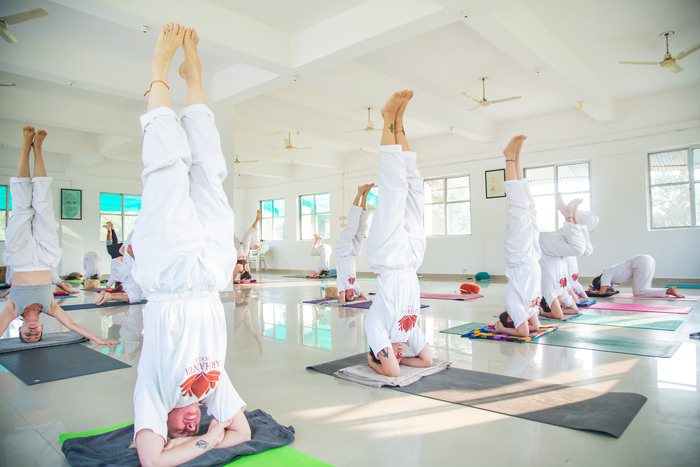
When people compare self-practice and yoga teacher training certification, they are often comparing two very different learning environments.
Self-Practice
- You build your practice around what you already know or feel comfortable doing.
- Without external correction, small alignment mistakes can continue unnoticed.
- Learning is self-directed, often without a clear progression.
- You rely on personal interpretation, which can limit deeper understanding.
- Practice improves familiarity, but not always precision or clarity.
- There is no training in teaching, cueing, or observing others.
Self-practice works best when your goal is consistency, but progress depends entirely on your current awareness.
Yoga Teacher Training Certification
- You follow a structured curriculum designed for progressive learning.
- Every posture is taught, observed, and corrected in real time.
- You study alignment, anatomy, philosophy, and teaching methodology.
- Learning is guided, so gaps and mistakes are addressed immediately by experienced teachers.
- You develop the ability to analyze, not just perform.
- You develop teaching skills: cueing, sequencing, correction, and confidence as a yoga teacher.
Self-Practice vs Yoga Teacher Training Certification: A Clear Comparison of Learning, Correction, Growth, and Teaching Skills
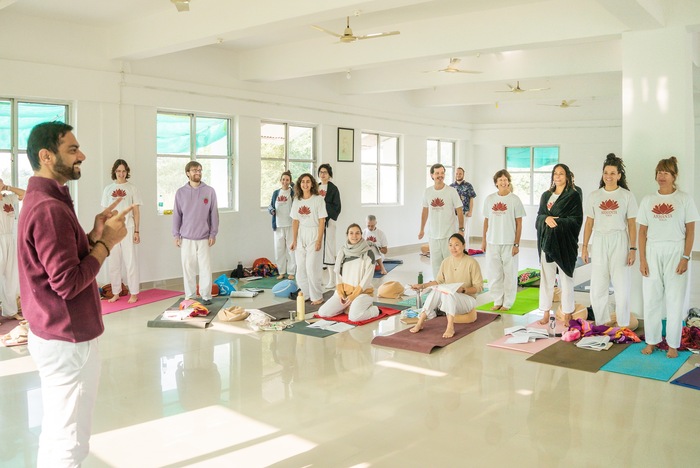
Choose self-practice if you want consistency and personal familiarity. Choose yoga teacher training certification if you want structured learning, real-time correction, and the skills to teach confidently.
Want to learn more about Yoga Teacher Training? Read our complete blog Is Yoga Teacher Training Worth It in 2026.
What You Gain from Self-Practice, and What It Doesn’t Cover in Yoga
Self-practice supports independence and consistency, but it doesn’t fully develop technical understanding or teaching ability.
What you gain from self-practice
- Control over your routine
You choose when, where, how long, and what to practice without external structure or any specific routine. - Consistency at your own pace
You build consistency on your own, helping you to sustain a habit without schedules, assessments, or deadlines. - Improved familiarity with poses
Repetition helps you get comfortable with movements and transitions. - Personal awareness of your body
You start noticing flexibility, balance, and physical limits over time. - Accessibility without commitment
You can begin immediately, which answers the most asked question: “Can you learn yoga without certification?” Yes, at a basic level.
What self-practice doesn’t cover
- No real-time correction or feedback
Misalignment can continue without you recognizing it, as it doesn’t provide any real-time feedback. - No structured or progressive learning path
Here, growth depends on what you already know or choose to explore - Limited understanding of technique and purpose
You may perform poses without fully understanding alignment, anatomy, or intent of that pose. - No training in teaching skills
It doesn’t provide the teaching preparation you need because it lacks guidance from experienced teachers - No exposure to deeper study
Areas like anatomy, sequencing, and methodology are not systematically covered.
What a Yoga Teacher Training Certification Offers
In self-practice vs. yoga teacher training certification, the experience shifts from personal repetition to structured, guided learning that builds real understanding and teaching ability.
Structured curriculum
- Asana and alignment
You learn precise positioning, adjustments, and variations. You don’t just learn to do multiple poses, but you also develop a deeper understanding of how they work. - Anatomy in practice
Instead of theory alone, you study anatomy. You start to understand why certain movements feel restricted or unstable. - Philosophy with context
Concepts are linked to real practice, helping you apply what you learn in real life. - Teaching methodology
You learn how to sequence, cue, and structure a class with clarity, which strengthens your teaching ability.
Guided learning
- Real-time feedback from experienced teachers
Subtle misalignments are pointed out and corrected immediately by experienced teachers. - Observation-based improvement
You’re not relying on self-assessment alone; your practice is actively refined by experienced teachers, which helps prepare you to teach others. - Consistent progression
The structure ensures you don’t stay limited to what feels familiar; you keep progressing.
Practical training
- Hands-on teaching practice
You get a chance to teach, receive feedback, and improve through repetition. This builds confidence and helps you teach more clearly in real-life situations. - Communication and cueing skills
You learn how to give clear, effective instructions that feel useful to others. You learn how to sequence a class and lead a mixed-level class, guiding from beginners to experienced students. - Understanding different bodies
Watching and guiding others changes how you approach alignment and correction. You develop a solid understanding of how a pose can feel different in different bodies, which improves how you teach.
I’ve seen this shift clearly while training students. I had a student who looked confident in her own practice, told me she had been practicing yoga for years, but struggled to explain a basic pose like Downward Dog. The moment she had to guide others, she felt nervous and lost her cues. However, with constant feedback and practice teaching sessions, she overcame the fear and led a class successfully, showing how training can turn confidence into teaching ability.
What else do you learn in a Yoga Teacher Training? Find out here.
When Self-Practice Is Enough
In the context of self-practice vs yoga teacher training certification, self-practice is enough when your expectations from yoga remain personal, practical, and not skill-based. It fits well when:
Your goal is personal wellbeing
If you’re practicing yoga to feel better physically and mentally, or to enjoy benefits like less stiffness, better mobility, and improved focus, self-practice does the job well. You don’t need structured training to experience these benefits. A consistent self-practice routine can offer all of them.
You want stress relief, not technical depth
For many, yoga is a way to unwind after a hectic day. They don’t want to go deeper by analyzing alignment or anatomy; they prefer to keep it as a stress-reduction tool. If you also fit this category and are not interested in breaking down every posture, self-practice can help you keep things simple and effective.
Consistency matters more than anything
If your priority is showing up regularly without pressure, self-practice gives you that flexibility. There are no timelines, assessments, or expectations to meet. You can show up daily whenever and wherever you like. This consistency makes yoga more effective for many and is the primary goal for many practitioners.
Teaching yoga is not your goal
If your plan is not to become a yoga teacher, you can stick to the self-practice format. Every year, we have at least one student who doesn’t want to become a yoga teacher but enrolls to deepen their understanding of yoga. So, if you want to expand your learning and move beyond the surface level, yoga teacher training might be the more ideal choice for you; otherwise, self-practice is enough for your goals.
You’re not looking for structured learning
If you’re not interested in studying anatomy, sequencing, or teaching methodology, then the benefits of yoga teacher training may not be relevant to you right now. In this situation, practicing yoga at home is enough; just make sure you practice consistently. If you want to teach yoga later, training can give you the structure and guidance you need. If your goal is personal wellbeing, stress relief, and a simple routine, self-practice is the right fit.
To practice yoga at home daily, follow our guide: How to Do Yoga at Home Daily: A Guide for Beginners.
When You Need Yoga Teacher Training Certification
In the discussion of self-practice vs. yoga teacher training certification, there comes a point where continuing self-practice at home no longer gives you the clarity you need. That’s usually when certification starts to feel like the right direction.
When your practice feels stuck or repetitive
If you find yourself repeating the same flows every day, without any real progress, it’s often not a discipline issue; it’s a lack of direction. In yoga self-practice vs certification, this is a common turning point where structured learning starts to matter more.
When you’re unsure about alignment
Second-guessing your posture, relying on YouTube videos to see if you are doing it right, or constantly adjusting without knowing what’s correct are clear signs that you need to find a suitable course to deepen your understanding of yoga. Self-practice doesn’t give you reliable feedback, while one of the key benefits of yoga teacher training is real-time correction that builds confidence in how you move in a pose.
When you want to teach yoga
Let me be clear on this: If teaching is your goal, self-practice is not enough. You need to learn how to guide, observe, and correct others. And these skills only develop through structured training. If you keep hearing your inner voice whispering “I want to become a yoga teacher”, you certainly need to enroll in a yoga teacher training course.
When you want to understand yoga beyond poses
At some point, doing the poses isn’t enough; you want to know why certain movements work, how the body responds, and how to master advanced yoga sequencing skills. This is where the confusion between yoga teacher training vs personal practice becomes clear: one focuses on experience, the other on understanding.
When you want confidence in guiding others
Explaining a pose, watching someone else perform it, and correcting them in real time is very different from practicing alone. I remember meeting a student in one of our YTT batches who had a consistent personal practice but hesitated every time they had to explain a pose to others. They knew how to do it, but not how to break it down for someone else. However, after consistently attending our teaching methodology sessions, those same students felt confident. Later, they even led a complete class confidently without any need for help.
Feeling unsure about your readiness? Read our complete article, 10 Signs You Are Ready to Become a Yoga Teacher.
Can You Combine Self-Practice and Certification?
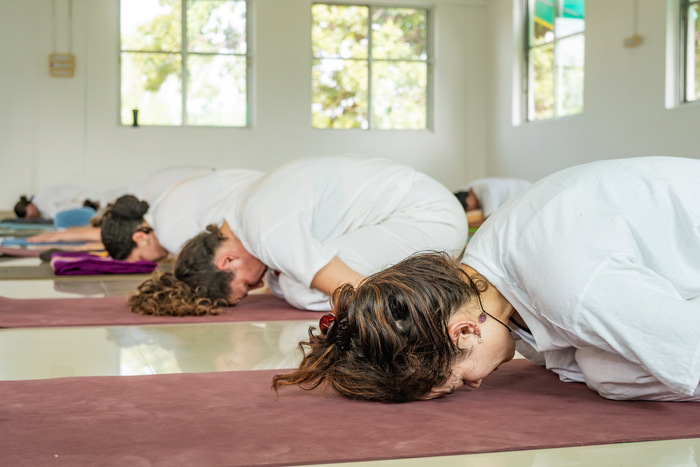
Yes, you certainly can combine self-practice and certification. When the topic itself is self-practice vs yoga teacher training certification, it’s easy to treat them as opposing choices. In reality, they work best together and complement each other’s purposes.
Certification builds the foundation
A yoga teacher training program gives you what self-practice cannot: structure, correction, and clarity. You learn alignment, anatomy, and how to approach practice with clarity and intention. This is where most of the benefits of yoga teacher training come from: you stop guessing and start understanding yoga beyond surface level.
It also answers “do you need yoga certification to teach?” If teaching is part of your plan, certification isn’t optional; it’s what prepares you to guide others responsibly. So, if you are aiming to build a strong foundation for teaching yoga, you may begin with a yoga teacher training course.
Self-practice sustains and deepens that foundation
What you learn during training doesn’t stay fixed; it evolves through practice and repetition. This is where self-practice becomes essential. It allows you to apply what you’ve learned during the training; it helps you test it in your own body and build consistency that helps you sustain in the long run.
Frequently Asked Questions
1. Can you learn yoga without certification?
Yes, you can learn yoga without certification at a personal level. But if your goal is to become a yoga teacher, certification becomes a requirement.
2. Do you need yoga certification to teach?
In most cases, yes. If you plan to teach professionally, certification is expected because it trains you in alignment, safety, sequencing, and how to guide others, not just practice yourself.
3. What is the main difference in self-practice vs yoga teacher training certification?
Self-practice is self-directed and experience-based, while certification is structured and guided. The difference lies in correction, depth of knowledge, and whether you’re preparing to teach or just practice.
4. Is yoga teacher training worth it if I don’t want to teach?
It can be, especially if you want to understand yoga beyond poses. Many people join for the benefits of yoga teacher training, such as better alignment, deeper awareness, and structured learning, even when they don’t have any teaching goals.
5. What are the limitations of yoga self-practice vs certification?
Self-practice can become repetitive and lacks real-time feedback. In yoga self-practice vs certification, the limitation is not effort; it’s the absence of expert guidance and a clear learning framework.
6. How do I know if I should choose yoga teacher training vs personal practice?
If your goal is personal wellbeing, self-practice is enough. If you want clarity, progression, or to teach, enrolling in a yoga teacher training should be your next step.
Final Thoughts
If you keep wondering whether self-practice or yoga teacher training certification is better, just remember, there isn’t a universally better option; only what aligns with your current goal.
Self-practice works when your focus is personal growth: staying consistent, feeling better, and keeping yoga part of your routine. Certification becomes relevant when your expectations change. For example, when you want clarity in alignment, a deeper understanding of what you’re doing, or the ability to guide others with confidence.
Both paths are valid. They just serve different purposes at different stages.
If you’re considering moving from self-guided practice to something more structured, or want to switch from self-practice to a structured yoga teacher training program? You may learn more about our 200-hour Yoga Teacher Training program and see if it fits where you are right now.