Are you thinking about starting yoga but aren’t sure which style is right for beginners? Hatha yoga for beginners is the best choice. It teaches you basic poses, steady breathing, and good alignment at a comfortable pace. This way, you can build strength, flexibility, and body awareness without feeling rushed or stressed.
What Is Hatha Yoga?
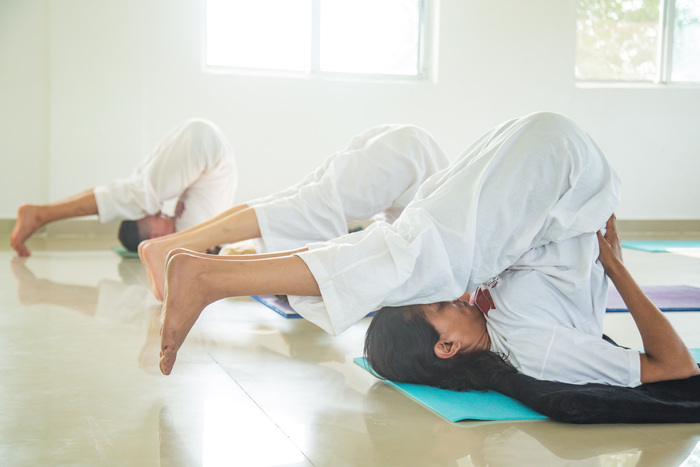
Hatha yoga is based on traditional methods. It teaches you basic postures, steady breathing, and how to keep your body in good alignment. This helps you move with awareness and learn each pose correctly.
Hatha yoga moves at a slower pace. You hold each pose for several breaths, which gives you time to notice your body’s position and make small changes. Rather than rushing, this approach helps you build stability and control gradually.
Alignment is very important in Hatha yoga. You learn how to position your body, balance your weight, use the right muscles, and keep a steady posture. This helps you avoid strain and builds a solid foundation.
In Hatha yoga, Breath awareness supports your entire practice. You breathe slowly and evenly through the nose, which helps you stay calm and focused while holding each pose.
Unlike faster styles such as Vinyasa, Hatha yoga takes its time between poses. This slower pace makes it a good starting point for beginners.
If you want to learn more, check out: What Is Hatha Yoga? Meaning, History & Practice Explained
Why Hatha Yoga Is Ideal for Beginners
When you begin, the hardest part is not the poses themselves but understanding how your body moves. Hatha yoga makes this easier by slowing things down and giving you time to learn without feeling rushed.
Slower Transitions
When it comes to hatha yoga for beginners, movement is never continuous or rushed; it is always intentional. You move into a pose, pause, and stay there for a few breaths. This removes the pressure of keeping up and allows you to focus on what your body is actually doing. Here, you don’t just follow instructions randomly; you understand how your body is responding to a pose.
Time to Understand Posture
Since you hold Hatha poses longer, you have time to notice details from within. You might see if your weight is uneven, your shoulders are tense, or your spine is not straight. This awareness comes only when you stay in a pose for a while.
Builds Foundation for All Yoga Styles
Hatha yoga always starts with the basics. It trains you with fundamental principles of yoga that other styles assume you already know. You learn how to stabilize your body, coordinate breath with movement, and hold a posture with control. This makes it easier to transition into faster or more complex practices later.
Less Injury Risk
Hatha yoga does not encourage rushing or forcing yourself deeper into poses. Instead, you learn to respect your current limits and keep good alignment. This approach lowers the risk of strain and lets your strength and flexibility grow safely over time.
For more details, read our full blog: Which Yoga Style Is Best for You? Hatha Yoga vs Vinyasa vs Yin
Benefits of Hatha Yoga for Beginners
Improves Flexibility Without Forcing
Hatha yoga gradually improves your flexibility by keeping yourself in the poses and letting the muscles loose over time, which is why it’s so suitable for people who are just starting. You aren’t expected to get into any particular position quickly. Instead, your body will become more flexible at its own speed. If you carry on with the practice, you will see a considerable increase in your flexibility.
Better Posture and Spinal Alignment
Hatha yoga enables you to focus on keeping your spine in a correct position and makes you more conscious of the way you sit, stand and carry yourself. By regularly doing hatha yoga your body learns to keep a more natural and upright posture, which lessens the strain resulting from sitting all the time or from bad postures.
Functional Strength and Stability
Hatha yoga lets you hold postures for a few breaths. By holding postures, you build strength that supports your muscles, especially in the core, back, and legs. This kind of strength improves balance and control, improving your overall stability.
Sharper Focus and Mental Clarity
When practicing hatha yoga, you need to pay attention to both your breathing and your position. By continuously focusing in this way, your mind learns to remain in the present moment and thus finds it easier to concentrate without being distracted.
A Noticeable Sense of Calm
Hatha yoga involves slow breathing and steady movement. And when you practice slow breathing regularly, it helps you regulate your nervous system. Over time, this creates a calmer baseline, even outside your practice.
Increased Body Awareness
One of the most practical outcomes of hatha yoga for beginners is learning to notice small imbalances or tension patterns. This awareness helps you move more efficiently and avoid unnecessary strain.
Better Breath Control
Hatha yoga helps you observe and regulate your breathing instead of ignoring it. Steady, controlled breath supports each posture you perform and helps you maintain both physical ease and mental steadiness.
Related: Hatha Yoga’s Ancient Wisdom Revealed
10 Beginner-Friendly Hatha Yoga Poses
When it comes to hatha yoga for beginners, each pose is an opportunity to understand movement precisely. Take a moment to settle into every posture, observe your breath, and notice how small adjustments change the experience.
Mountain Pose (Tadasana)
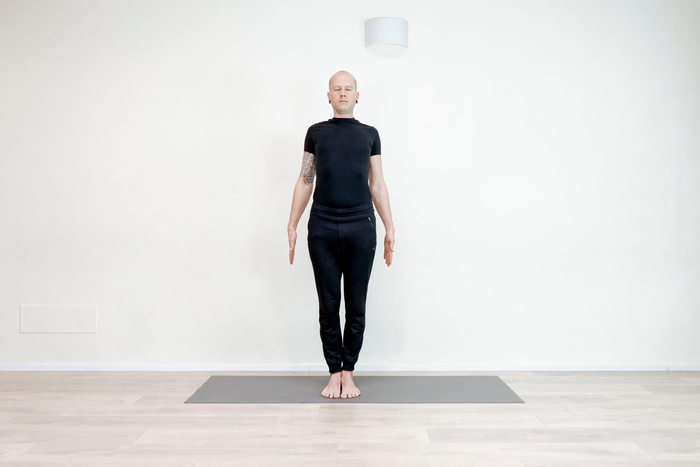
This pose is the foundation for many standing poses. It might look easy, but it helps you learn to stand with awareness and balance.
- Stand with your feet together or hip-width apart.
- Let your arms rest naturally by your sides.
- Lift gently through the crown of your head.
- Keep your gaze soft and steady.
What to pay attention to
Balance your weight evenly and avoid locking your knees.
Standing Forward Bend (Uttanasana)
This forward fold helps release tension in your back and teaches you to move from your hips with control.
- Stand straight and then slowly hinge forward from your hips.
- Let your upper body hang toward the floor.
- Allow your knee to bend slightly, if needed.
- Allow your head and neck to relax.
Alignment Tips
Always start the fold from your hips, not your lower back.
Downward-Facing Dog (Adho Mukha Svanasana)
This pose helps you build both strength and flexibility, especially in your spine and legs.
- Start on hands and knees.
- Lift your hips up and back to form an inverted “V” shape.
- Press your palms firmly into the mat.
- Let your heels move toward the floor.
How to make it count?
Focus on making your spine long instead of pushing your heels to the floor.
Cobra Pose (Bhujangasana)
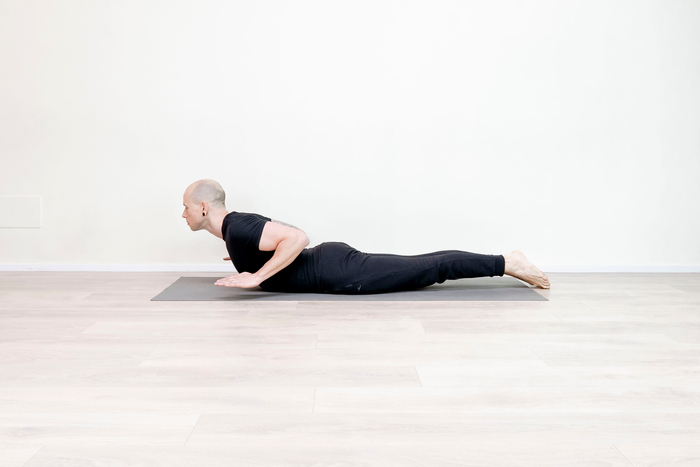
This gentle backbend strengthens your spine and opens your chest.
- Lie flat on your front and bring your palms in line with your shoulders.
- Press lightly into your hands and lift your chest.
- Keep elbows slightly bent and close to your body.
- Draw your shoulders away from your ears.
What to pay attention to
Always use your back muscles to lift, not just your arms.
Child’s Pose (Balasana)
This is a resting posture that allows your body to reset and your breath to slow down.
- Begin on your knees and slowly guide your hips back toward your heels.
- Fold your torso forward.
- Rest your forehead on the mat.
- Place arms forward or alongside your legs.
How to make it more effective
Let your hips drop naturally without forcing the stretch.
Cat–Cow (Marjaryasana–Bitilasana)
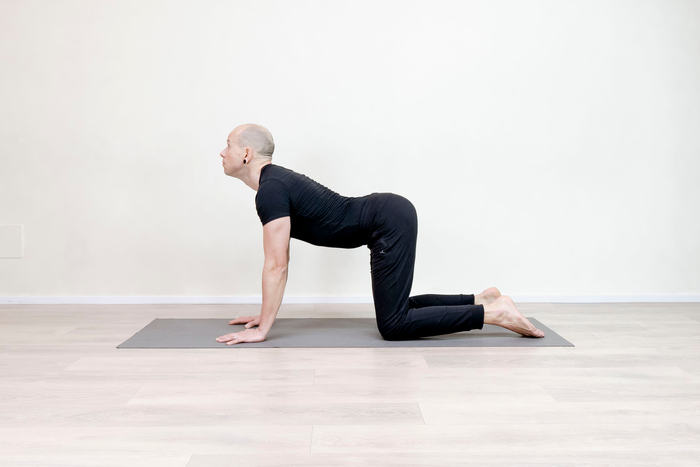
This flowing movement can help you connect your breath with spinal motion.
- Start on hands and knees.
- Inhale as you lower your belly, broaden your chest, and gently lift your gaze (Cow)
- Exhale as you draw your navel inward, then round your spine, and lastly tuck your chin toward your chest (Cat)
- Continue moving slowly with your breath.
What to pay attention to
Keep the movement smooth and guided by your breathing.
Warrior I (Virabhadrasana I)
This standing pose builds strength and also helps you improve your balance and focus.
- Step one foot forward into a lunge.
- Keep your back foot grounded at an angle.
- Raise your arms overhead.
- Face your torso forward.
Alignment Tips:
Keep your front knee aligned over your ankle.
Seated Forward Bend (Paschimottanasana)
A seated stretch that encourages length through the spine and hamstrings.
- Sit with legs extended straight.
- Inhale to lengthen your spine.
- Exhale and fold forward from your hips.
- Reach toward your feet or shins.
What to pay attention to
Maintain length in your spine rather than rounding forward.
Bridge Pose (Setu Bandhasana)
A gentle backbend that strengthens the lower body and opens the front of the body.
- Lie down on your back and position your feet flat on the floor with your knees pointing upward.
- Press into your feet to lift your hips.
- Keep your shoulders grounded.
- Let your arms rest alongside your body.
How to make it more effective
Always engage your legs to lift, instead of compressing your lower back.
Corpse Pose (Savasana)
This final resting pose lets your body absorb the benefits of your practice.
- Lie flat on your back.
- Let your arms rest slightly away from your body.
- Turn your palms upward.
- Close your eyes and relax your entire body.
What to pay attention to
Release all effort and allow your breath to return to its natural rhythm.
Related: Yoga Exercises – Yoga Asana Guide
Common Mistakes Beginners Make While Practicing Hatha Poses
When starting hatha yoga for beginners, most challenges don’t come from the poses themselves; they come from how they’re approached. These are the common mistake patterns I’ve repeatedly seen in real sessions.
Holding the Breath Instead of Using It
One common thing I notice while teaching is beginners unconsciously holding their breath, especially in slightly challenging poses. Some students even believe holding the breath makes the pose more effective. In reality, the opposite happens. When your breath stops, your body tightens, and you quickly feel exhausted and struggle to sustain the pose.
A simple way to fix this is to keep your breathing steady, even if the pose feels uncomfortable. If your breath feels strained, it’s a clear sign to ease back.
Forcing Flexibility Too Early
Many people think that pushing deeper into a stretch means they’ll improve faster. I’ve seen beginners pull themselves down in forward bends or overstretch in Downward Dog. But this doesn’t make the pose better. It usually just leads to soreness later.
Instead of forcing yourself to stretch more, stay within a range where you can still breathe easily.
Comparing Your Practice to Others
In group classes, it’s common to look around and adjust your pose based on what others are doing. But you have to remember that every body is different. The pose someone is doing might look easier on the surface, but it can feel very different when you do it yourself. Here, you might require specific adjustments to keep going.
The single piece of advice that I give to all my students is this: regard your practice as being individual since the same posture can appear different in one person compared to another and yet still be effective.
Skipping Rest Between Poses
I often see beginners overlook resting postures like Child’s Pose or Savasana because they feel they should keep going. Many come out of rest early or skip it, assuming it’s not important. In reality, rest is as important as challenging poses. It allows your body to absorb what you’ve practiced.
Instead of treating rest as optional, stay fully in rest poses. Remember, rest is not a break from practice; it’s part of it.
To learn about more such mistakes, read our complete blog 7 Beginner Yoga Mistakes I See as a Teacher (And How to Fix Them)
Tips for Beginners to Start Hatha Yoga Safely
Start Slower Than You Think You Need To
Beginners often try to go through the poses too quickly, especially when they’re attending an online class or watching a video. However, it’s when you move too fast that your alignment is lost. By taking an extra breath either before entering or after leaving a pose, you will remain in control and actually get a clear understanding of what you’re doing. Therefore, when practicing hatha yoga as a beginner, it is best to start slowly and to notice how your body responds to each pose.
Use Props Without Hesitation
There’s a common misconception that props are only for people who can’t do the pose properly. As a result, many beginners treat props as a sign of weakness. In reality, blocks, cushions, or even a folded towel can help you maintain proper alignment. I’ve seen many beginner students struggling to reach the floor in forward bends. But when I instructed them to use a simple block, they admitted that the pose feels more stable and effective.
Learn From a Qualified Teacher
Small adjustments can make a big difference in Hatha Yoga. A skilled teacher can notice things you might miss, like uneven weight or slight misalignment in your spine. It’s always best to learn Hatha Yoga from an experienced teacher.
Listen to What Your Body Is Telling You
There is a clear difference between effort and discomfort. In Hatha Yoga, sharp pain, pinching, or breath restriction mean you should stop or adjust the pose. Some students push through discomfort thinking it’s part of the process, but there are no such rules. If you feel pain or breathing difficulty, do not ignore it. These signs may indicate alignment issues. Instead of continuing, ease out and ask your teacher for adjustment cues.
Also See: New to Yoga? Why a 200-Hour Yoga Teacher Training Is Perfect for Absolute Beginners
Frequently Asked Questions
As a beginner, how often should I practice Hatha Yoga?
For most people, 2–3 sessions per week is a practical starting point. This gives your body enough exposure to learn the poses without feeling overwhelmed or sore.
Is Hatha Yoga a difficult practice for those who are just starting?
Usually not. Beginner Hatha Yoga uses slower movements and simple postures, so it’s easier to follow along.
Do I need to be flexible before starting?
No, you don’t need to be flexible to start. Flexibility comes with practice. Many people begin with a limited range of motion, and that’s perfectly normal. Hatha Yoga helps you become more flexible over time.
How long should a beginner hold each pose?
Try holding each pose for about 3 to 5 slow breaths. This gives you time to settle in without feeling rushed, and keeps your practice comfortable.
Can I practice Hatha Yoga at home?
Yes, you can practice at home. It’s helpful to learn the basics first, though. Taking a few guided classes, either online or in person, can make your home practice safer and more effective.
What should I do if a pose feels uncomfortable?
If a pose feels uncomfortable, try easing out a bit and check your alignment. Discomfort often means you’re pushing too hard or your alignment is off. If your breath feels strained or uneven, it’s a good idea to come out of the pose.
Final Thoughts
When you start Hatha Yoga as a beginner, the goal isn’t to master every pose right away. It’s more about learning to move with awareness.
If you keep practicing regularly, even with short sessions, you’ll start to notice small but meaningful changes. Your posture will get better, your breath will feel steadier in stressful moments, and your body will feel more relaxed in daily life.
If you are interested in learning Hatha Yoga from experienced teachers in a traditional ashram-like environment, you may explore our 200-Hour Hatha Yoga Teacher Training. For any further assistance, feel free to reach out to us.